Khazal
The Khazal are the dominant dwarven culture of Khazural and the ancestral builders of its great mountain holds, forge-cities, and subterranean fortress-realms. They are one of several dwarven peoples found across Arkanthys, but remain the most politically and culturally influential among their kind.
Defined by discipline, craftsmanship, and rigid social hierarchy, the Khazal built one of the oldest surviving civilizations in the world. Their society is organized around great Forgehouses, dynastic industrial institutions that govern labor, politics, and social identity throughout Khazural.
Though often perceived by outsiders as stern, insular, and prideful, the Khazal see themselves as the keepers of enduring order and the rightful stewards of the deep places of the world.
Origins
Khazal tradition holds that dwarves were not created by gods or shaped through divine intervention. Instead, they believe their kind arose naturally from the Deep Rhythm, the primordial pulse of the world itself.
Known among them as the Song in the Stone, the Deep Rhythm is understood not as a deity but as the foundational force underlying creation, the unseen cadence by which stone settles, mountains rise, and the deep earth endures.
To the Khazal, dwarves are not children of the gods. They are children of the world.
Physiology
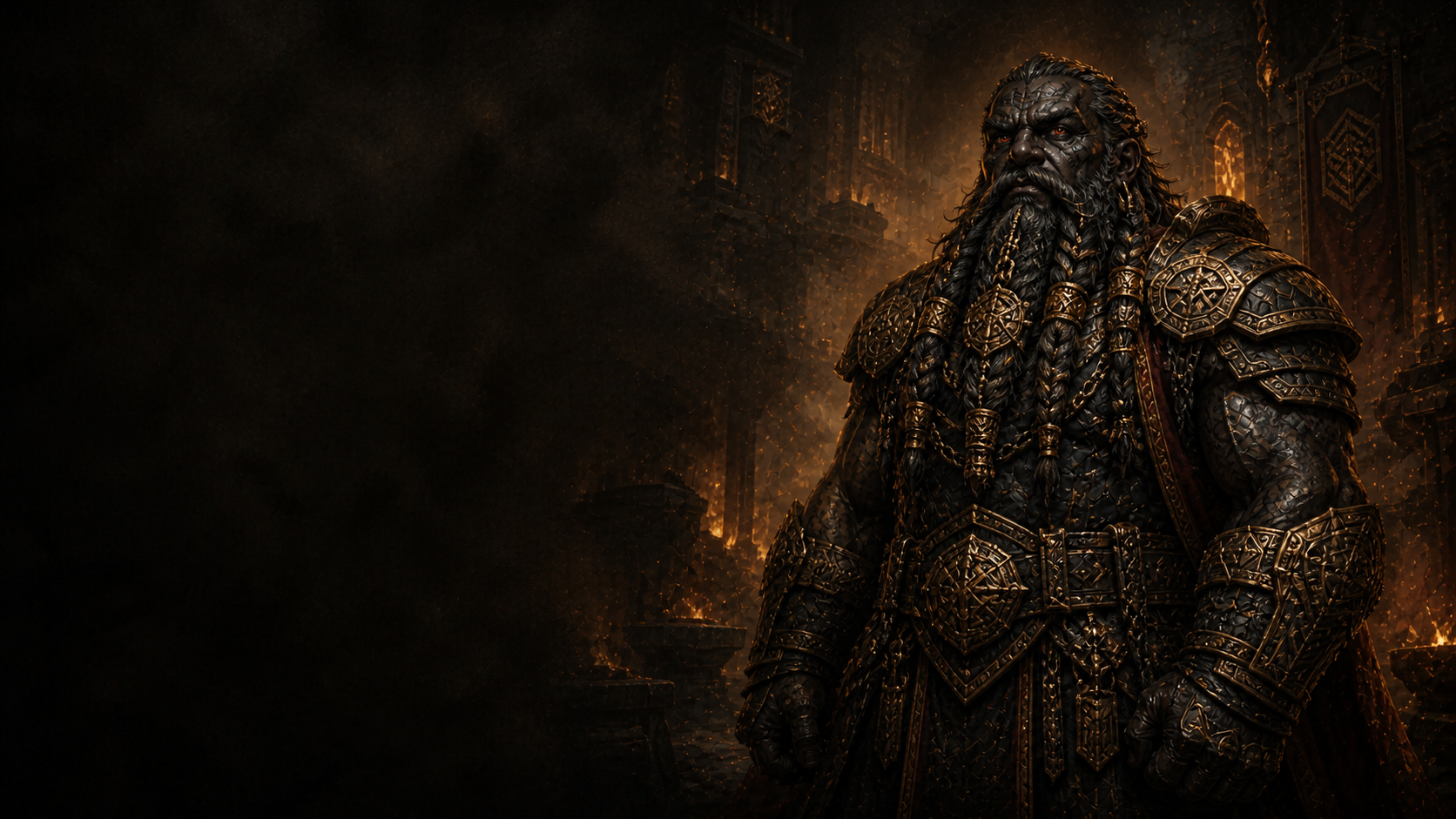
Khazal dwarves are taller and broader than many other dwarven peoples, possessing dense musculature, powerful frames, and exceptional physical resilience.
Their skin tones range from dark bronze to near-black, often resembling polished obsidian or volcanic stone. Red or ember-colored eyes are common and widely associated with noble bloodlines and ancient forgehouses.
Male Khazal traditionally wear long, heavily decorated beards, braided and adorned with rings, chains, clasps, and forgehouse insignia. These decorations often denote family lineage, rank, profession, military distinction, or sworn allegiance.
Female Khazal do not grow beards and are generally shorter and slighter than their male counterparts. Instead, they decorate their hair in similarly elaborate styles, incorporating braids, rings, metalwork, and gemstones reflective of their status and house affiliation.
Society and Structure
Khazal society is built around Forgehouses, hereditary industrial dynasties that function simultaneously as noble houses, economic powers, political blocs, and cultural institutions. Every Khazal belongs to a Forgehouse, either by birth, adoption, patronage, or earned induction. Some inherit their place through bloodline. Others rise through labor, service, and achievement until formally accepted into the house they serve.
Forgehouse affiliation shapes nearly every aspect of Khazal life, including profession, political allegiance, marriage prospects, and social standing. Above all Forgehouses stands the High King of Khazural, to whom all Khazal owe ultimate loyalty.
Beliefs and Spirituality
Most Khazal do not worship gods in the conventional sense.
Their spiritual beliefs center on reverence for the Deep Rhythm, the metaphysical pulse believed to flow through all stone, metal, and living earth. The Deep Rhythm is not prayed to as a conscious being, nor petitioned for miracles.
Instead, it is acknowledged, studied, and respected. To live in harmony with the Rhythm is to live correctly.
To work stone well, forge true metal, build enduring structures, and preserve proper order is considered spiritual alignment with the world’s natural cadence. Many Khazal view divine worship as a surface-dweller practice rooted in dependence rather than understanding.
Values and Worldview
Khazal culture prizes:
Honor: A dwarf’s word is expected to carry weight equal to iron.
Perfection in Craft: Mediocrity is shameful. Work reflects the worth of its maker.
Discipline: Emotion is respected only when mastered.
Loyalty: To Forgehouse, Hold, and Crown.
Endurance: Strength is measured by what one survives, not what one boasts.
Failure through honest effort is tolerated. Failure through carelessness is not.
Relations with Outsiders
The Khazal are wary of outsiders and deeply skeptical of foreign cultures, particularly those they perceive as transient, impulsive, or frivolous. However, they are not isolationists.
Khazural maintains diplomatic, economic, and military relations with the outside world where beneficial. Khazal distrust foreigners by default, but respect competence, discipline, and reliability regardless of origin.
Internal Diversity
Though united under Khazural and the High King, the Khazal are far from culturally uniform. Each major hold maintains its own traditions, customs, dialects, social expectations, and political character.
A dwarf from Baraz-Kronn may differ drastically in worldview, etiquette, and values from one raised in Zulfbar or Uzul. To outsiders they appear a singular people. To the Khazal, each hold produces its own kind of dwarf.
Relation to Other Dwarven Peoples
The Khazal distinguish themselves sharply from other dwarven cultures, particularly the Deep Dwarves of the Deeproots. Though recognized as kin, Deep Dwarves are viewed by many Khazal as divergent, altered by prolonged existence in the deepest reaches beneath the world. Relations between the two remain complex, varying from cooperation to distrust depending on hold and circumstance.

Comments