Imperial Orders
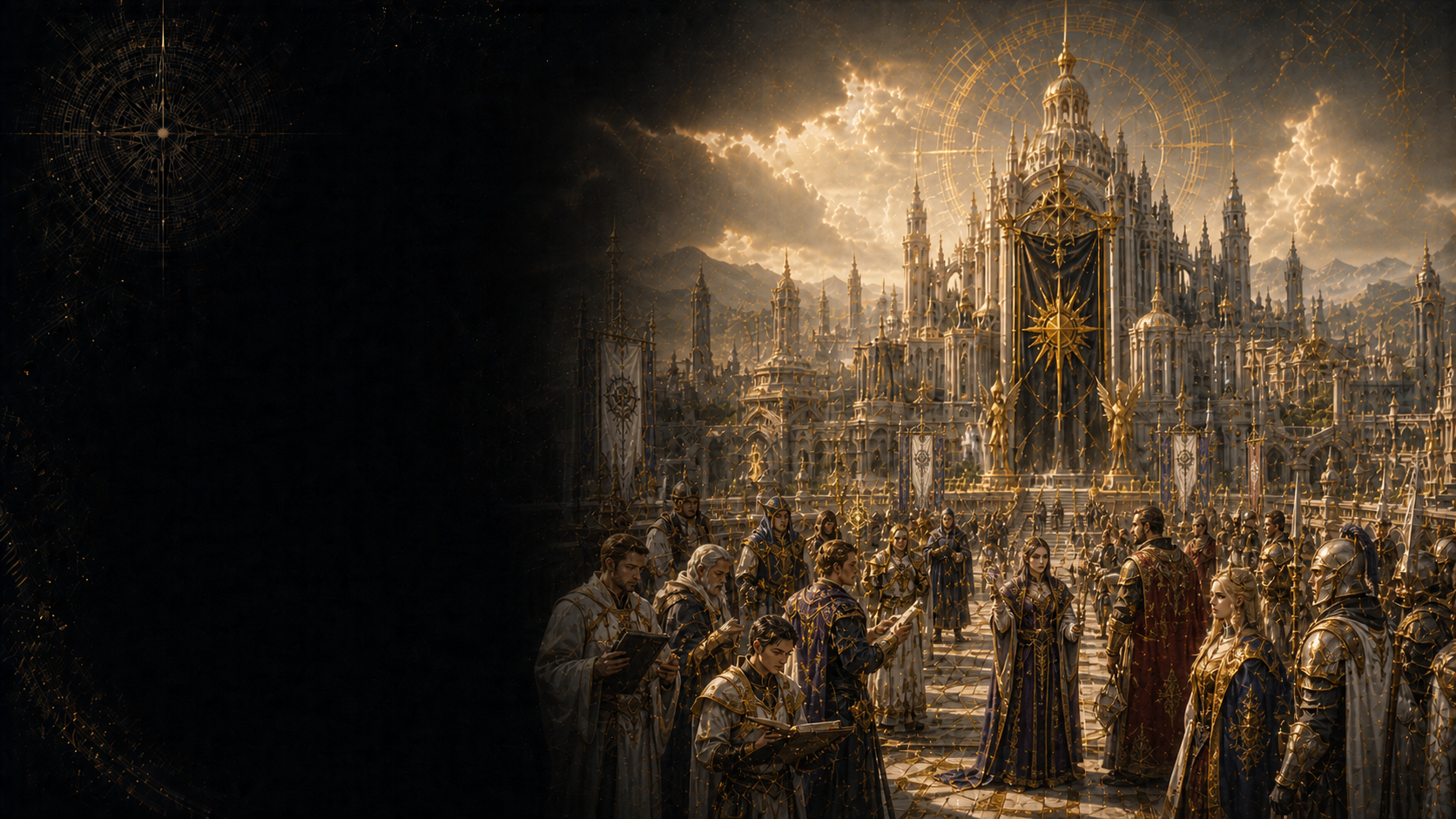
The Imperial Orders are the permanent institutional bodies of the Aurellian Empire, established to govern the many burdens no ruler could carry alone. As the empire expanded, its needs outgrew the reach of personal rule. Borders had to be defended and sometimes extended. Laws had to be written, interpreted, and enforced. Taxes had to be collected, records maintained, dynasties documented, and the wounded, poor, and displaced given aid. The Orders emerged to answer those needs and became the framework through which imperial authority could endure beyond the strength of any one emperor.
They are not independent brotherhoods standing outside the state. They are part of the state itself. Each order holds a defined place within the imperial structure and carries a responsibility the empire considers too important to leave informal or temporary. Some stand very near the throne and answer directly to the emperor or empress. Others serve broader institutional roles that continue regardless of who sits upon the throne. Together they form one of the most important foundations of Aurellian rule.
Though equal in theory, the Orders are not equal in public standing. Some are feared, some respected, some scarcely noticed until their work becomes unavoidable. Some live in full view of the people, while others are spoken of more as legend than fact. All, however, are necessary. The empire relies on them because it was built to do so.
Foundation and Growth
The Imperial Orders did not all arise at once. They appeared gradually as the Aurellian Empire grew and the demands of rule became more complex. Some were founded in response to dangers tied to the throne itself. Others emerged because an expanding empire required permanent institutions of war, law, administration, stewardship, and succession. Each order was created when the need for it became impossible to ignore.
The first of these was Ordo Imperator, founded in 4A Y173 by Gabriel Aurellian and Winrey Auric. Much later, in 4A Y189, only a year before Gabriel’s death, Ordo Dominus was established. The rest followed as the empire matured and turned from survival alone toward administration, permanence, and control. In this way, the Orders reflect the changing needs of the empire across its early generations. They were not ceremonial foundations made for prestige. They were answers to real problems.
Place Within the Empire
The Orders are woven directly into the machinery of imperial rule. Through them, the Aurellian Empire governs, records, enforces, preserves, and sustains itself. They are the means by which state power becomes organized and lasting rather than personal and immediate. Without them, the empire would still have rulers, armies, and laws, but no enduring institutional shape.
Not every order relates to the throne in the same way. Ordo Decimus, Ordo Dominus, and Ordo Imperator stand in closer direct service to the imperial center. Ordo Absolvo, Ordo Lex, and Ordo Servitus hold broader roles whose work extends beyond the immediate needs of the reigning sovereign. Even so, all remain part of the same structure. When the throne is occupied, the emperor or empress stands above them. When it is vacant, the regent temporarily arbitrates between them and preserves the continuity of rule until the next bearer of the Cinderbrand appears.
Recruitment and Service
With the exception of Ordo Imperator, the Imperial Orders accept recruits from across the empire and are not reserved to nobility. A person may enter an order through ability, merit, training, or suitability to its work. Some orders prefer to shape members from a young age, while others are more open to adult recruitment. Inherited service exists only rarely and never as a rule.
No one may belong to more than one order. Each demands full loyalty to its own duties and function. To join an order is to bind oneself to a specific arm of the imperial state and to take one place within a larger machine.
The Major Orders
Ordo Imperator is the most singular of all the Imperial Orders. It is composed of the Five, elite beings created by Gabriel Aurellian and Winrey Auric from the divided remnants of the Pale Crown. Their purpose is bound to the deepest burdens of the throne, the Cinderbrand, and the hidden continuity of Aurellian sovereignty. They are charged with guarding that burden and with bringing the rightful bearer to Targon when the mark appears. Unlike the other orders, they do not recruit and do not function as a conventional institution. To ordinary people they are more legend than visible authority.
Ordo Dominus serves as the custodian of Grimhold. Its duty is to preserve that land in the state the empire has deemed necessary, to prevent relic poaching and unlawful interference, and to ensure that its dangerous inheritance remains contained and undisturbed. In the present age, its standing is especially high because its leader, Servius Livia, serves as acting regent during the vacancy of the throne.
Ordo Decimus is the military force of the Aurellian Empire. It wages war, crushes rebellion, defends borders, and carries out the armed will of the state. Straightforward in purpose and highly visible in public life, it is the empire’s fist and its spearpoint.
Ordo Absolvo is the order responsible for documenting dynasties, overseeing lawful succession, and maintaining records of how power passes between rulers, not only within the Aurellian line but across other kingdoms and empires as well. Within the empire, it holds a central role in coronation and the formal recognition of new emperors. Outside it, it offers the same services to other realms.
Ordo Lex is the administrative and legal body of the empire. It handles taxation, finances, administrative law, judiciary matters, and the writing of law itself. It is the bureaucratic force that allows the empire to function beyond military power and royal command.
Ordo Servitus is a monastic order devoted to service and aid. Its members swear themselves to helping those in need, and unlike the other orders, its headquarters lies far from Targon in the mountain fortress of Fellgard in Rimefang. It remains part of the imperial structure, but its work gives it a different character from the palace-centered orders.
Presence and Perception
The Imperial Orders are widely known throughout the empire, though not equally visible. Ordo Decimus, Ordo Dominus, Ordo Absolvo, Ordo Lex, and Ordo Servitus all appear in public life in one way or another, whether through soldiers, magistrates, scribes, officials, or monastics. Ordo Imperator is the exception. The Five are rarely seen outside Palace Imperia, and many common people speak of them as if they were creatures of imperial legend rather than beings of the present age.
Some orders carry strong visual identity. The soldiers of Ordo Dominus wear silver armor marked with their insignia. Ordo Decimus is associated with red, gold, and black. Ordo Servitus is known for white robes bearing a thorned silver rose. Ordo Absolvo projects authority through regal presentation rather than martial insignia, while Ordo Lex is defined less by appearance than by its presence in records, laws, and administration. The Imperators, when seen at all, are remembered in towering golden armor marked with the sun sigil of the Aurellian dynasty.
Though differences of purpose and temperament exist between them, the Orders function together as parts of the same imperial body. They cooperate because the state requires it. Whatever tensions may arise, they remain bound to one another through the work of empire.
The Orders in 4A 502
In the present year, the vacant throne has made the Imperial Orders more politically important than at most other times in the Fourth Age. With no crowned Aurellian seated in Sunheart Hall, much of the practical continuity of rule rests in institutional hands. Servius Livia, as regent, stands temporarily above them in arbitration, but not in sovereign replacement.
Each order continues in its own function. Ordo Decimus remains the empire’s military strength. Ordo Lex preserves the legal and administrative frame of the state. Ordo Absolvo maintains the law and record of succession. Ordo Servitus continues its work from Fellgard. Ordo Dominus holds unusual prominence through the regency. Ordo Imperator remains closest to the dormant mystery of the throne itself.
The vacancy has not replaced the Orders. It has revealed how necessary they are. In the absence of a crowned ruler, they preserve what can be preserved and hold the empire in working order until the next rightful sovereign appears.

Comments