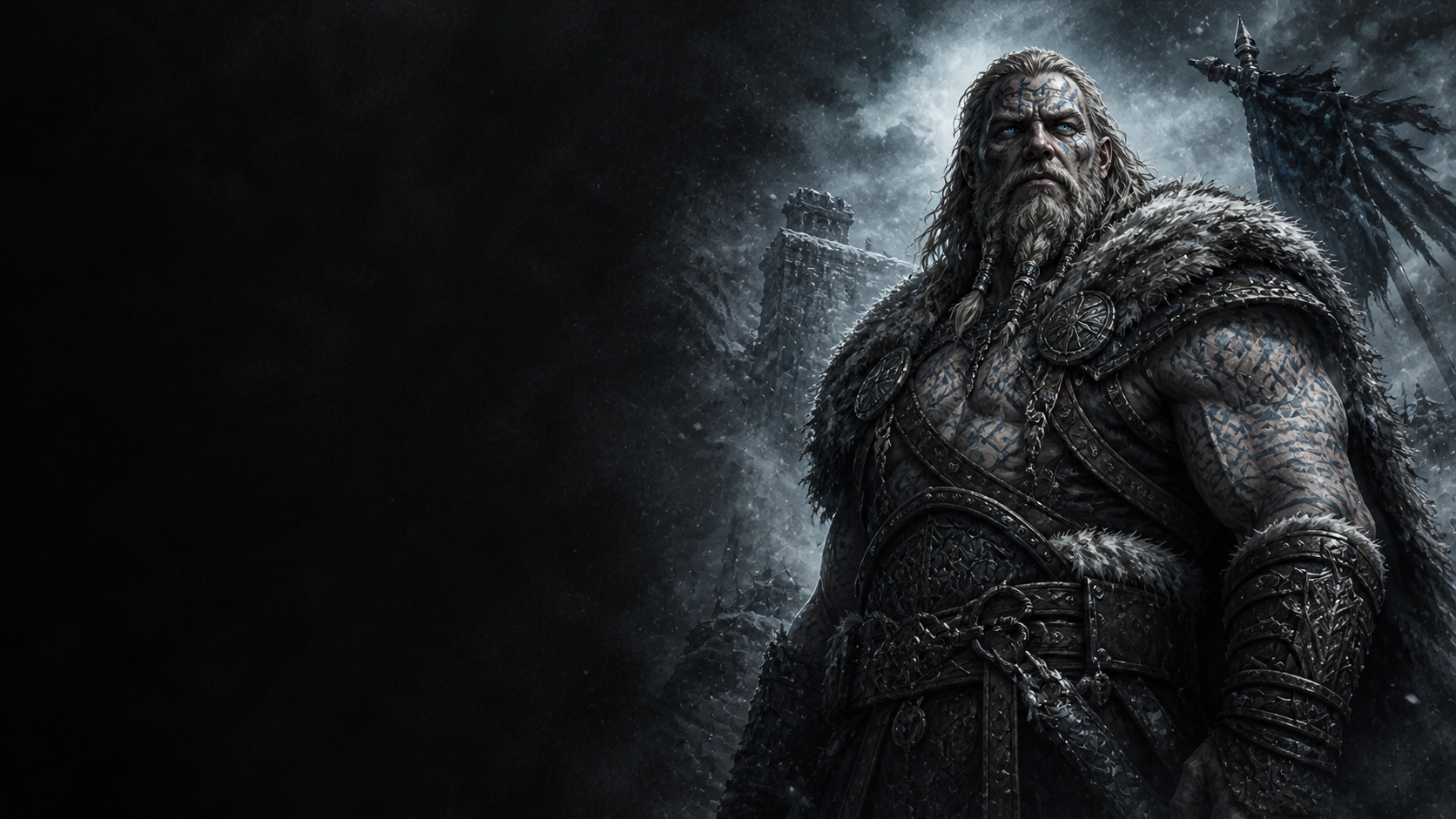
Skarnn
The Skarnn are the indigenous population of Nifleheim, located on the southwestern peninsula of Grimhold. They are a cold-adapted people known for physical strength, endurance, and strict adherence to ancestral customs. The Skarnn trace their origin directly to Grimhold, regarding the land itself as both progenitor and final resting place. Their culture is shaped by extreme cold, jagged terrain, and limited resources, resulting in a society that values resilience, honor, and communal survival.
Social Structure
Skarnn society is organized into clans, each occupying defined territory passed down through bloodline inheritance. Clan identity is tied to land, ancestry, and the history associated with that territory. While many smaller clans exist, political influence is concentrated among four major clans controlling the most critical regions of Nifleheim.
These clans operate under the authority of the Jarl, who serves as a unifying figure during famine, defense, migration, and external threats. Individual clans maintain internal autonomy but remain bound through covenants of survival and continuity.
Cultural Traits
The Skarnn possess a high resistance to cold, reinforced through generations of adaptation to Grimhold’s climate. Their physiology favors powerful builds suited for labor and combat. Honor functions as a measurable form of social standing. Reputation directly affects an individual’s position within the clan.
Disputes unresolved through mediation are settled in the Arena of Nifleheim, a neutral battleground where outcomes are binding and universally enforced. The Arena serves as a central legal mechanism between clans.
Physical Characteristics
The Skarnn are physically larger than most humans, with average heights beginning around 190 centimeters. Males commonly exceed 200 centimeters. Their bodies are heavily built, with dense muscle mass and clearly defined strength developed through constant exposure to labor, combat, and harsh terrain.
Their skin is typically pale due to limited sunlight in Grimhold, though it often appears weathered from prolonged exposure to wind and cold. The Skarnn possess thicker skin than most human populations, a natural adaptation that reduces heat loss and increases resistance to frostbite. Their bodies retain warmth more efficiently, supported by a higher average body temperature.
Hair is worn according to tradition and individual identity. Women commonly wear tightly maintained braids or locks, while men display a wider range of styles, often accompanied by long, decorated beards. Both are used as markers of status, experience, and personal history.
Tattooing is universal among the Skarnn. Their bodies are marked with runic inscriptions that denote clan affiliation, personal achievements, and, in some cases, the orders they serve. These markings function as a visible record of identity and standing.
Eye color varies across the full natural range, though blue is the most common. There are no recorded deviations beyond typical human variation.
Sexual dimorphism is pronounced. Males are generally larger and heavier in build, while females retain comparable endurance and physical resilience but differ in overall structure.
The Skarnn share a human lifespan, though the environment in which they live often results in visible aging at an earlier stage.
Belief System
The Skarnn do not follow gods or divine intermediaries. Their belief system is centered on Grimhold itself. The land is understood to possess an inherent presence predating both gods and mortals. Birth, life, conflict, and death are considered part of a cycle governed by the land. Offerings are made to earth, stone, and frost rather than to any external entity.
This framework remained unchanged after the fall of the Pantheon. The Skarnn interpret The Godwar as confirmation that divine forces are unstable and unworthy of trust.
Relations with the Empire
The Skarnn are not subjects of the Empire and were deliberately excluded from its formation. They consider Grimhold sovereign territory and reject external authority. The establishment of Ordo Dominus intensified tensions, as the Skarnn view the order as an intrusion on ancestral land. In the present day, relations are defined by hostility and distrust. While open war has not begun, conflict is widely considered inevitable.
Political Structure
Nifleheim is governed by a Jarl selected through lineage, Arena legitimacy, and clan support. The Jarl holds broad authority but is constrained by clan autonomy. Directives that violate ancestral rights may be refused.
The four major clans play a decisive role in maintaining or challenging the Jarl’s legitimacy. Matters involving territory, military response, and foreign relations require collective agreement.

Comments