The Rise of the Pantheon
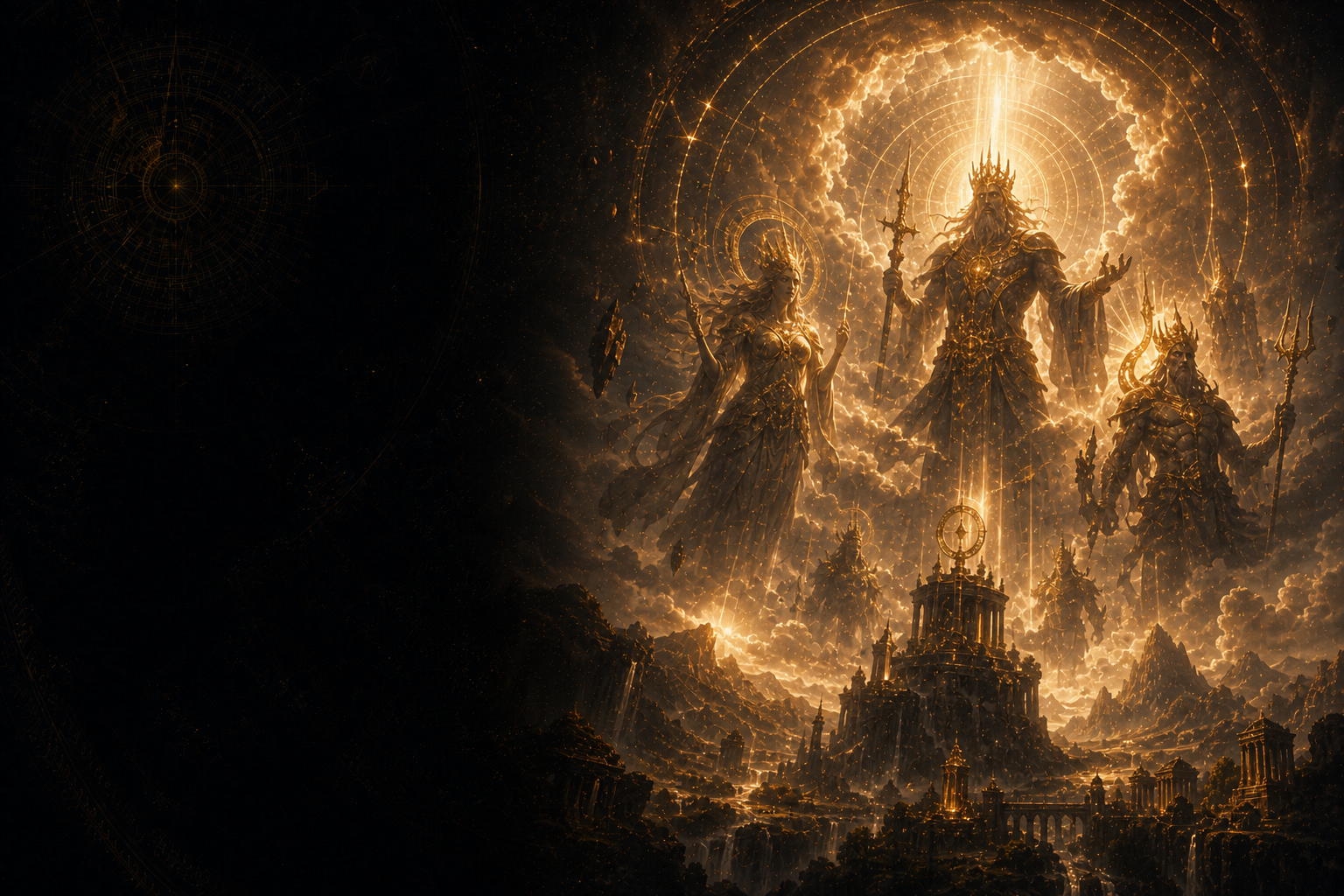
The Rise of the Pantheon marks the beginning of the Second Age of Arkanthys. During this era the first true gods appeared within the world, not as creators, but as beings formed from the immense residual power left behind when the Creators drifted away from Arkanthys. These divine entities did not arrive fully formed. They began as unstable concentrations of arcane force that gradually condensed into identity, awareness, and will. Over time these powers stabilized into distinct beings who would come to influence the fate of the world.
Unlike the Creators, who acted through impersonal cosmic principles, the Pantheon possessed intention, personality, and ambition. When they came to understand the world around them, they did not see Arkanthys as an accident of cosmic forces, but as a realm awaiting rulers.
Their emergence marked the beginning of divine influence upon the world and laid the foundation for the civilizations, religions, and conflicts that would follow.
The Birth of the First Gods
The earliest gods formed gradually as the vast energies left behind by the Creators began to condense into stable manifestations. These manifestations appeared across the world in different forms. Some emerged from storms and skyfire, others from volcanic flame, deep stone, still waters, or the quiet expanse of the night. In their earliest state, these beings were unstable and shifting, existing more as living concentrations of power than fully realized deities.
At first their forms were uncertain and their awareness incomplete. Their domains fluctuated and overlapped, and many of these early divine manifestations struggled to maintain coherence. In time, ten such entities stabilized into recognizable divine forms. These early gods differed greatly in strength and stability. Some possessed clear identity and purpose, while others remained fragmentary and volatile.
During this earliest period of divinity, conflict between the gods was rare. The world was vast and largely untouched by organized mortal life, and the young gods explored their power freely, shaping regions, climates, and natural phenomena as expressions of their emerging identities.
This fragile balance would not last.
The Pale Crown
Among the early gods, one entity stabilized more quickly than the others. Thalor, later known as the Bright King, developed a clear identity centered on sovereignty, structure, and dominion. While many of the early gods struggled to maintain stable form, Thalor’s purpose and presence hardened rapidly.
He soon recognized that several of the younger gods remained incomplete, their identities unstable and their domains unfocused. Rather than allow these fragmentary divinities to persist, Thalor absorbed them. One by one, five of the weaker gods were consumed, their essence bound into Thalor’s own being. From this act he forged the first divine artifact of the age: the Pale Crown.
The Crown was more than a symbol of authority. It was a concentration of divine power formed from the essence of the fallen gods. Through it, Thalor’s influence grew beyond that of the other surviving deities. From that moment forward, the balance among the gods was permanently altered.
The Five Who Remained
After the forging of the Pale Crown, five gods remained as the stable Pantheon of Arkanthys.
Thalor, the Bright King, embodied sovereignty and divine authority.
Kassira, the Crimson, governed justice and the purifying force of righteous flame.
Elunys, the Veiled, guided the dead across the Sea of Stars and maintained the boundary between life and death.
Ylara preserved knowledge, writing, and the memory of the world.
Drex embodied defiance, change, and the will that resists domination.
Together these five formed the ruling Pantheon, the first generation of gods capable of shaping the world through deliberate intent rather than instinctive power.
The World They Inherited
As the Pantheon stabilized, they began to perceive the true nature of the world around them. Arkanthys was not an empty realm waiting to be shaped. Mountains already stood where no god had raised them. Oceans moved according to laws the Pantheon did not create. Strange phenomena existed throughout the world, remnants of forces far older than the gods themselves. These mysteries were not understood by the Pantheon. But they did not need to be. The world was stable, alive, and filled with emerging life. To the gods it appeared as a realm without rulers, a world that could be shaped according to their will.
And so the Pantheon began to impose their influence upon Arkanthys. What began as exploration would soon become dominion, and the age of divine rule would follow.

Comments