
Ylara
Ylara was one of the original deities of Arkanthys and the former goddess of knowledge, memory, writing, preservation, and arcane understanding. She served as the Pantheon’s archivist, record-keeper, and guardian of accumulated truth, responsible for preserving history, codifying language, and stabilizing the foundations of mortal scholarship and arcane study.
Her influence touched every civilization that valued learning, literacy, or structured magical practice. Ylara vanished during The Godwar when her final great library was burned by her own archivists, marking the destruction of the greatest repository of knowledge in recorded history and the symbolic death of an age of learning.
Her fate remains uncertain.
Appearance and Symbolism
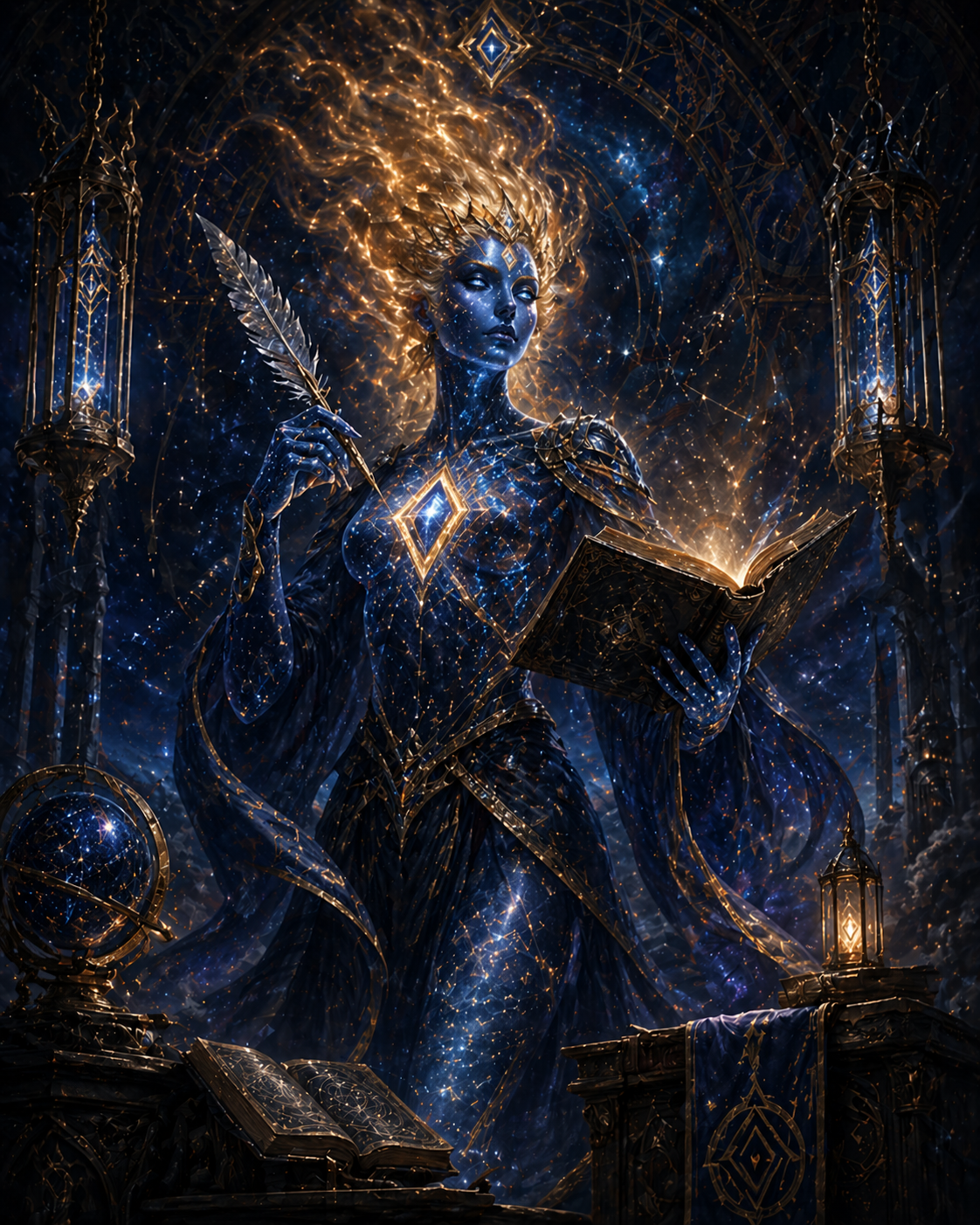
Ylara is traditionally depicted as an ethereal feminine figure composed of blue starlit essence, her body resembling a constellation given form. Her skin appears as a lattice of faint glowing points and arcane lines, giving the impression that her shape is woven from the night sky itself.
Her hair is portrayed as a flowing plume of golden radiance rising upward like living flame. At her chest glows a geometric rune, most commonly a diamond sigil, representing preserved truth, structured knowledge, and the hidden architecture of reality. She is almost always shown holding an open illuminated tome or star-metal quill.
Her principal symbols include the open book, diamond rune, quill of star-metal, and quiet lantern.
Her sacred colors are deep blue, gold, and silver.
Worship
Worship of Ylara centered on libraries, scriptoria, archives, and arcane institutions rather than temples in the conventional sense. Her clergy consisted of scribes, archivists, chroniclers, librarians, and mystics tasked with preserving knowledge, maintaining historical record, and preventing the corruption or loss of truth.
Devotion to Ylara was expressed less through ritual and more through scholarly labor. To preserve truth was itself considered worship. Oaths sworn within Ylaran sanctums were regarded as binding by virtue of truth itself rather than divine punishment.
Following her disappearance, organized worship collapsed almost entirely. Her traditions survive only in fragmented scholarly customs, archival rites, and arcane institutions descended from older Ylaran practice.
Holy Days
Ylara’s principal holy day was the Day of Script, during which scribes restored damaged texts, copied fragile works, and compiled new histories in her honor.
A lesser observance, the Lantern Hours, involved reciting genealogies, oral histories, and ancestral records from dusk until midnight to affirm that memory survives darkness. Both traditions persist only in isolated scholarly communities and surviving archival orders.
History
Divine Archivist
Ylara emerged in the First Age as the divine embodiment of preserved knowledge and structured understanding. She is credited with creating written language, formalizing runic systems, and laying the foundations for early arcane theory and magical notation.
As civilization expanded beneath the Pantheon’s influence, Ylara established great repositories of knowledge across the world, preserving history, magical practice, law, and philosophy for future generations.
Keeper of Continuity
During the Divine Concord, Ylara’s role expanded beyond scholarship into preservation of divine and mortal continuity alike. She recorded the decrees of the Pantheon, maintained the official histories of divine rule, and ensured that knowledge endured through war, famine, collapse, and dynastic upheaval.
Though not an enforcer of divine authority, her work became essential to its maintenance. No system survives long without memory.
Crisis of Knowledge
As the Pantheon’s rule grew increasingly oppressive in the late Third Age, Ylara became troubled by the ways knowledge was being used to preserve tyranny rather than enlightenment. Though she did not rebel against the Pantheon, neither did she become an active instrument of oppression.
She remained committed to preserving truth even when truth became uncomfortable to divine authority.
The Burning of the Final Library
Ylara vanished during the early years of The Godwar. In 3A Y11146, her final great library was set ablaze by her own archivists, who chose to destroy its contents rather than allow knowledge to remain a tool of divine domination.
The fire consumed untold records of history, healing, arcane theory, genealogy, and philosophy. At the moment the library fell, Ylara vanished.
Whether she was unmade by the destruction of her domain, withdrew in grief, or transcended mortal understanding remains unknown. Her disappearance marked one of the greatest intellectual catastrophes in history.
Legacy
Ylara’s legacy survives in fragments. Her runes remain foundational to modern arcane notation. Her scripts underpin most written languages derived from early civilized cultures. Her philosophies continue to shape scholarship and archival tradition across Arkanthys.
Yet her greatest works were lost with her. To this day, no surviving library rivals the repositories once kept in her name.
Among scholars, Ylara is remembered not merely as the goddess of knowledge, but as the keeper of all that was lost when truth itself was burned.

Comments