Divine Concord
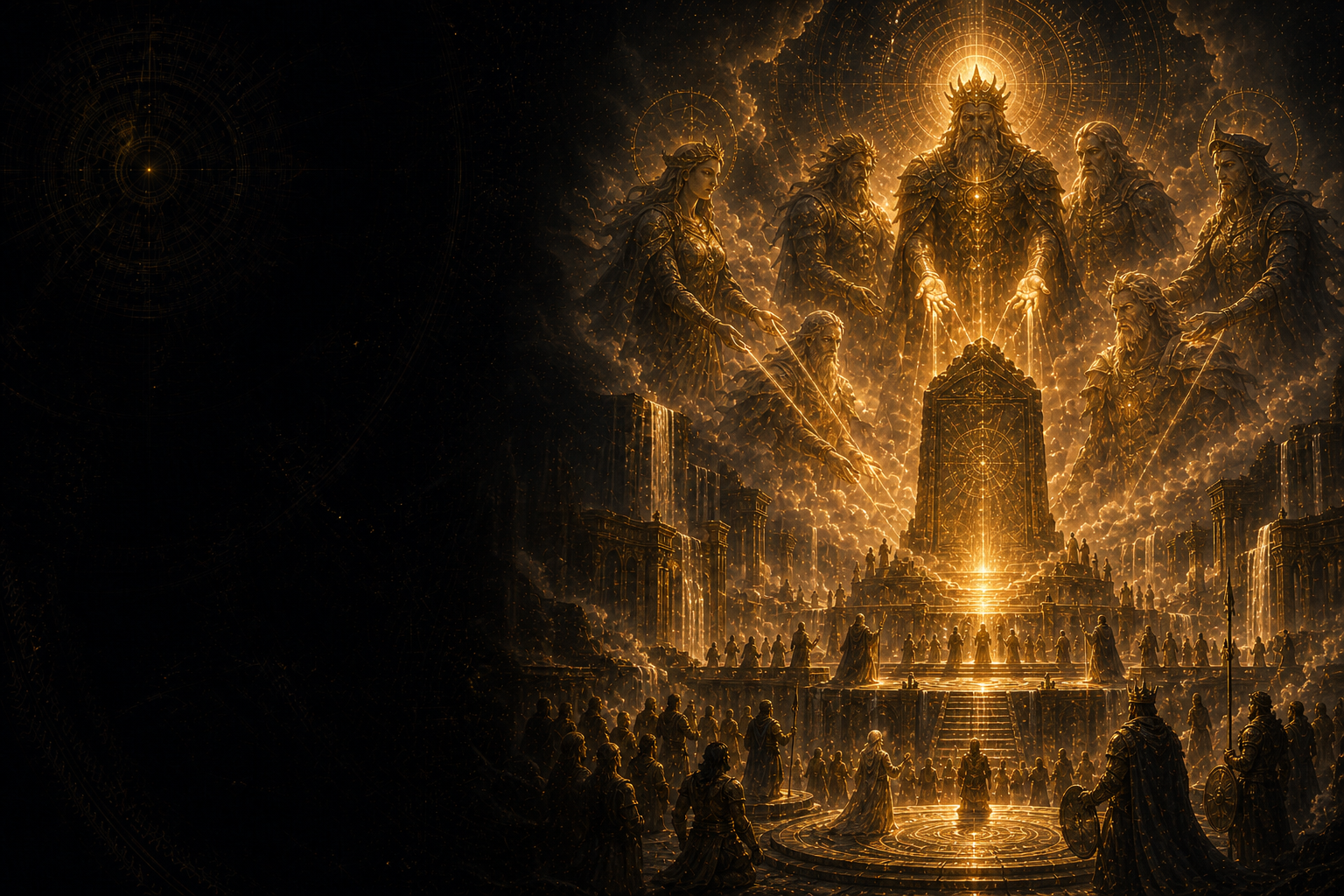
The Divine Concord was the great covenant established between the Pantheon and the civilizations of Arkanthys during the height of the Ostagarian Empire. It marked the first formal agreement defining the relationship between divine authority and mortal governance.
Under the Concord, the gods withdrew from constant direct involvement in mortal affairs while establishing a structured framework through which their influence would continue to guide the world.
For many centuries the Concord was regarded as a golden compromise between divine power and mortal autonomy. In practice, however, it gradually reshaped civilization into one increasingly centered around the authority of the Pantheon. The Concord would ultimately lay the foundations for the Age of Worship and the tensions that would one day lead to The Godwar.
Origins of the Concord
By the middle centuries of the Second Age, the world had grown far larger and more complex than in the early days of Ostagar. Cities spread across multiple continents, trade networks connected distant lands, and many different peoples now inhabited Arkanthys. During the earliest stages of the empire, the gods frequently walked among mortals, offering guidance, teaching, and direct intervention in major events. While this presence accelerated the development of civilization, it also created instability. Entire regions could be reshaped by divine decisions, and mortal institutions often struggled to function independently.
Recognizing that civilization needed greater stability, the Pantheon declared the formation of the Divine Concord. The Concord was intended to create clear boundaries between divine authority and mortal governance.
The Terms of the Concord
The Concord established several principles intended to regulate divine involvement in the world.
The gods would no longer intervene directly in the daily governance of mortal societies. Kings, councils, and institutions would rule their own cities and territories without constant divine oversight. Instead, the Pantheon would guide civilization through visions, prophets, sacred institutions, and appointed emissaries. Temples would serve as centers where divine teachings could be interpreted and preserved.
The Concord also formalized the authority of the Pantheon as the ultimate guardians of cosmic order. While mortal rulers governed their lands, divine law stood above all mortal law. In theory, this structure allowed mortal societies to grow while still benefiting from divine wisdom.
Although the Concord promised reduced divine interference, it had the unintended effect of expanding the institutional presence of the gods across the world.
Temples grew into powerful centers of administration, scholarship, and cultural authority. Priests and scholars devoted to the Pantheon became influential figures within many cities, interpreting divine teachings and shaping public life. Over time, the influence of these institutions spread across much of the known world. Civic life, law, education, and scholarship increasingly incorporated the doctrines of the Pantheon.
This period marked the beginning of a gradual shift in which reverence for the gods became deeply woven into the structure of civilization.
Legacy
The Divine Concord reshaped the relationship between mortals and the gods more than any event since The Founding of Ostagar.
For generations it was celebrated as a balanced system that allowed civilization to flourish while preserving divine guidance. The Ostagarian Empire reached the height of its stability during the early centuries following the Concord.
Yet the same institutions that preserved divine order also concentrated religious authority throughout the world. Over time, reverence for the Pantheon transformed into expectation, and expectation into obligation.
The Concord therefore stands as both a symbol of cooperation and the beginning of the long transformation that would lead into the Age of Worship.

Comments