Baraz-Kronn
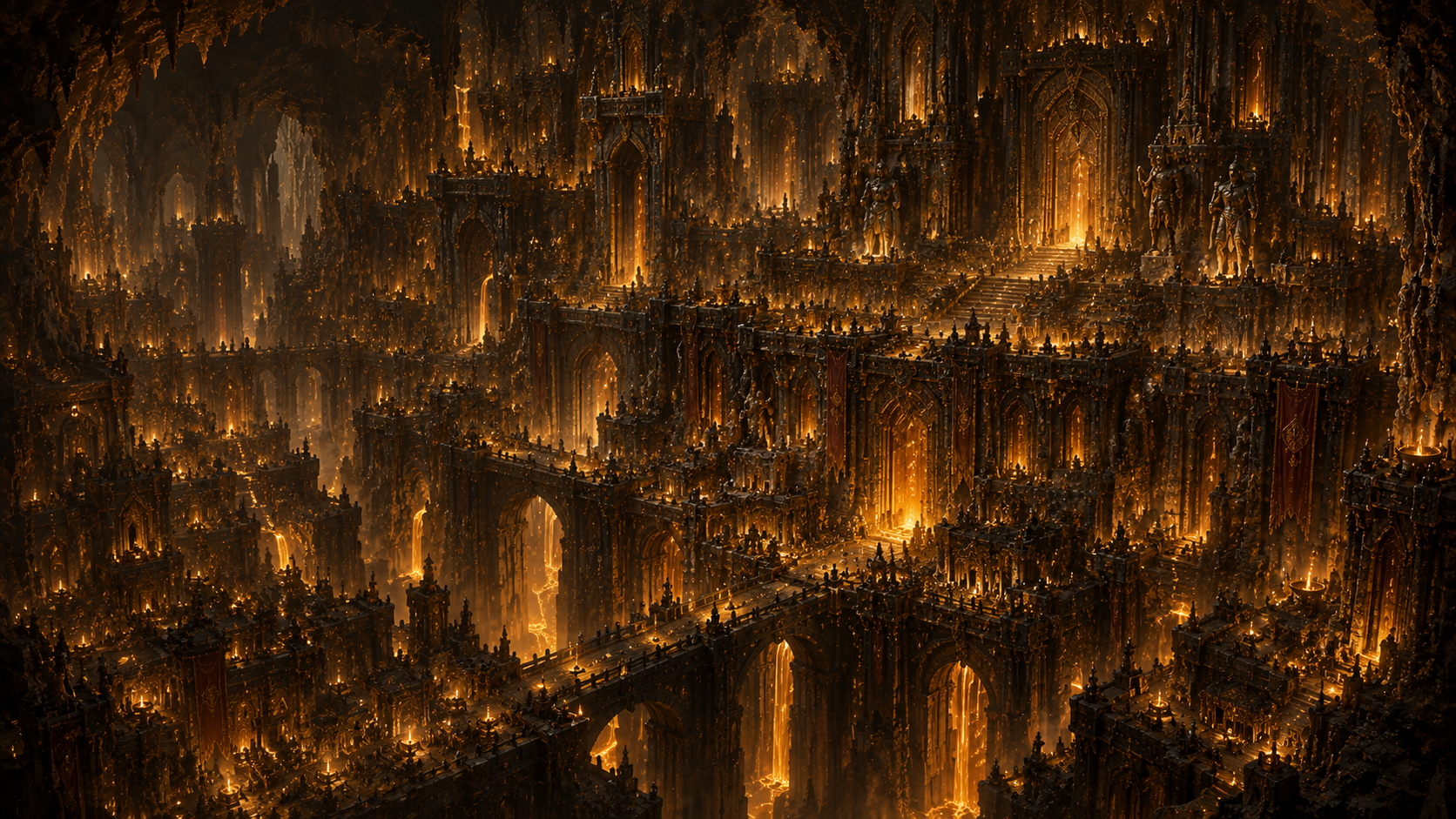
Baraz-Kronn is the capital of Khazural and the greatest of all dwarven holds. Entirely subterranean except for the Embergate Market, it stretches for miles beneath the northern Elderspine Mountains. Known as The Gilded Halls, it serves as the spiritual, cultural, political, and military center of the Ungi people. Hundreds of thousands of dwarves inhabit its interconnected districts, forge-halls, vault-cities, and ancestral chambers.
Every major oath, alliance, and proclamation in Khazural passes through Baraz-Kronn. No other hold carries the same continuity or authority.
Location and Structure
Baraz-Kronn lies deep within the Elderspine, accessible only through the Grand Gates above the Embergate Market.
Beyond the entrance, the hold descends into a vast network of halls, pillars, tunnels, citadels, and subterranean avenues. Its scale accommodates entire districts, military quarters, guild sectors, and ancestral vaults carved over millennia.
The Sky Below forms the central chamber’s ceiling, inlaid with diamonds, emeralds, sapphires, and other gemstones arranged to mirror surface constellations. This artificial firmament illuminates the heart of the city, reflecting across gold-veined columns and polished obsidian floors.
Access is strictly controlled. The Bronze Line marks the boundary between foreign trade territory and the inner hold. Beyond it, only dwarves of Khazural and those granted direct audience by the High King may enter.
The Throne of the High King
At the center of the hold stands the Throne of the High King, forged from arcanum and gold. It functions as both political authority and oathstone. Every Ungi who swears loyalty to Khazural does so before it.
High King Barador Gildhelm rules from this seat as the final interpreter of runelaw and guardian of the Stone Pact. He is regarded as patient and unyielding, and has not left Baraz-Kronn in over a decade.
The Five Grand Forgehouses
Baraz-Kronn houses five ancient Forgehouses, each tied to one of the Five Echoes, foundational principles said to underlie creation. These houses do not rule, but their influence rivals that of any ancestral clan.
House Dornbraeth holds the Echo of Shape and is responsible for architecture and structural design across Khazural.
House Rhund-Khazal holds the Echo of Gravity and governs oaths, consequence, and judicial interpretation.
House Thaldrazan holds the Echo of Time and defines endurance-based military doctrine and command training.
House Brimgaruun holds the Echo of Law, overseeing precision in craft, engineering, and contractual systems.
House Zarak-Vorr holds the Echo of Memory, maintaining tomb-vaults, ancestral records, and the continuity of the Ungi dead.
Each Forgehouse maintains its own district, containing halls, forges, shrines, and vaults aligned to its Echo.
Embergate Market
The Embergate Market is the only section accessible to outsiders. Located above the main descent, it functions as the controlled trade point between Khazural and the outside world. Goods, envoys, and caravans are processed here, but none may cross the Bronze Line without formal approval. The market is guarded by rune-sentinels, automaton constructs capable of identifying individuals through glyph resonance.
Districts and Layout
Baraz-Kronn is divided into multiple functional districts. The High Hall surrounds the Throne and forms the political and ceremonial center. The Forge Districts span multiple layers, sustaining Khazural’s industrial output through continuous production. The Gallery of Kings contains engraved pillars and reliefs documenting every High King since the First Hallings. The Vault-City lies in the deepest levels, containing ancestral tombs, clan vaults, and the oldest surviving structures. The Military Quarter houses the Emberguard, the elite force sworn to defend the High King.
All districts are connected through stone causeways, magma-lit tunnels, and Deeproot veins linking the hold to the wider Khazural network.
Access and Security
Baraz-Kronn maintains the highest level of internal security in Khazural. Rune-sentinels patrol the Bronze Line and inner wards. Warding runes of grounding, concealment, and defense are embedded throughout the structure. Military presence is constant but controlled, with the Emberguard operating exclusively within the hold.
No outsider has entered the inner hold, seen the Sky Below, or approached the Throne Hall without direct royal sanction.
Culture and Atmosphere
Baraz-Kronn operates on a continuous cycle of industry and ritual. Forge-fires burn without interruption, while processions, guild assemblies, ancestral rites, and legal recitations define daily life. The hold functions as the core of dwarven identity, where craft, history, and obligation converge. Across Khazural, Baraz-Kronn is regarded with reverence. Other holds do not fear it; they recognize it as the center of endurance and continuity.
Founding and Legacy
Baraz-Kronn was founded during the First Hallings, following the initial dwarven migration into the Elderspine. Its construction is tied to early figures and events preserved in stone records, though many details remain partially understood. The hold is considered the most sacred site in Khazural, containing relics and knowledge dating back to the earliest era of the Ungi.
Baraz-Kronn stands as the central pillar of Khazural, seat of the High King, anchor of the Stone Pact, and the enduring core of dwarven civilization.

Comments