Bharûm-Drakhal
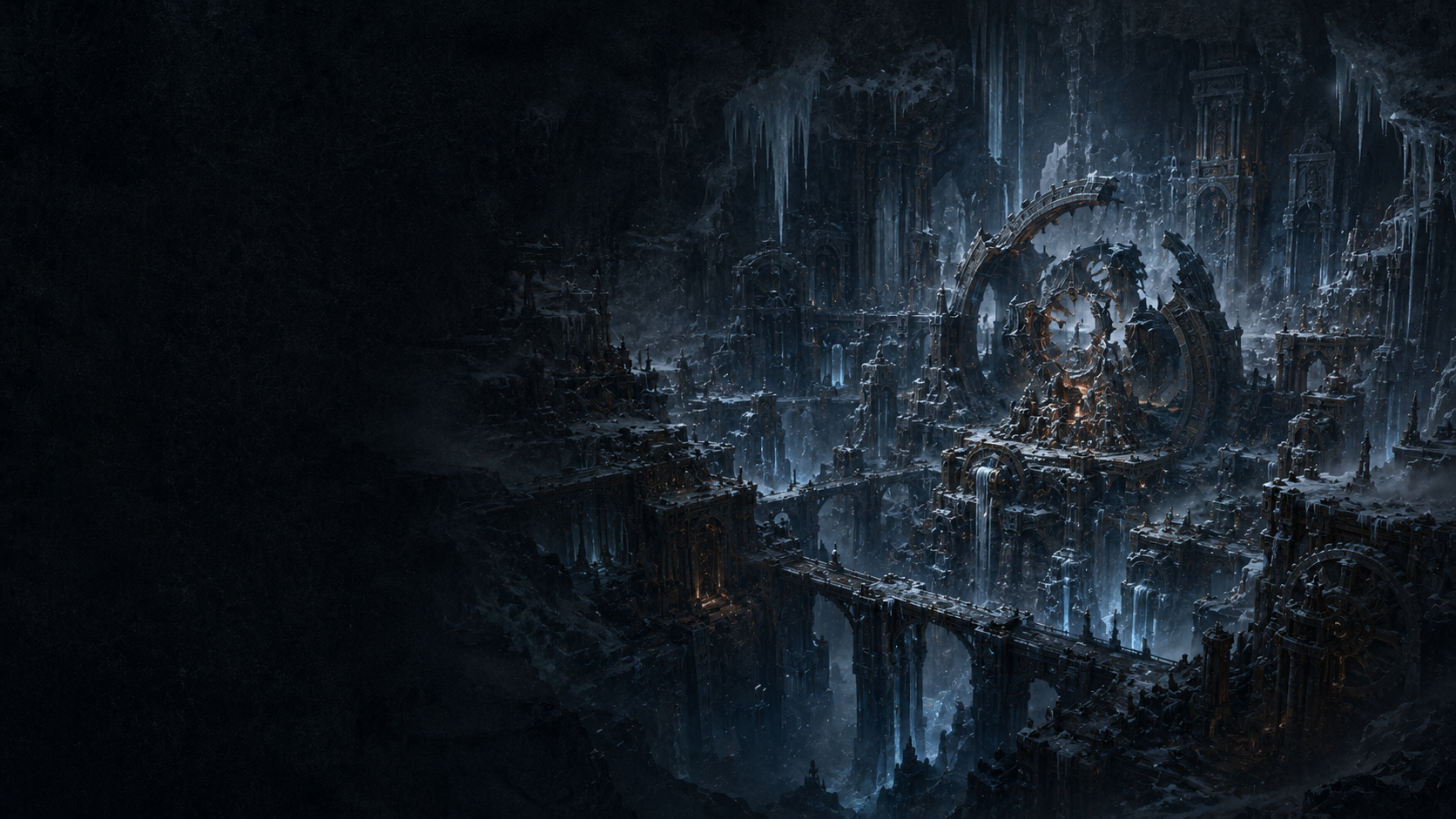
Bharûm-Drakhal was the most technologically advanced dwarven city ever constructed and the greatest feat of Ungi engineering in recorded history. Built deep beneath the western fjords of Grimhold, it was conceived not merely as a settlement, but as a fully integrated machine-city bound into the mountain itself.
Unlike other dwarven holds, which relied primarily on stonecraft, forgework, and runic engineering, Bharûm-Drakhal functioned through vast mechanical and thermal systems powered by the Heartgear, an immense engine built around a divine relic known as the Shard of Pyrrhex.
For much of recorded history, Bharûm-Drakhal served as the thermal heart of Grimhold. Through an immense subterranean network of engineered conduits and geothermal channels, its systems distributed heat throughout the surrounding mountain ranges and western fjords, moderating the region’s climate and enabling large-scale habitation.
Its destruction resulted in the freezing of Grimhold and the collapse of its entire thermal network.
Founding and Purpose
Bharûm-Drakhal was founded during the First Age following the Ungi descent from the First Hallings into the deeper mountain ranges.
Its purpose was singular: to harness and regulate the geothermal and arcane forces beneath the western mountains. According to dwarven tradition, prospectors discovered a divine fragment buried deep below the range during the early excavations—a crystalline remnant believed to be a shard of Pyrrhex, Titan of Flame and Renewal.
The dwarves named this relic the Heartgear. Recognizing its immense thermal and kinetic output, they constructed Bharûm-Drakhal around it, transforming the relic into the central power source of the largest mechanical infrastructure project in dwarven history.
Structure and Engineering
Bharûm-Drakhal was designed according to the Threefold Principle of Weight, Flame, and Fire, the foundational engineering philosophy of its builders.
Weight governed structural stability, pressure regulation, and gravitational control.
Flame governed energy transformation, thermal transfer, and industrial production.
Fire represented animation, destruction, and the sustaining force of creation itself.
Its internal structure was divided into several major operational levels.
Chasm Gate
The primary entrance to the city, carved into the fjord cliffs and sealed by the Weight Doors.
Halls of Descent
Massive transit and regulation corridors designed to equalize pressure, thermal flow, and mechanical load throughout the upper city.
Resonance Halls
Acoustic chambers engineered to transform harmonic vibration into regulated energy calibration for the Heartgear’s operation.
Forgeheart
The central industrial district surrounding the Heartgear, containing the city’s primary forges, regulators, and mechanical foundries.
Deep Veins
Vertical shafts extending into the mountain’s geothermal strata, used for extraction of heat, pressure, and mineral resources.
Necropolis of Chains
The burial vault of Bharûm-Drakhal’s engineers, oathkeepers, and Khazal.
The Heartgear
At the center of Bharûm-Drakhal stood the Heartgear, a colossal mechanical engine constructed around the Shard of Pyrrhex.
The engine converted the shard’s immense thermal and kinetic energy into mechanical output, driving the city’s infrastructure and feeding heat through subterranean channels across Grimhold.
No other machine of comparable scale has ever existed.
Its continued operation was directly responsible for the relative warmth of pre-collapse Grimhold.
Destruction
During the later stages of Gabriel Aurellian’s rebellion, forces loyal to Ostagar sought to cripple northern support for the rebellion by destroying Grimhold’s thermal source.
The Heartgear was sabotaged and the Shard of Pyrrhex shattered.
The resulting detonation destroyed the core of Bharûm-Drakhal, killing thousands instantly and causing catastrophic structural failure throughout the city. Entire districts collapsed, thermal systems ruptured, and the mountain’s mechanical infrastructure entered uncontrolled stasis.
Within years, Grimhold’s climate collapsed into permanent winter.
The Weight Doors
The entrance to Bharûm-Drakhal was sealed by the Weight Doors, monumental bronze slabs held shut through magnetic polarity generated by an internal lodestone matrix.
When the Heartgear failed, the magnetic systems locked permanently into place, sealing the city.
For centuries the doors remained immovable. Modern scholarship believes only an exact magnetic resonance matching the original harmonic frequency can reopen them. This theory gained renewed attention following the discovery of Winry’s meteorite, whose composition appears to resonate with the same anomalous frequency.
Philosophy and Society
The dwarves of Bharûm-Drakhal viewed creation and maintenance as sacred duties.
Their culture centered on the belief that labor sustained the world and that neglect was a form of sacrilege. Engineers, smiths, and machinists held status equal to priests in other societies.
The highest title within the city was Khazal, meaning Weight-Bearer, granted only to the master engineers entrusted with direct stewardship of the Heartgear.
Present State
Bharûm-Drakhal remains sealed beneath the western fjords.
Though the city is believed to be ruined, explorers and surface camps report faint geothermal warmth still rising from below and a low mechanical resonance audible beneath the stone.
Whether remnants of the Heartgear still function remains unknown.

Comments