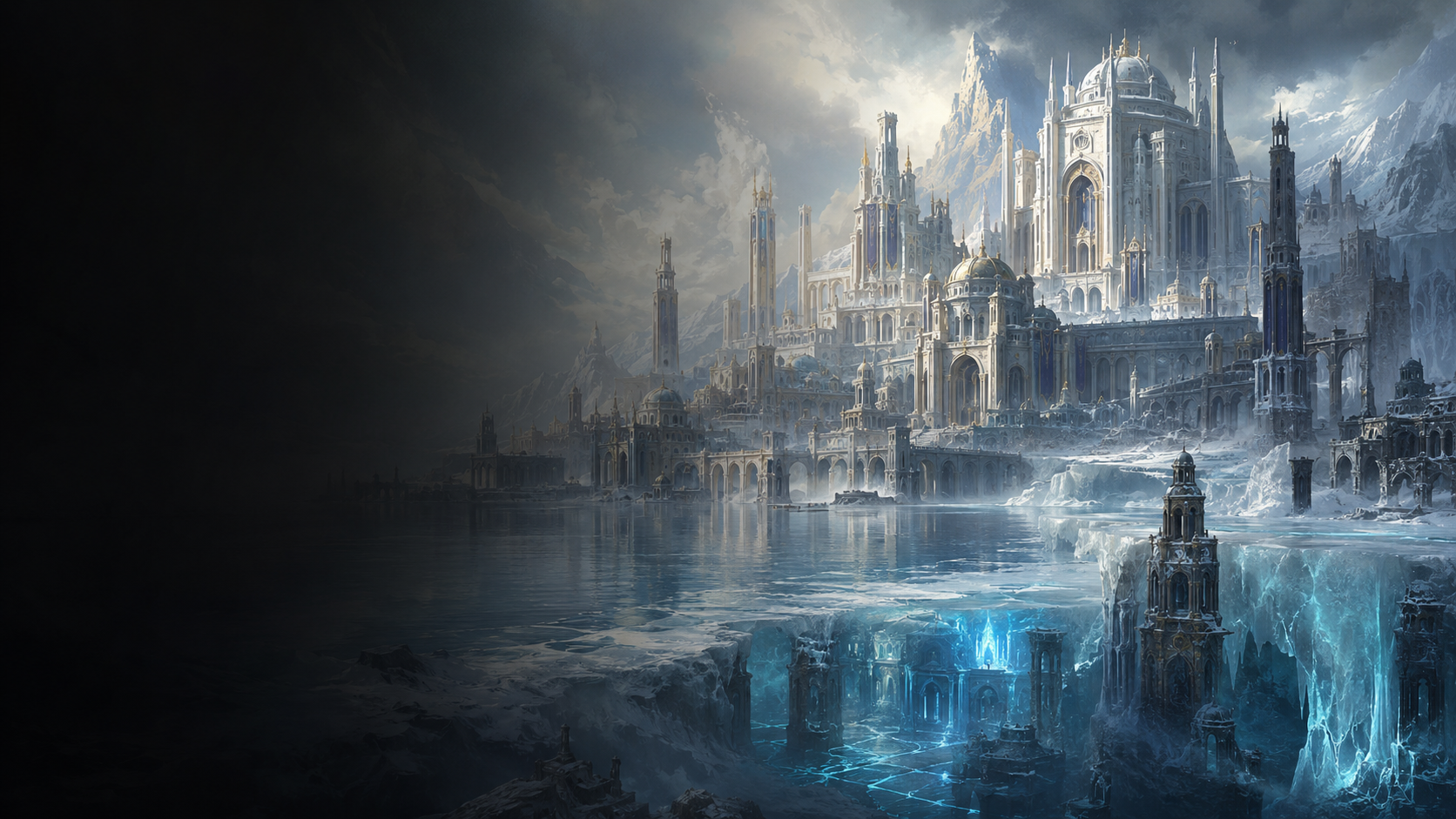
Ostagar
Ostagar is the first city ever built on Arkanthys and the origin point of organized mortal civilization. Founded by the Saren in the early Second Age along the shores of Nyvarra’s Mirror, it became the center from which law, written language, governance, architecture, and structured knowledge spread across the world.
Over centuries, the city expanded into a vast marble metropolis housing hundreds of thousands. It stood as the primary center of trade, arcane study, engineering, and divine worship. Its white marble towers, obsidian halls, and sanctuaries marked it as the most advanced and influential settlement of its age.
Ostagar is also the birthplace of Gabriel Aurellian, whose rebellion would later bring about the fall of the Pantheon’s rule.
During The Godwar, Ostagar became the first great capital to fall.
It now lies preserved beneath the ice of the Icemarch.
Founding of the First City
Ostagar was established shortly after The Creation of the Saren, the first mortal civilization shaped by the Pantheon. The earliest settlements formed along the stable shores of Nyvarra’s Mirror, where access to water and fertile land allowed sustained growth. Under direct guidance from the Pantheon, the Saren developed language, law, architecture, and agriculture in structured form.
The settlement expanded rapidly into a centralized city.
From Ostagar, early systems of governance, written script, and organized scholarship spread outward. Later civilizations trace their origins to migrations that began here.
Architecture and City Structure
At its height, Ostagar was the largest and most advanced city in the world.
Construction relied on white and pale-blue marble, obsidian, and divine shaping techniques. Tower districts rose above the lake, connected by plazas, arcades, and canal systems that carried water throughout the city.
Sanctuaries inscribed with divine runes were distributed across all major districts. Markets, guild halls, and workshops occupied the lower levels, while administrative and ceremonial structures dominated the upper tiers.
The city’s scale extended across a vast portion of present-day Grimhold. Crossing it required multiple days. At night, reflected light from lanterns and waterways gave the city a uniform, luminous appearance.
The Basilica
The Basilica served as the central site of worship and the most prominent structure in Ostagar. Constructed from pale-blue and white marble, it dominated the skyline. Its interior contained vast halls supported by massive columns, with vaulted ceilings illuminated by controlled radiant flame.
At the center of its dome hung the Bell of Ostagar.
The Bell was regarded as a direct link to the Pantheon. Its sound carried across the city and the lake. It marked major events, declarations, and divine presence.
The Vault of Names
Beneath the Basilica lay the Vault of Names. This subterranean structure recorded every known Saren lineage. Names were inscribed into obsidian and meteorite surfaces, forming a continuous genealogical archive.
The Vault extended deep beneath the city in layered chambers. It served as both record and verification system for identity, lineage, and inheritance.
After the fall of Ostagar, the Vault was buried beneath ice. Most of its records remain inaccessible.
The Mirrorhall
The Mirrorhall was the center of metaphysical and arcane study. Constructed from polished obsidian, it contained rune-bound mirrors linked to the moment of a soul’s emergence. These mirrors did not reflect physical form, but existence itself.
Scholars used them to study memory, possibility, and identity across time. Most mirrors shattered during the fall. Surviving fragments are believed to remain beneath the ice.
The Heartvault
The Heartvault lay beneath the Basilica at the deepest accessible level. It contained relics and artifacts attributed to the Pantheon. The chamber functioned as both treasury and sacred repository. During the fall of the city, the Heartvault was breached. Its contents were removed, destroyed, or lost.
Decline After the Divine Concord
Following the Divine Concord, direct divine presence diminished, but control intensified. Independent engineering, arcane development, and mechanical innovation were systematically dismantled. Institutions tied to discovery were dissolved. Authority shifted fully to divine decree. Religious structures expanded across the city, replacing earlier centers of study and production.
Ostagar transitioned from a city of development to a city of preservation.
The Siege of Ostagar
From 2A 1134 to 2A 1139, Ostagar was besieged by the forces of Gabriel Aurellian.
The city remained loyal to the Pantheon and was reinforced accordingly. Its defenses prolonged the siege for five years.
In 2A 1139, the city fell.
The Basilica was destroyed.
The Bell of Ostagar was melted.
The Mirrorhall collapsed.
The Vault of Names was sealed beneath ice.
The Heartvault was breached.
Ostagar ceased to function as a city.
Present Day
Ostagar remains beneath the glacier of the Icemarch. Fragments of its upper structures are visible above the ice, while the majority of the city remains preserved below. Subsurface chambers are unstable and partially intact.
Reports describe light beneath the ice, structural echoes, and surviving arcane phenomena.
The site is considered hazardous. For the Skarnn, Ostagar represents both origin and warning.

Comments