Elegy
The Elegy is the sole religious and funerary authority of the Skarnn, entrusted with preserving ancestral rites, overseeing burial customs, and adjudicating matters of death, sacrilege, and ritual law. It exists outside direct clan governance and derives its legitimacy from sacred tradition rather than bloodline, territory, or military power.
Though the Jarldom rules the living, the Elegy governs the sacred rites of the dead. Its authority is ancient, deeply embedded in Skarnn culture, and respected throughout Nifleheim.
Authority and Presence
The Elegy does not hold territory in the conventional sense. Its influence is established through the Honor of the Dead Decree, issued by Magnus Stoltengard, 21st Jarl of Nifleheim, which granted the order permanent right to maintain burial grounds, crypts, memorial sites, and funerary sanctums within all recognized Skarnn settlements.
As a result, the Elegy maintains a presence in every major city and clan seat through shrines, crypts, temples, and mortuary complexes. These sites are regarded as sacred ground regardless of local clan jurisdiction.
Shrine of Eternal Rest
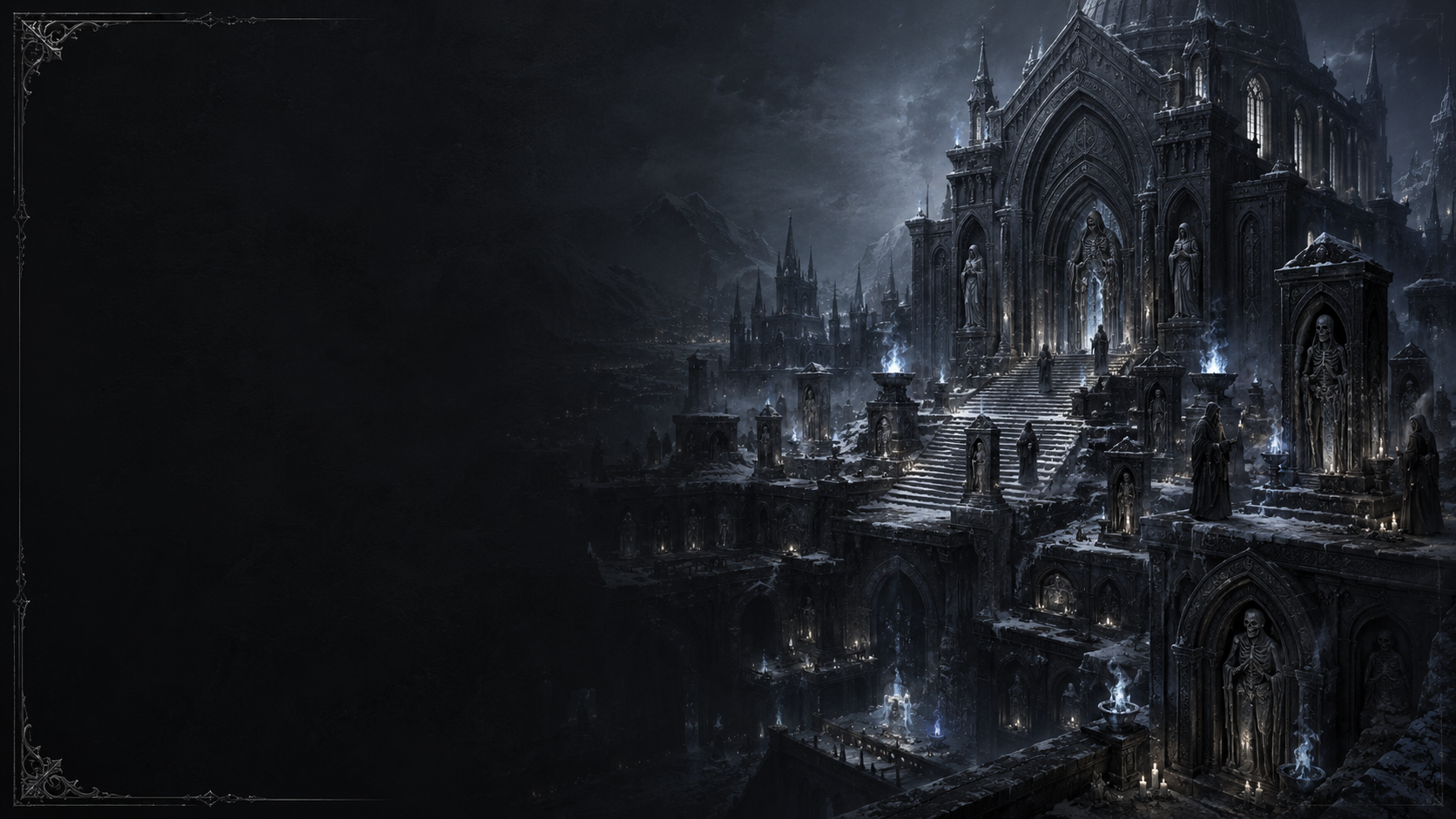
The primary seat of the Elegy is the Shrine of Eternal Rest, a vast blackstone cathedral in the Midcity of Nifleheim. It serves as the order’s spiritual center, judicial sanctum, and administrative headquarters.
Beneath it lies an immense crypt-complex, portions of which predate the modern Jarldom. Access to its deepest chambers is restricted to the highest ranks of the order.
Leadership
The Elegy is led by the High Electress, currently Sif Helmarr, who serves as the supreme spiritual and judicial authority of the order.
Beneath her stand the Judicators, who interpret ritual law and preside over matters of sacrilege, burial disputes, funerary custom, and death-sanction hearings.
The Executors serve as the order’s enforcement arm, carrying out lawful sentences, securing profane relics, and enforcing sacred decrees.
Lower ranks consist of Caretakers, Mortuaries, and Zealots, who maintain crypts, oversee rites, and serve the public religious functions of the order.
Doctrine and Function
The Elegy’s doctrine holds that the dead must be honored, remembered, and preserved according to ancestral law. To violate burial custom is to dishonor the forefathers themselves.
The order safeguards funerary rites, maintains ancestral records, and preserves ritual traditions dating back to the First Age. In addition to its religious duties, the Elegy adjudicates matters where law intersects with death, burial, sacrilege, and sacred tradition.
Judicial Authority
The Elegy may investigate sacrilege, confiscate profane relics, and issue judgments in matters concerning burial law or spiritual offense. It may recommend execution in severe cases, but no death sentence may be carried out without approval from the relevant clan authority or the ruling Jarl.
The Jarl remains the supreme legal authority in all Skarnn lands. The Elegy’s influence stems not from supremacy over the Jarldom, but from the fact that few rulers dare openly defy sacred tradition.
Infrastructure and Crypt Networks
The Elegy maintains extensive burial vaults and subterranean crypt-complexes beneath many major Skarnn settlements. These structures serve as tombs, sanctified storage chambers, ossuaries, and ritual spaces.
In certain cities, older crypt sections connect through sealed underground passages constructed over generations as burial grounds expanded. Knowledge of these lower passages is restricted to senior members of the order.
Relations with the Clans
The Elegy maintains formal neutrality in clan politics. Its members serve all Skarnn regardless of bloodline or allegiance.
Clan leaders respect the order’s authority but remain wary of its influence over ritual law, inheritance customs, and funerary legitimacy.
Though respected, the Elegy answers ultimately to the authority of the Jarl.
Reputation
Among the common Skarnn, the Elegy is regarded with reverence and unease in equal measure. Its priests guide souls to rest. Its judges condemn the faithless. Its executors carry sentences no ordinary warrior may challenge.
To be blessed by the Elegy is honor. To be judged by it is dread.

Comments