Rise of the Valiran Empire
The Rise of the Valiran Empire marks the emergence of one of the most powerful mortal states of the Third Age. Originating in the ancient forests of Valira, the empire united the elven realms of Myrien and Cadrien under a single imperial authority and rapidly expanded its influence beyond the borders of the forest continent.
Unlike the Ostagarian Empire, which had developed under the direct guidance of the Pantheon, Valira grew largely through the ambitions and decisions of its own rulers. Drawing strength from the ancient magic of the land and the sacred presence of the two World Trees, the elves forged a state capable of rivaling the great powers of the age. Within a few generations, the forests of Valira had transformed into the center of a powerful imperial civilization whose influence stretched across deserts, mountains, and trade routes throughout Arkanthys.
The Twin Realms of Valira
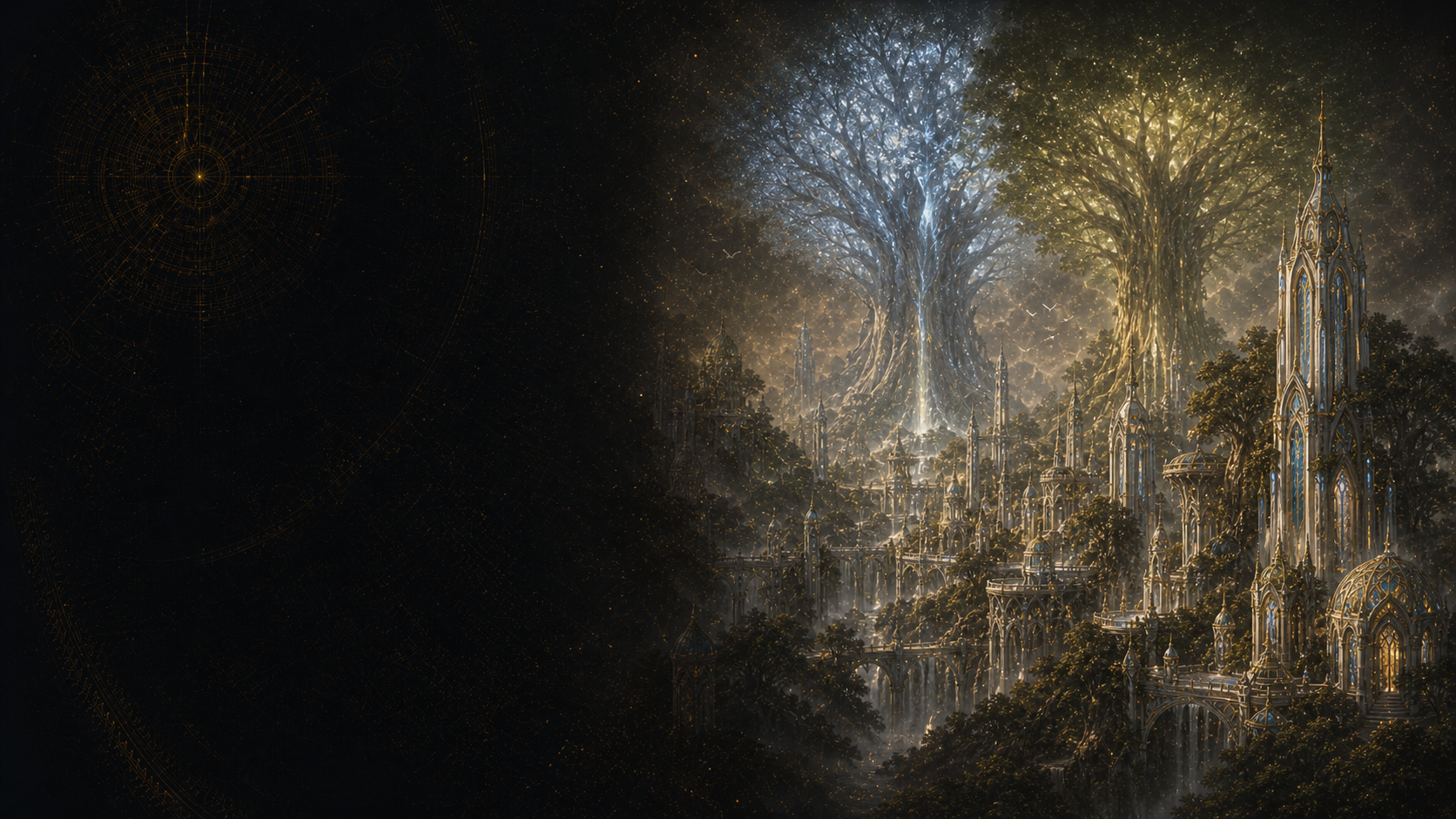
Before the rise of the empire, Valira was divided into two major elven realms: Myrien and Cadrien. Each region was centered around one of the ancient World Trees of Valira.
In the western forests of Myrien stood Myriandor, a colossal tree whose vast canopy nourished the surrounding lands and symbolized life, renewal, and the deep bond between the elves and the natural world.
To the east, within the forests of Cadrien, rose Syrandora, an equally ancient tree associated with arcane wisdom and the deeper mysteries of the weave. Elven traditions held that the first elves were born from the fallen acorns of these sacred trees, tying their people forever to the living magic of Valira.
Although the peoples of Myrien and Cadrien shared ancestry and culture, their realms developed independently for centuries, each governed by powerful noble houses that traced their lineage to the earliest generations of elves.
The Unification Under Urus Velaine I
The unification of these two realms was achieved by Emperor Urus Velaine I, the founder of the Valiran Empire. Urus emerged during a period of growing external pressures and shifting power across Arkanthys. Recognizing that the divided realms of Valira could not remain isolated while other empires expanded across the world, he began a campaign to unite Myrien and Cadrien under a single banner.
Through diplomacy, alliances among noble houses, and carefully directed military actions, Urus succeeded in bringing the two forest realms together. When he was crowned Emperor of Valira, the long-standing division between Myrien and Cadrien formally ended, and the Valiran Empire was born. For the first time, the two World Trees stood within the same imperial domain.
Valiran Conquest
With Valira unified, imperial attention soon turned south toward the deserts of Aranna. Unlike Valira, Aranna was not a unified state. The region was divided among powerful Tar barons, each controlling fortified territories built around valuable Tar fields. These baronies frequently fought among themselves, creating a fractured political landscape.
Valiran armies advanced gradually through the region, bringing the scattered baronies under imperial influence one by one. The final and most formidable resistance came from Baron Acra, ruler of the desert stronghold known as the Black Tower of Acra. The tower dominated the surrounding desert and served as the last bastion of Tar Baron independence. After a prolonged siege, the tower finally fell to Valiran forces. The defeat of Acra marked the effective end of organized resistance in Aranna.
In later centuries, the ruins of the Black Tower would become the foundation of the desert city of Morden.
Expansion northward brought the Valiran Empire into conflict with the dwarven realms of Khazural. Unlike the fractured Tar baronies of Aranna, Khazural was defended by ancient mountain kingdoms and fortified passes that proved extremely difficult to conquer.
In response to the growing threat of Valiran expansion, the Ungi constructed the Bulwark, an immense defensive wall carved directly into the mountains along the southern borders of Khazural. Stretching for miles across the high passes, the Bulwark was designed to shield Ungi lands from imperial encroachment. More wall than fortress, it became one of the greatest feats of mortal engineering and a powerful symbol of dwarven resistance. Although the wars between Valira and Khazural were fierce, the conflict eventually ended in an uneasy peace that left both sides wary of further escalation.
The Height of Valiran Power
By the height of its expansion, the Valiran Empire had become one of the most influential states in Arkanthys. Its authority extended across the forests of Valira and deep into the deserts of Aranna. Its armies rivaled those of the Ostagarian Empire, and its control of trade routes gave it immense economic power.
For the first time since The Founding of Ostagar, the world contained a rival capable of challenging the dominance of the Ostagarian order. The balance of power across Arkanthys had begun to shift.
Legacy
The rise of the Valiran Empire transformed the political landscape of the Third Age. What had once been a world dominated by a single imperial center now contained multiple powerful states, each pursuing their own ambitions and shaping the course of history. Although the empire would later fracture following the death of Emperor Calan Velaine, the foundations established during this period permanently altered the balance of power across Arkanthys.
The centuries that followed would become known as the Age of Imperial Rivalry, when competing empires began pulling the world toward open conflict.

Comments