
Thalor
Thalor, known as the Bright King, was one of the original deities of Arkanthys and the former god of order, civilization, law, and structured flame. He was regarded as the chief architect of early civilization and the principal divine force behind the establishment of governance, hierarchy, and codified law among mortal peoples.
As first among the Pantheon, Thalor served as both its founder and ideological center. His doctrines shaped divine governance for millennia and formed the philosophical basis of the Divine Concord.
In later ages, his pursuit of perfect order grew increasingly rigid and absolutist, contributing directly to the oppressive divine rule that provoked The Godwar.
Thalor was slain by Gabriel Aurellian during the final battle of The Godwar. He has not reformed since. Residual fragments of his power persist within relics, ancient Concord ruins, and broken manifestations of divine radiance.
Appearance and Symbolism
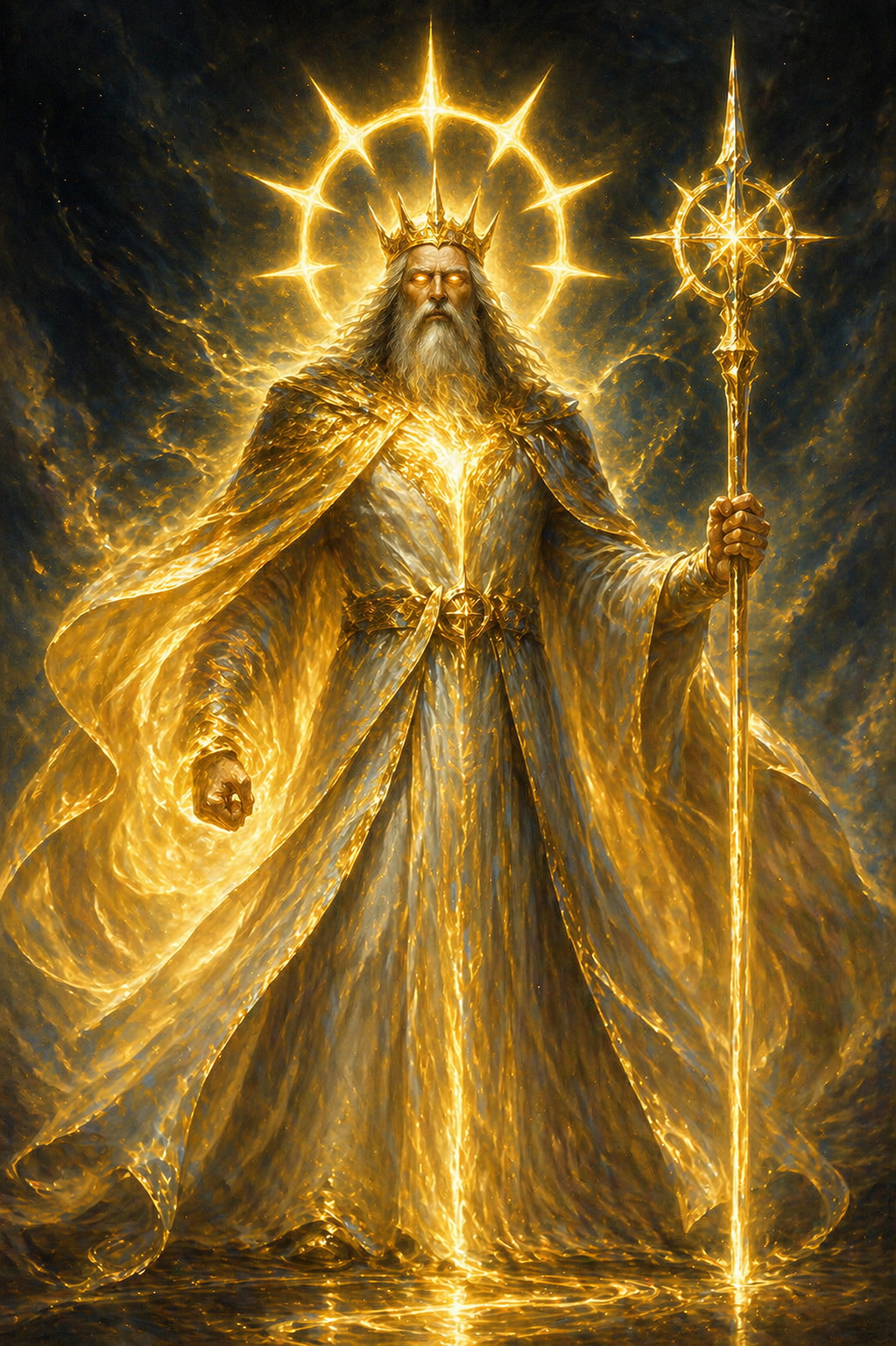
Thalor is traditionally depicted as a towering humanoid figure composed of controlled golden radiance. A crown-like halo of seven luminous spokes surrounds his head, symbolizing perfect structure and divine authority. His eyes burn with steady golden flame, and his expression is almost always portrayed as stern, impassive, or judicial.
He is clad in white-gold robes or layered mantles of radiant light, rendered in precise symmetrical form. Most depictions arm him with a geometric scepter or radiant blade representing judgment, law, and disciplined force.
His most common symbols include the seven-spoked crown, the chained sun, and the radiant scepter.
The sacred number associated with Thalor is seven. His sacred colors are white-gold, brass, and radiant yellow.
Worship
Before The Godwar, Thalor was among the most widely worshipped deities in the world and served as the central divine patron of governance, civic law, and structured society. His temples functioned not only as religious sites, but also as courts, administrative centers, archives, and civic institutions.
Following his death and the fall of the Pantheon, official worship of Thalor was outlawed throughout the Aurellian Empire and most successor states. Modern veneration survives only in fragmented forms. Certain scholars preserve his early philosophical doctrines concerning governance and civic order, while isolated loyalist cults continue to revere his later teachings of absolute authority in secret.
Though no longer worshipped openly, many modern legal and bureaucratic systems still bear unmistakable Thalorian influence.
Holy Days
Most festivals dedicated to Thalor were abolished following The Godwar.
Known historical observances include the Day of Illumination, during which civic leaders renewed their oaths of office; the Concordance March, commemorating the formation of the Divine Concord; and the First Flame Rite, a ceremonial lighting of structured flame symbolizing clarity, law, and divine judgment.
These observances survive today only in academic records and historical reenactment.
History
First of the Pantheon
Myth holds that Thalor was the first god to emerge from the First Light, taking form before all others as the Bright King. He is credited in both divine scripture and secular scholarship as the primary architect of language, written law, structured governance, and the earliest systems of organized civilization. Alongside the other founding gods of the Pantheon, he helped shape the mortal world during the earliest eras of recorded history.
It was under Thalor’s guidance that the Pantheon established the first frameworks through which gods and mortals would coexist.
The Divine Concord
At the end of the First Age, Thalor forged the Divine Concord, the foundational covenant that formalized the role of the Pantheon in mortal affairs and codified the principles of divine governance.
Under this system, the gods did not remain distant abstractions. They ruled directly through avatars, visions, priesthoods, and appointed mortal intermediaries.
For centuries, this arrangement brought relative stability and accelerated the rise of civilization across much of Arkanthys. Yet over time, Thalor’s philosophy of order hardened.
Where once he sought harmony through structure, he increasingly pursued obedience through control. Dissent came to be viewed not as disorder to be corrected, but as defiance to be extinguished.
Tyranny and Rebellion
By the late Third Age, divine rule had become increasingly oppressive across the world. Political boundaries were redrawn by divine decree. Mortal rulers served at the pleasure of the Pantheon. Entire populations were punished for rebellion, dissent, or ideological deviation.
Though all gods participated in this system, Thalor’s doctrine remained its ideological foundation. As resentment grew, so too did organized resistance.
In 3A Y11134, Gabriel Aurellian initiated the uprising that would become known as The Godwar.
Death in The Godwar
Over the following decades, the Pantheon fell one by one as the rebellion shattered divine authority across the world.
Thalor was the last god to remain.
In 3A Y11157, after the breach of The Celestial Gate and the assault upon the Seat of the Pantheon, Gabriel Aurellian confronted Thalor in the final battle of The Godwar. The Pale Crown, symbol of Thalor’s sovereignty, failed to preserve him once its power was turned against its creator.
Gabriel slew the Bright King, ending the age of divine rule and shattering the Pantheon forever.
Legacy
Thalor’s legacy is among the most divisive of all divine figures. To some historians, he was the architect of civilization and the necessary force that lifted mortals from chaos into order.
To others, he was the ultimate tyrant: the god who mistook obedience for peace and domination for harmony. Regardless of judgment, few deny his impact.
The laws of kingdoms, the structure of empires, the shape of bureaucracy, and the memory of divine tyranny all bear his mark. Even in death, the Bright King’s order continues to shape the world.

Comments