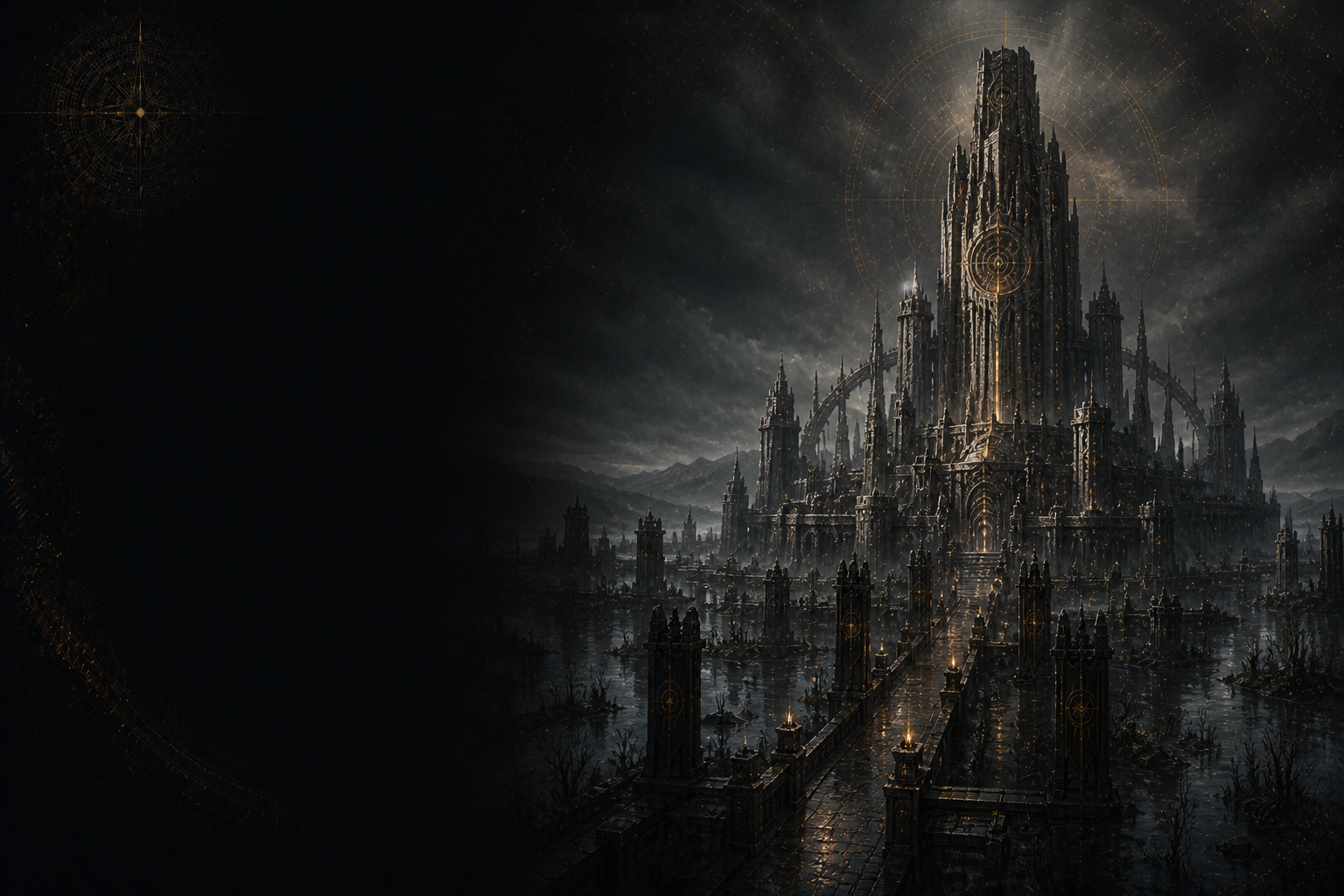
Altarra Tower
Altarra Tower is the foremost arcane institution of the Aurellian Empire and the greatest center of magical study, containment, and preservation in Arkanthys. Raised in the far northwest of Targon City, deep within the misted expanse of the Merrenberre Swamp, it stands apart from the imperial heart by deliberate design. It is an academy, an archive, and a containment stronghold in one. Mages come there to study, to refine control, to serve, and in many cases to learn the limits beyond which magic becomes a threat rather than a gift.
Its place in the empire is defined by the Aurellian stance toward magic itself. Magic is respected, but also regulated. It is not treated as something to be freely pursued without oversight, nor as a thing to be feared and destroyed wherever it appears. Altarra Tower exists because the empire accepts both truths at once: magic is necessary, and magic is dangerous. The Tower was built to give the arcane a place where it could be centralized, tested, recorded, disciplined, and, when necessary, sealed away from the wider world.
For that reason Altarra is not a place of comfort or freedom in the romantic sense. It is a place of structure. Its reputation rests not on warmth, but on discipline, memory, and control. Within its walls the empire gathers what it dares not leave scattered, and the knowledge preserved there has shaped the handling of arcane power for centuries.
Founding
Altarra Tower was founded in the early Fourth Age, in the years after The Godwar had shown what unchecked arcane and divine force could do to the mortal world. During that conflict, relics, spells, and powers beyond mortal tolerance had been unleashed across the world. Entire regions were scarred, laws of nature were bent or broken, and artifacts too dangerous for ordinary handling passed through war-torn lands in the hands of desperate rulers, rebels, and zealots. When the war ended, the empire faced a problem that could not be solved by victory alone. The arcane remnants of that age still existed, and leaving them scattered would have invited later catastrophe.
The Tower was founded by Winrey Auric, Pyro Carraden, and Arabella Vittoro, the first Archmage of Altarra. Each brought something essential to its creation. Winrey gave it practical engineering brilliance and the understanding that dangerous power required systems as much as wards. Pyro Carraden gave it the deepest early scholarship in relic structure, containment, and divine residue. Arabella Vittoro gave it leadership, institutional form, and the first stable vision of what the Tower would become. Together they established not merely a school, but a state-sanctioned arcane fortress meant to preserve knowledge while preventing disaster.
It was built far from Palace Imperia for a reason that remained fundamental ever after. Dangerous arcane study and containment were to be kept away from the imperial heart. The empire would regulate magic, study it, and make use of it, but it would not gather its most volatile secrets beneath the same roof as the throne.
Location and Setting
Altarra Tower rises from the Merrenberre Swamp, a cold, mist-laden expanse in the far northwest of the Targon region, well north of Targon City. The swamp is not incidental to the Tower’s existence. It was chosen because isolation serves containment, and because the environment itself discourages intrusion. Fog, waterlogged ground, and uncertain paths do part of the work that walls and wards cannot do alone.
The Tower does not stand apart from the swamp so much as it uses it. Stone causeways, narrow crossings, controlled canals, and guarded routes shape all approach to the complex. Outsiders cannot simply wander into it, and even those with cause to travel there do so under controlled conditions. The surrounding marsh creates both physical and psychological distance between Altarra and the rest of the empire. Reaching it feels like leaving ordinary imperial space behind and entering a place governed by stricter laws.
That setting also shaped how the Tower came to be understood by the wider world. It is respected, feared, and spoken of with caution. People know it as the empire’s great house of arcane knowledge, but they also know it as the place where dangerous things are taken and not returned. Its distance helps preserve that reputation. Altarra is not a public institution in the common sense. It is restricted, watchful, and intentionally difficult to approach.
Structure and Character
Altarra Tower is both a single name and a broader complex. The central tower defines the institution, but the whole site includes the supporting structures, ringed sections, secured passages, and deep internal systems that make its work possible. Its architecture rises upward rather than sprawling widely, giving the place a vertical severity that distinguishes it from the grand openness of Palace Imperia.
The Tower’s design is dense, functional, and made to endure. Its highest and most restricted spaces contain the inner workings of arcane governance, advanced study, and sealed access points to deeper structures. The broader complex houses the life of the institution itself, from sanctioned study to controlled testing and the maintenance of magical discipline. Though it is one of the greatest magical centers in the world, beauty is not its defining value. Order is.
Its halls are cold, methodical, and closely watched. The atmosphere of Altarra reflects the philosophy on which it was founded. Magic is not approached there as spectacle or personal freedom. It is studied as force, system, danger, and responsibility. This gives the Tower a reputation for severity even among those who respect it most. It is not cruel for the sake of cruelty, but it is patient in a way that many find unsettling. Everything there exists to ensure that power remains under control.
Purpose and Role in the Empire
Altarra Tower serves three central functions within the empire. It is the greatest magical academy in Arkanthys, the most complete arcane archive in the known world, and the foremost containment structure for dangerous magical objects and relics. Those three roles are inseparable. Students are trained in the same institution that preserves forbidden knowledge. Scholars work in the same place where unstable artifacts are sealed beneath layers of protection. Knowledge and containment exist side by side because the empire considers them impossible to separate safely.
As an academy, Altarra trains gifted mages under strict regulation. Only gifted mages and nobles are permitted to study there, and entry is not given freely. Every prospective student must undergo the Invitation Trial, the formal examination by which the Tower determines whether an individual is fit to enter. The Trial measures the strength of a person’s magic, the degree of control they possess over it, the danger they may represent, and their intelligence and arcane knowledge. Power alone is not enough. A mage who cannot be trusted to remain stable is as much a threat as an asset.
As an archive, Altarra preserves the greatest concentration of recorded magical knowledge in the empire and likely in all Arkanthys. Its work is not merely to collect books, but to gather, verify, order, and preserve the arcane memory of the world. Lost languages, relic studies, containment protocols, ritual systems, and records tied to magical phenomena all pass through Altarra’s care. It remembers what the wider world would lose, and in doing so it acts as one of the empire’s deepest reservoirs of knowledge.
As a containment structure, the Tower serves the empire’s most severe arcane function. When dangerous magical artifacts arise, the imperial response is confiscation and confinement. Such objects are not left in private hands. They are taken, secured, and, where possible, studied under controlled conditions. This task falls in large part to the agents and custodians of Altarra, especially the Red Robes, who act as both mage-guardians and keepers of the Tower’s secrets.
Altarra Tower also maintains the most complete registry of mages and magic-users in the known world. Through devices known as the Arcana Matrix, built by Winrey Auric himself, the Tower tracks fluctuations in magic tied to a person’s connection to the Roil. From the earliest signs of magical awakening, those disturbances are recorded, identified, and preserved within Altarra’s archives.
Governance
The Tower is directly under imperial sovereignty, but it does not function as a routine branch of palace administration. It maintains operational autonomy in arcane governance and containment matters, an arrangement preserved because the work done there requires specialist rule rather than interference from ordinary political offices. The emperor may claim it, but the Tower governs its own dangerous knowledge through internal authority and established protocol.
Its present ruler is Luceran Voln Halor, the fourth Archmage of Altarra Tower. Halor was elected by unanimous vote of the Seat of Five after the death of Archmage Valerius Thane Ormont, marking the first unanimous elevation in the Tower’s recorded history. His rule is associated with procedural discipline, administrative reform, and a tightening of control over high-risk research.
The Seat of Five serves as the ruling council of Altarra Tower. It provides the senior governing structure beneath and beside the Archmage, shaping the internal direction of the institution and preserving continuity when succession or crisis demands it. Under Halor, the balance of the Tower has shifted firmly toward stability, layered safeguards, and close regulation rather than experimentation for its own sake.
This balance matters in the present age. Altarra is not meant to become an extension of imperial military ambition, and Halor in particular has maintained that line carefully. His diplomacy with imperial authorities remains functional, but he does not permit outside oversight over the deepest vault operations of the Tower. In this, he continues the long-standing belief that dangerous arcane containment must remain in the hands of those equipped to understand it.
The Invitation Trial
Entry into Altarra Tower begins with the Invitation Trial, the formal process by which the institution determines who may be admitted into its ranks. The Trial is not a simple examination of brilliance, nor a contest rewarding only the strongest display of arcane force. It exists to answer a harder question: whether a given person can be trusted with the kind of knowledge Altarra preserves.
Those who undergo the Trial are measured on several fronts. The Tower examines the strength of their magic, the degree of control they possess over it, the level of danger they might represent if allowed to advance further, and their actual intelligence and command of arcane understanding. A powerful but unstable mage is a liability. A knowledgeable but undisciplined one is scarcely better. Altarra does not seek raw power in isolation. It seeks individuals whom power will not easily break or corrupt.
Because of this, admission to Altarra has always been selective and severe. To enter the Tower is not merely to win a place at a prestigious academy. It is to be judged fit for proximity to the most closely regulated magical knowledge in the empire.
The Red Robes
Among the most visible servants of Altarra are the Red Robes, the Tower’s mage-custodians and protective arm. They serve as guardians, enforcers, retrieval agents, and keepers of internal security. Their duty is not merely to defend the Tower from intrusion, but to defend the wider world from what the Tower contains.
The Red Robes play a central role in the empire’s policy toward dangerous magical items. When powerful artifacts emerge, especially those judged unstable, forbidden, or beyond lawful private possession, it is often the Red Robes who move to confiscate them and bring them back under Altarra’s control. In that sense they are more than soldiers. They are custodians of arcane quarantine.
Within the Tower they also act as wardens of restricted knowledge, silent protectors of archives, escorts for dangerous transfers, and guardians of the sealed depths below. Their reputation is stern and often unsettling. To most people, the arrival of the Red Robes means that something has been judged too dangerous to remain where it was found.
Pyro’s Vault
Beneath Altarra Tower lies Pyro’s Vault, the deepest and most feared containment structure in the empire. It is named for Pyro Carraden, who played a foundational role in designing the Tower’s containment systems and ultimately gave his life in the effort to seal the earliest and most dangerous relics recovered from the era of The Godwar and the rebellion. The Vault stands as both a monument to his sacrifice and a continuation of his work.
Public knowledge of the Vault is limited. People know that Altarra holds a vault beneath its depths, but almost no one outside the Tower understands what lies within it. That ignorance is intentional. The empire does not advertise the full nature of the things it keeps there.
Pyro’s Vault serves as a prison for magical items and relics too dangerous for destruction, too unstable for open study, or too catastrophic to remain in circulation. Divine remnants, cursed artifacts, forbidden grimoires, magical weapons, unstable arcane materials, and dangerous constructs may all be confined there. In a world where magic items are extremely rare, the existence of such a place carries immense weight. The empire does not merely collect curiosities beneath Altarra. It buries threats.
The Vault is the reason Altarra can never be understood as only a school or archive. Its deepest purpose is containment. Everything else in the Tower exists in some relation to that truth.
Altarra in 4A 502
In the present year, Altarra Tower remains stable, highly restricted, and more tightly controlled than at many earlier points in its history. Under Luceran Voln Halor, its administration favors reinforced safeguards, layered approvals, and preventative containment over looser scholarly freedom. High-risk arcane work is watched carefully, and access to the deepest sectors remains tightly limited.
The wider political uncertainty of the empire has not removed Altarra from importance. If anything, the vacancy of the throne has made controlled institutions even more essential. While Palace Imperia waits upon the return of the Cinderbrand, Altarra continues its work without spectacle. Dangerous artifacts are still seized. Knowledge is still recorded. Students are still judged. The Tower remains what it was built to be: a place where the arcane is not allowed to rule itself.
Its danger does not come from disorder within its walls. Altarra itself is not known as a place of constant magical collapse or uncontrolled disaster. Its danger lies in what it contains. The world trusts the Tower precisely because it keeps those dangers under restraint. As long as that remains true, Altarra Tower will continue to stand as one of the most necessary and least comforting institutions of the Fourth Age.
Legacy
Altarra Tower endures as the empire’s answer to the problem of magic after divine war. It represents the Aurellian belief that power must be studied without being worshipped, respected without being romanticized, and controlled without being abandoned to fear. In its academy, archive, and vault, that philosophy takes physical form.
No other place in Arkanthys gathers so much dangerous knowledge under one authority. No other institution so fully joins education, preservation, and containment in one structure. Altarra remembers what the world would rather lose, keeps what the world cannot be trusted to hold, and trains those few it judges capable of walking safely near such things.
Its authority rests not only in what it teaches or seals away, but also in what it records. Through the Arcana Matrix and its vast registries, Altarra keeps watch over the emergence of magic itself, ensuring that few arcane lives begin unnoticed.
For that reason it is one of the pillars of the empire, even from a distance. Far from Targon City and far from the marble center of Palace Imperia, Altarra Tower still serves the same larger purpose: it preserves the order of a world that has already seen what unbound power can do.

Comments