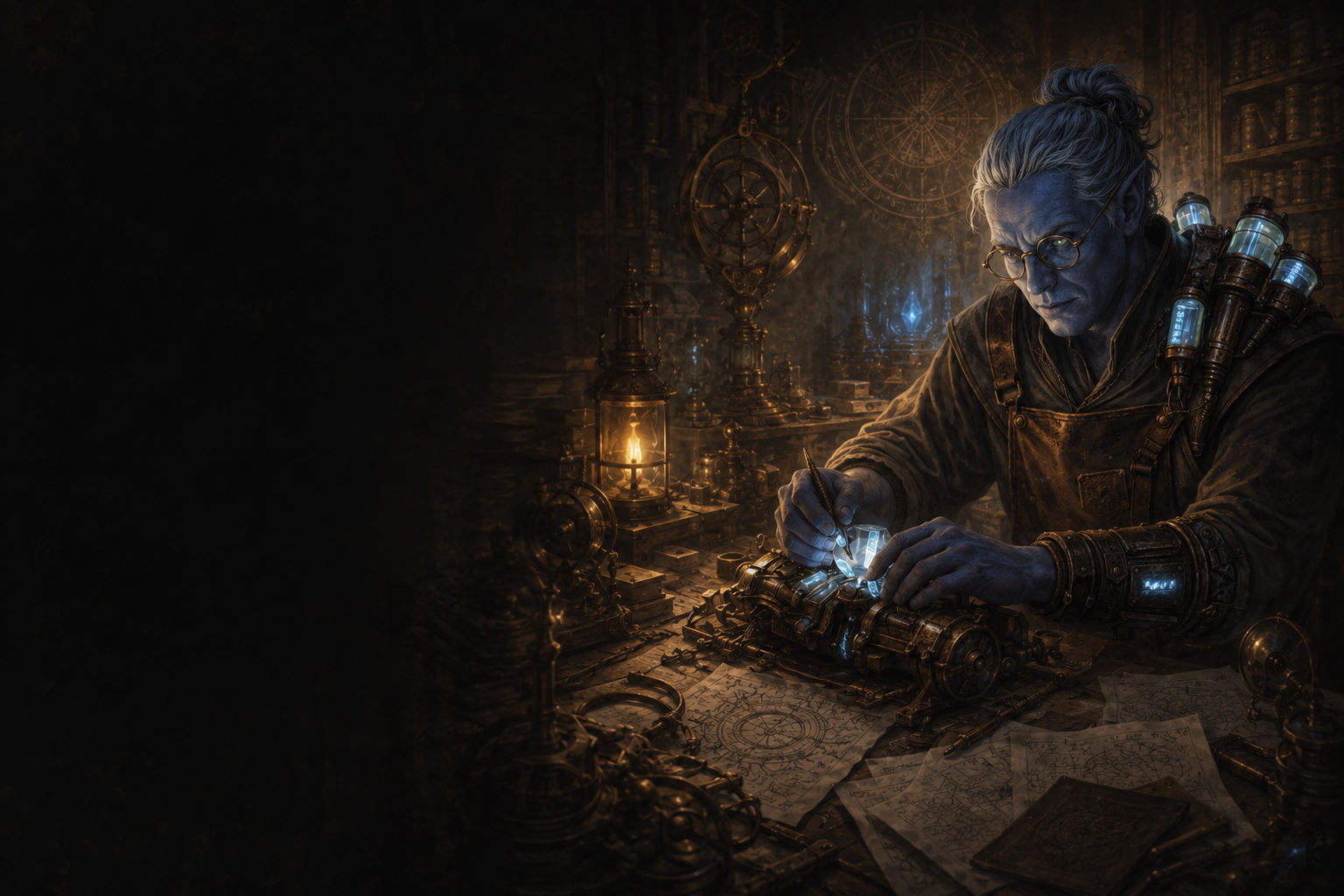
Winrey Auric
Winrey Auric was a Vedalken inventor, engineer, and arcane theoretician whose work shaped both the Aurellian Rebellion and the early imperial order that followed. He stands as one of the central figures of the late Third Age, responsible for many of the technological and arcane systems that allowed mortals to challenge divine authority.
Born into a noble house in Ostagar, Winrey rejected political life in favor of study and creation. His partnership with Gabriel Aurellian defined the direction of the rebellion, combining invention with purpose. He survived The Godwar, served as the Empire’s first Principes Arcanum Ars Ingeniaria, and died two years after Gabriel, leaving behind a body of work that continued to influence the world long after his death.
Early Life
Winrey Auric was born into a noble Vedalken family in Ostagar. From an early age he demonstrated exceptional intellectual ability, particularly in arcane theory and mechanical design.
He was capable of reconstructing complex diagrams from memory and building functional mechanisms from limited materials. Despite this, he struggled socially and showed little interest in noble expectations or political life. He entered the Scriptorium, where he met Gabriel Aurellian. Their differences in origin and temperament did not prevent a close working relationship. Their collaboration would later become central to the rebellion.
Rhea Auric
Rhea Auric, Winrey’s wife, was an inventor who shared his interest in mechanical and arcane innovation. Together they pursued work that existed outside the restrictions imposed by the Pantheon. Such work was forbidden.
Rhea was arrested by the Unbound and publicly executed as a warning against unsanctioned invention. Winrey witnessed her death. This event marked a decisive shift in his life. His work, previously driven by curiosity, became directed toward a specific purpose.
The Rebellion
Winrey joined Gabriel without hesitation once he became a target of Oculus. He developed early arcane countermeasures that allowed the rebels to avoid divine detection, including concealment glyphs and disruption systems designed to interfere with divine magic. These innovations became essential to the survival of the rebellion.
He also constructed various tools, machines, and defensive systems used throughout the conflict. His work allowed the rebels to operate outside the constraints that had previously made resistance impossible. Over time, his approach shifted from reactive invention to structured design. His work became more controlled, more deliberate, and more focused on long-term outcomes.
After The Godwar
Following the end of The Godwar and the establishment of the Aurellian Empire, Winrey was appointed Principes Arcanum Ars Ingeniaria. In this role, he oversaw the integration of arcane and mechanical systems across the empire. His work included contributions to the construction of Palace Imperia, the restoration of the Scriptorium, the development of large-scale engineering systems, and the early study and containment of divine relics.
He was also one of the founding figures behind Altarra Tower, contributing to its design as a controlled environment for arcane study and containment.
Final Years
Winrey lived two years longer than Gabriel. His later life was quieter, though he remained active in his work. He continued teaching and developing new projects, often working in isolation.
He died in his workshop, surrounded by unfinished designs. His death was not marked by ceremony in the moment, but his legacy ensured his place among the central figures of the age.
He was later interred in the Imperial Necropolis.
Legacy
Winrey Auric is remembered as one of the primary architects of the world that emerged after the fall of the Pantheon. Where Gabriel is associated with leadership and transformation, Winrey is associated with construction and continuity. His work provided the systems that allowed the empire to function beyond the end of the war.
His influence persists through the institutions, structures, and methods that remain in use long after his lifetime.

Comments