
Drax
Drax was the only member of the original Pantheon who was not born divine. Once a mortal warrior of the First Age, he ascended to godhood through unknown means and became the god of mortal will, rebellion, change, and self-determination. Known as the Mortal God, Drax embodied the belief that destiny was not fixed and that even divine authority could be challenged through strength, defiance, and will.
His existence alone stood in philosophical opposition to the rest of the Pantheon. Where the other gods represented cosmic order, inherited divinity, or primordial authority, Drax represented ascent from below.
He was the first god slain during The Godwar. His death proved that divinity could be broken and transformed Gabriel Aurellian’s rebellion into a world-shaking revolution.
Appearance and Symbolism
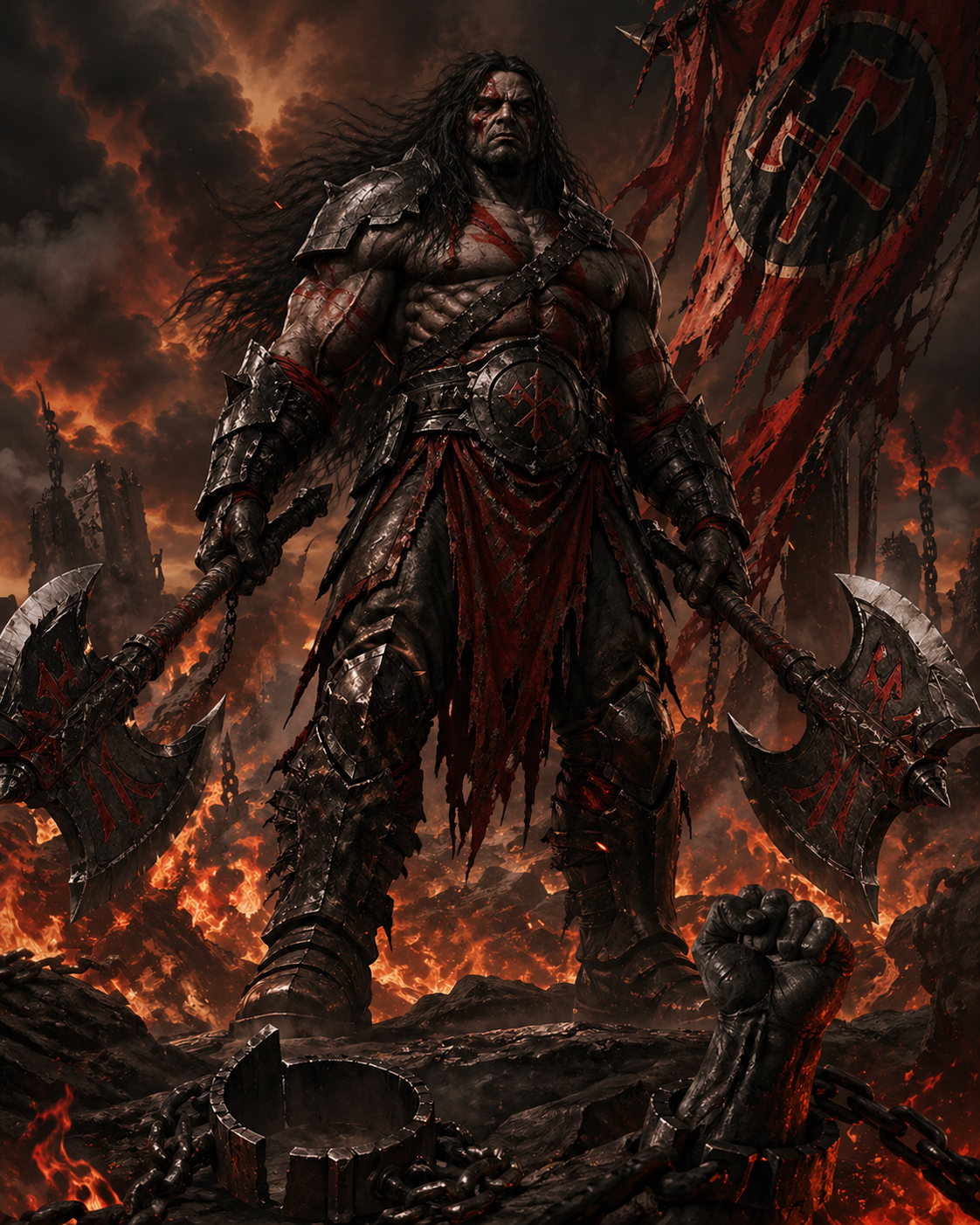
Drax is traditionally depicted as a towering, broad-shouldered warrior clad in battered warplate, his body scarred and his armor dented from countless battles. Unlike the radiant or idealized forms of the other gods, Drax is portrayed with weathered features and the hardened bearing of a veteran soldier.
He is most commonly shown wielding two massive battle-axes, symbolizing strength seized rather than inherited. Artistic depictions place him amid fire, smoke, broken chains, or battlefield ruin, emphasizing upheaval and liberation through conflict.
His principal symbols include the crossed axes, the broken shackle, the rising flame, and the clenched fist.
His sacred colors are iron gray, deep red, and ember-orange.
Worship
Worship of Drax centered on freedom, resilience, self-determination, and resistance to tyranny. His followers believed mortals possessed the right and strength to shape their own fate regardless of divine decree.
His temples were fewer than those of the other gods and often functioned less as formal places of worship and more as communal halls, training grounds, or ideological gathering points. His clergy, known as the Unbound, taught that strength of will outweighed destiny, bloodline, and divine favor. Their rites emphasized endurance, oath-binding, liberation from oppression, and proving one’s worth through struggle.
Following his death, worship of Drax was heavily suppressed in Pantheon-loyal territories, though his ideology spread further in death than it ever had in life.
His influence survives in revolutionary doctrine, anti-authoritarian philosophy, and cultures that prize personal freedom above hierarchy.
Holy Days
The principal holy day of Drax was the Day of Defiance, commemorating his ascension from mortal to divine. It was marked by feats of strength, oath-taking, and public declarations of personal ambition or liberation. Another major observance was the Ember Trials, in which followers tested their endurance through fasting, combat, or ordeal.
Though formal worship has faded, many cultures still preserve echoes of these rites in secularized festivals of strength and independence.
History
Mortal Ascension
Drax began life as a mortal during the First Age. Though details of his early life are obscured by myth, all surviving traditions agree that he was born in hardship and rose through warfare, endurance, and repeated defiance of impossible odds.
In 2A Y805, Drax ascended to godhood, becoming the first and only mortal to enter the ranks of the Pantheon. His ascension shattered the belief that divinity was immutable and proved that the gods were not wholly separate from those they ruled.
From that day forward, he was known as the Mortal God.
Within the Pantheon
Though accepted into the Pantheon, Drax remained ideologically distinct from his divine peers. He championed free will, personal strength, and the right of mortals to determine their own path. These beliefs frequently placed him at philosophical odds with Thalor’s doctrine of structured order and Kassira’s doctrine of disciplined justice.
Though these tensions never escalated into divine schism, Drax’s presence served as a constant reminder that even within the Pantheon, the divine order was not ideologically unified.
Patron of Rebellion
As divine rule grew increasingly oppressive during the late Third Age, Drax’s teachings gained popularity among subject peoples, rebels, and oppressed populations across Arkanthys.
Though Drax himself never openly rebelled against the Pantheon, his doctrine inspired countless uprisings and ideological movements hostile to divine control. This placed him in an increasingly precarious position within the divine hierarchy.
Death in The Godwar
Drax became the first god to fall during Gabriel Aurellian’s rebellion. In 3A Y11141, Gabriel confronted him at Chieftain’s Grove, where the two fought for three days.
At dawn on the third day, Gabriel slew the Mortal God. His death shattered the illusion of divine invulnerability.
What had begun as rebellion became revolution. Across the world, mortals who had once feared the gods now understood they could be killed.
No event did more to accelerate The Godwar.
Legacy
Drax’s legacy endures as one of the most influential in all divine history. To his followers, he remains the ultimate symbol of mortal potential, the proof that even the divine may be challenged, surpassed, and overthrown.
To the old loyalists of the Pantheon, he was the original contradiction: a mortal who should never have been allowed to rise. Regardless of perspective, all agree on one truth:
Drax changed the meaning of godhood forever.

Comments