Kassira
Kassira was one of the original deities of Arkanthys and the former goddess of justice, righteous punishment, and cleansing flame. Within the Pantheon, she served as the divine executor of law, the force by which judgment became consequence and transgression met retribution.
Where Thalor established order, Kassira enforced it. She was feared across the mortal world for her severity, yet was not regarded as cruel. Her doctrine centered on discipline, proportionality, and the belief that purification often required suffering.
Kassira remained loyal to the Pantheon throughout its reign and never wavered in her support of divine authority. She was slain early in The Godwar when her own priesthood turned against her, becoming the first major divine casualty of the rebellion.
She has not reformed since.
Appearance and Symbolism
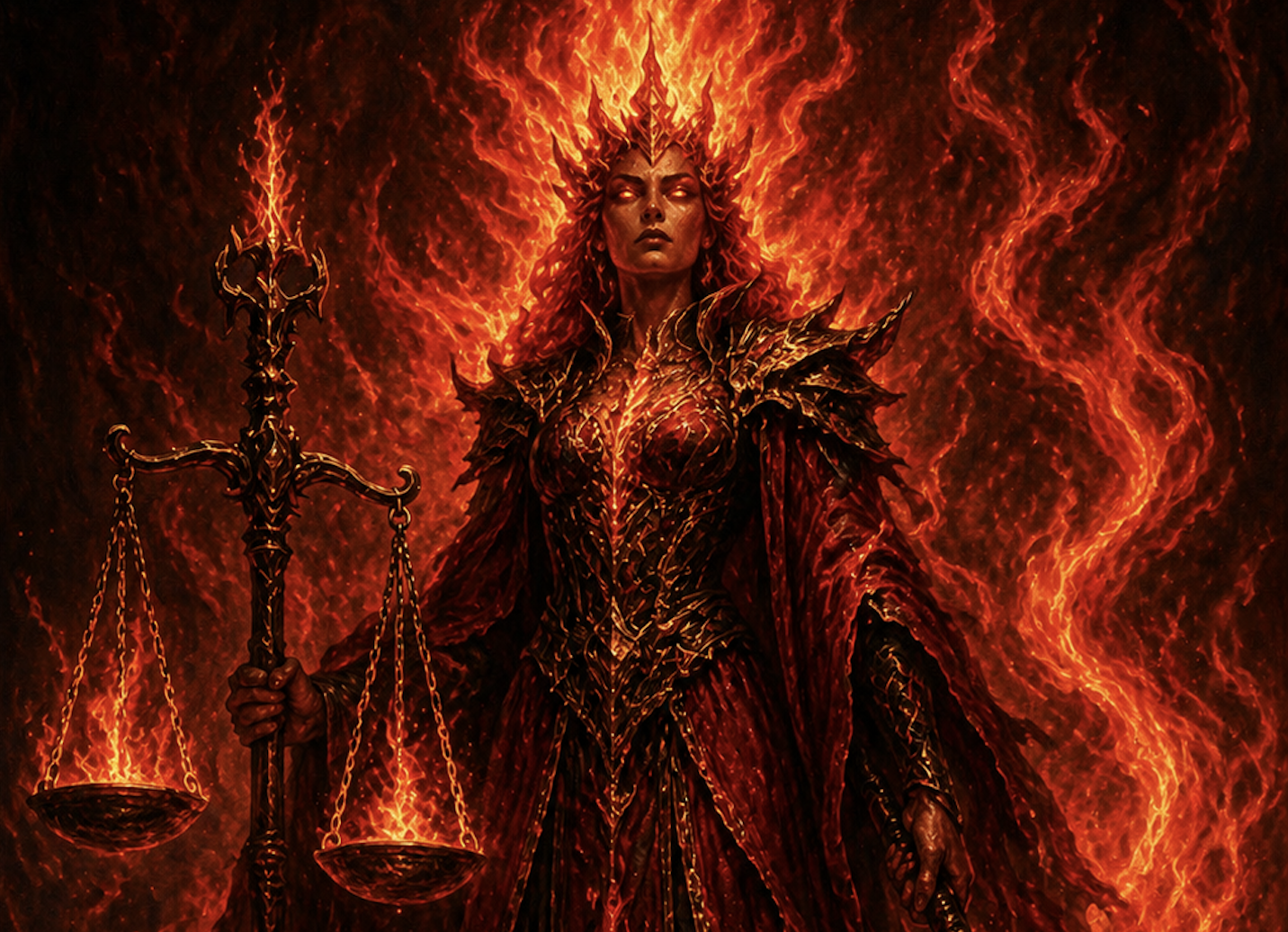
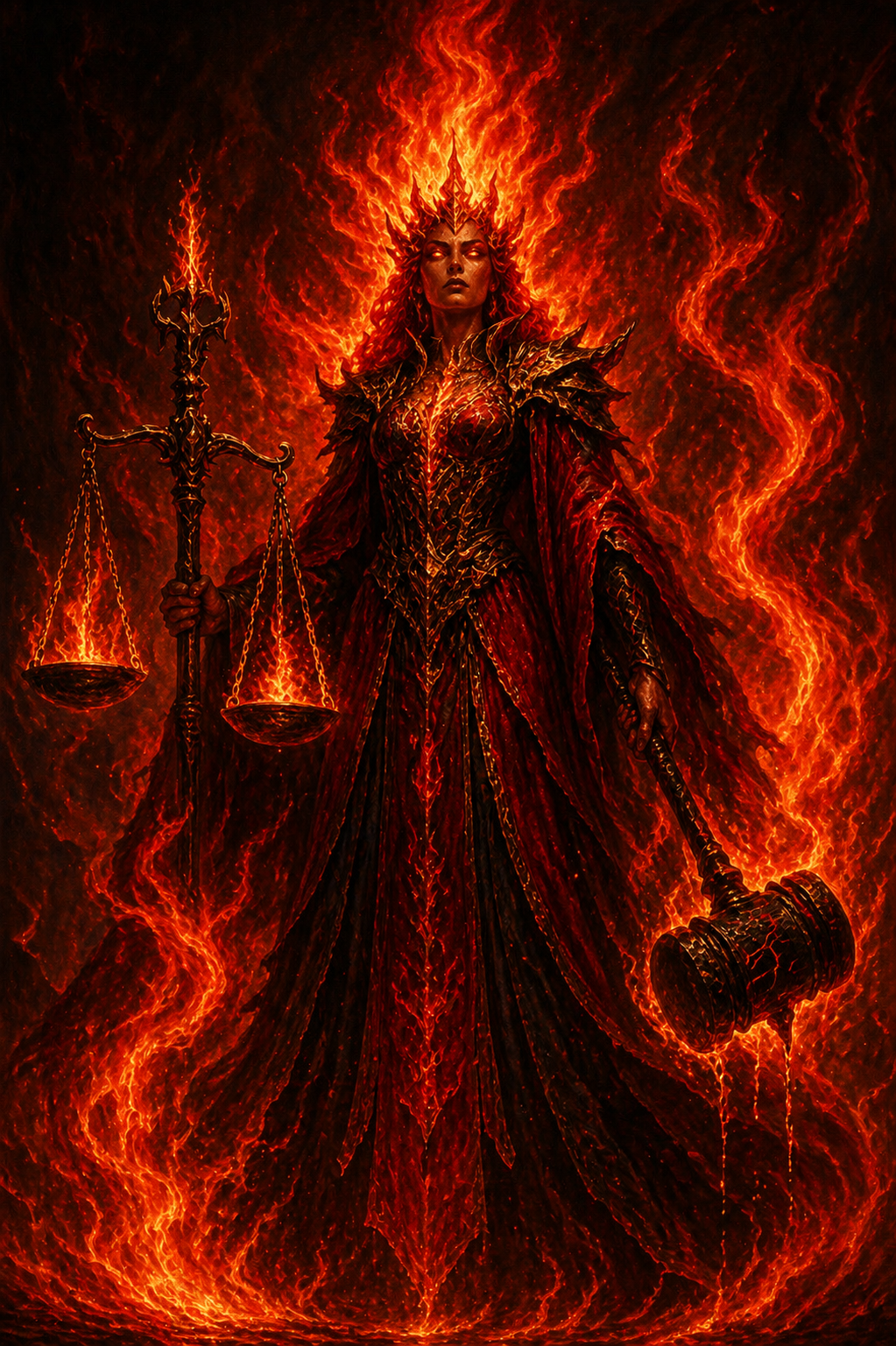
Kassira is traditionally depicted as a tall feminine figure wreathed in living flame, her body partially obscured by fire and heat distortion. Her hair is rendered as an upward-burning crown of crimson flame, and her eyes as smoldering embers devoid of softness or pity.
She is most commonly portrayed wearing layered crimson and black robes or segmented ceremonial armor, often blending into the flames around her. Artistic depictions frequently place burning scales or a fire-wreathed gavel in her hands, symbolizing judgment weighed and punishment delivered.
Her principal symbols include the burning scales, the crimson tear, the upward flame, and the blackened gavel. Her sacred colors are crimson, iron-black, and deep gold.
Worship
Before The Godwar, Kassira was widely worshipped by judges, magistrates, military officers, executioners, and those tasked with administering punishment in the name of law. Her temples functioned as tribunals, sanctified courts, and sites of oath-binding. Her priesthood served as arbiters, magistrates, and legal authorities in many divine-aligned states.
Following her death, formal worship collapsed rapidly. Modern reverence survives only in fragmented traditions, philosophical schools of justice, and isolated local customs emphasizing accountability, discipline, and measured punishment.
Open worship of Kassira is rare and often politically suspect.
Holy Days
Kassira’s holy calendar centered on ritual judgment, communal accountability, and moral reflection. The most significant observance was the Day of Redress, during which disputes were settled, punishments issued, and debts formally reconciled beneath sacred flame.
The Ember Vigil was a night-long rite of silent contemplation during which worshippers reflected on past failures and unresolved guilt. These rites survive only in scattered historical record and localized remnants of older legal traditions.
History
Divine Enforcer
Kassira emerged in the early First Age as the divine embodiment of punishment, correction, and righteous consequence. As mortal civilization developed under the Pantheon’s guidance, Kassira assumed responsibility for enforcing divine decrees, punishing transgression, and preserving balance through retribution.
She acted as the principal executor of the divine order established by Thalor and became one of the Pantheon’s most feared enforcers.
Instrument of the Concord
Throughout the Divine Concord, Kassira served as the force by which divine law was made absolute. She oversaw the punishment of rebellious provinces, sanctioned military purges, and carried out divine judgment against cities and rulers deemed in violation of sacred order.
As divine rule grew harsher in the late Third Age, Kassira’s punishments became increasingly catastrophic. Her most infamous act was the Year of Ash Rains, during which her judgment blackened the skies over Aranna and buried entire regions beneath burning cinders for nearly a year.
Though feared, Kassira never abandoned her principles. She believed fully in the justice of the system she upheld.
Betrayal and Death
Kassira was the first major god to fall during The Godwar. Unlike the other gods, she was not slain in open battle by Gabriel Aurellian or his armies.
Instead, she was betrayed by her own priesthood. As rebellion spread and faith in the Pantheon fractured, divisions emerged within Kassira’s clergy. Many among her faithful came to believe the divine order they had enforced was no longer just.
In an act remembered as one of the greatest betrayals in religious history, her priesthood turned upon her during a gathering at her greatest temple and brought the structure down into the sea. Kassira perished beneath the collapsing sanctum and drowning flame.
Her death marked the first irreversible fracture in the Pantheon’s unity and proved that the gods could fall not only to armies, but to faith itself.
Legacy
Kassira’s legacy remains deeply contested. To some, she was the purest expression of justice in divine form: severe, unyielding, but necessary.
To others, she became the embodiment of lawful tyranny. The proof that justice without mercy becomes indistinguishable from cruelty.
Her fall remains one of the defining symbolic moments of The Godwar. The goddess of punishment was not slain by her enemies.
She was judged by her own.

Comments