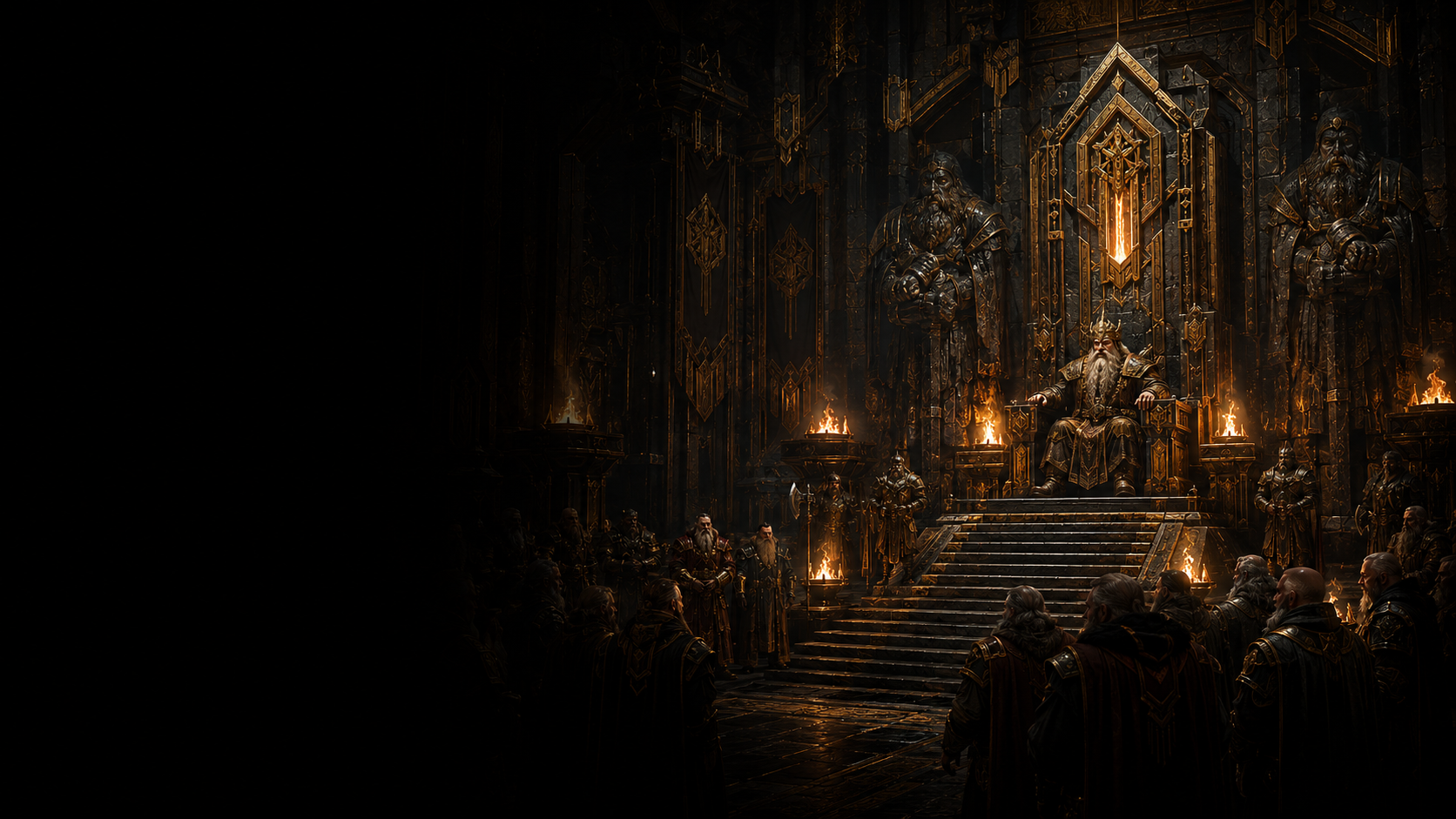
High King of Khazural
The High King of Khazural is the supreme sovereign of the dwarven realm and the highest political, military, and executive authority within the mountain kingdom. The office stands above all Forgehouses, military commands, and civic institutions, serving as the ultimate source of royal decree and final arbiter of state authority.
Though the Five Great Forgehouses wield immense influence throughout Khazural, none stand above the High King. His word carries the full force of crown, army, and throne, and no lawful authority within the kingdom may supersede his command.
The seat of the High King is the Ember Throne, from which the ruler governs the realm and embodies the unity of Khazural.
Authority and Powers
The High King holds absolute executive authority over Khazural. He commands the full military apparatus of the kingdom, directs foreign and domestic policy, issues royal decrees, appoints or removes officials, controls the royal treasury through the Embermint, and may overrule any institution or noble authority within the realm.
In theory, the High King’s will is law.
In practice, effective rule requires cooperation with the Five Great Forgehouses, whose institutions form the foundation of Khazural’s governance, economy, military, and infrastructure.
A wise High King rules above the houses. A foolish one rules against them.
Relationship with the Forgehouses
Though subordinate to the throne, the Five Great Forgehouses remain indispensable to the functioning of the kingdom. Each controls vital sectors of Khazural’s state machinery, and while the High King possesses authority to command them, stable governance depends upon maintaining their cooperation. Open defiance of the crown is rare, but not unheard of.
When Forgehouses have overstepped their bounds, the throne has historically responded with decisive force.
The most notable example occurred following the Valiran conquest of Khazural, when House Thaldrazan attempted to claim sole ownership over relics recovered during the postwar period and sought to assert private control over the Bulwark. In response, High King Baelgrim Drakk II seized the Ashvaults by royal decree, stripped them from Thaldrazan ownership, and placed them directly under the authority of the Ember Throne.
The lesson remains well remembered. The Forgehouses are powerful. The throne is stronger.
Succession
Succession to the Ember Throne follows absolute primogeniture. Upon the death or abdication of a reigning High King, the throne passes to the eldest legitimate child regardless of gender. This hereditary line continues uninterrupted so long as a valid royal heir remains.
If the royal line fails, is extinguished, or the Ember Throne is left unclaimed, only the Five Great Forgehouses possess the right to contest succession.
Such moments are regarded as periods of extreme political danger and have historically threatened to fracture Khazural itself.
The Ember Throne
The Ember Throne is the sacred seat of Khazural’s monarchy and one of the oldest surviving relics of the First Hallings.
Forged by Harrek the Forgefather, first High King of the Khazal, the throne has served as the seat of every High King since the founding of the kingdom. More than a symbol of office, it is regarded as the physical embodiment of dwarven sovereignty and the unity of the mountain realm.
Origins of the Office
The office of High King was established during the First Hallings by Harrek the Forgefather, the unifier of the early Khazal clans and founder of centralized dwarven rule.
Before his reign, the dwarves existed as fragmented clans and proto-holds scattered throughout the mountain ranges. Harrek united them beneath one banner through conquest, diplomacy, and foundational statecraft, establishing the monarchy and the first great structures of organized Khazural governance.
To this day, he remains the single most revered figure in Khazal history. His name is invoked in war cries, oaths, and royal ceremony alike.
Limitations and Reality of Rule
Though the High King’s authority is absolute by law, his power is not limitless in practice.
The Five Great Forgehouses remain essential to the operation of the kingdom, and even the strongest monarch must balance command with political acumen. A High King who alienates all five risks paralyzing the machinery of state, even if outright rebellion remains unlikely.
Thus, the greatest kings are remembered not merely for strength, but for mastery over both throne and house alike.
Cultural Standing
Among the Khazal, the High King is the most revered mortal in all of Khazural. He is regarded not merely as ruler, but as the living continuation of the Forgefather’s line and the supreme steward of dwarven civilization. Even the most ambitious Forgehouses, despite their private scheming, outwardly honor the throne and the one who occupies it.
It is common for Khazural soldiers to enter battle under the cry:
“For the Forgefather!”
A phrase invoking both Harrek himself and the enduring authority of the throne he created.

Comments