Forgehouses of Khazural
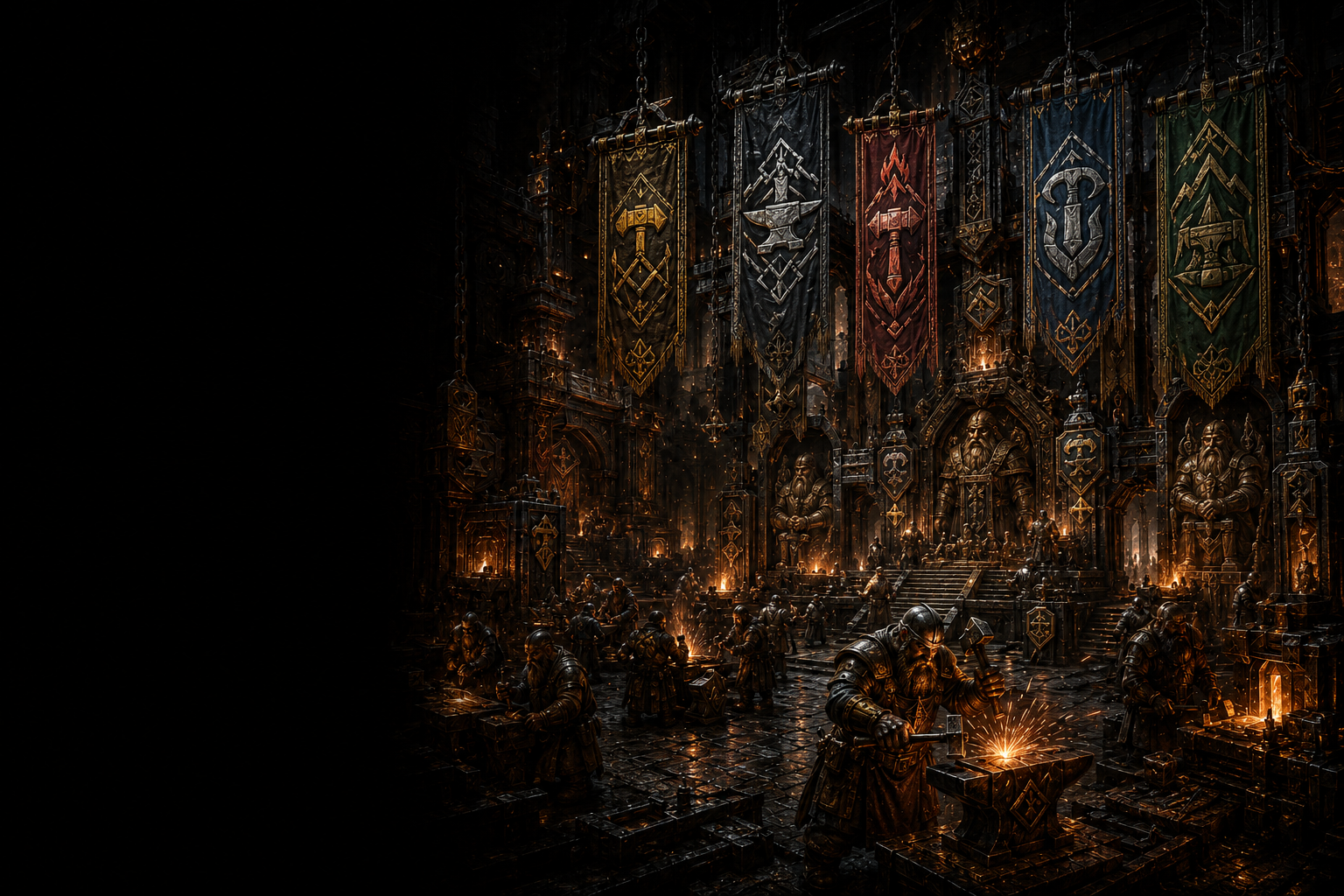
The Forgehouses are the five great dynastic institutions that form the social, political, and economic foundation of Khazural. More than noble houses in the conventional sense, each Forgehouse is a hereditary power bloc, industrial authority, and cultural institution bound to one of the Five Echoes, the foundational metaphysical principles of dwarven cosmology. Together, they shape every major aspect of Khazal civilization, from governance and law to architecture, memory, warfare, and ritual.
All Khazal ultimately live under the influence of one of the Five Forgehouses, whether by blood, employment, patronage, or sworn service. To belong to a Forgehouse is to possess identity, purpose, and standing within dwarven society. To belong to none is to stand outside civilization itself.
Origins
The Five Forgehouses trace their origins to the First Hallings, the earliest foundational period of Khazural civilization. According to dwarven tradition, each house emerged in alignment with one of the Five Echoes, embodying a distinct truth believed to resonate through The Deep Rhythm and structure existence itself. No new Forgehouse has been recognized since that era.
Within Khazal doctrine, the creation of a new Forgehouse would require the revelation of a new Echo and the establishment of a new Seat of Rule, an event considered impossible by most dwarven scholars and priests.
Role in Society
The Forgehouses dominate every level of Khazal civilization. They control industry, infrastructure, law, military command, relic stewardship, ancestral recordkeeping, and the majority of organized labor throughout Khazural. Though their power is centralized in Baraz-Kronn, their influence extends into every hold, fortress, and settlement of the mountain realm.
Each Forgehouse maintains its own internal hierarchy, retainers, sworn workers, and subordinate administrators, functioning as both noble dynasty and state institution.
Membership and Advancement
Membership within a Forgehouse is hereditary for those born to recognized house members. However, bloodline alone does not define the houses. Khazal not born into a Forgehouse may enter service under one through labor, military distinction, craftsmanship, scholarship, or sworn loyalty. After sufficient years of proven service, such individuals may petition for full induction into the house they serve.
If accepted, they become full members of that Forgehouse, and all descendants born thereafter inherit that affiliation by birth. Competition for capable recruits is fierce, as manpower directly correlates with house strength and influence.
Those rejected by all Five Forgehouses face effective social death. Without house patronage, a Khazal has no meaningful place within organized dwarven society and is often forced into exile, starvation, or desperate descent into the Deeproots.
Political Authority
Though Khazural is ruled by a High King, the Forgehouses remain the true pillars of state power. The throne normally passes hereditarily through the reigning royal bloodline. However, if the royal line fails, is extinguished, or the Ember Crown is left unclaimed, only the Five Great Forgehouses possess the legal and cultural right to contest succession.
This ensures that sovereignty remains forever bound to the foundational powers of Khazural. The current ruling dynasty is House Zarak-Vorr, with High King Barador Gildhelm of Zarak-Vorr seated upon the throne.
The Five Great Forgehouses
Each Forgehouse embodies one of the Five Echoes and holds a corresponding Seat of Rule, granting it unique authority within the broader governance of Khazural.
House Dornbraeth — Keepers of Stone and the Echo of Shape. Masters of architecture, infrastructure, and structural design.
House Rhund-Khazal — Keepers of Gravity and the Echo of Bond. Administrators of law, oaths, contracts, and judicial authority.
House Thaldrazan — Keepers of Time and the Echo of Endurance .Custodians of relic decay, ritual timing, and trial through hardship.
House Brimgaruun — Keepers of Law and the Echo of Consequence. Arbiters of immutable truth, relic judgment, and disciplined force.
House Zarak-Vorr — Keepers of Memory and the Echo of Persistence. Preservers of lineage, ancestry, history, and legitimacy.
Cultural Importance
To the Khazal, the Forgehouses are not merely political factions but sacred expressions of the world’s deeper order. Each house is viewed as an institutional manifestation of an Echo, and therefore as an extension of The Deep Rhythm’s structure within mortal civilization.
Conflict between houses exists, often fiercely, but open war between them is nearly unthinkable. To shatter a Forgehouse would be to wound one of the pillars upon which Khazural itself stands.
Reputation
Among outsiders, the Forgehouses are often mistaken for conventional noble dynasties. Within Khazural, such a comparison is considered ignorant at best and insulting at worst.
The Forgehouses are not simply families that rule. They are the hands by which Khazural shapes itself.

Comments