Ocularis
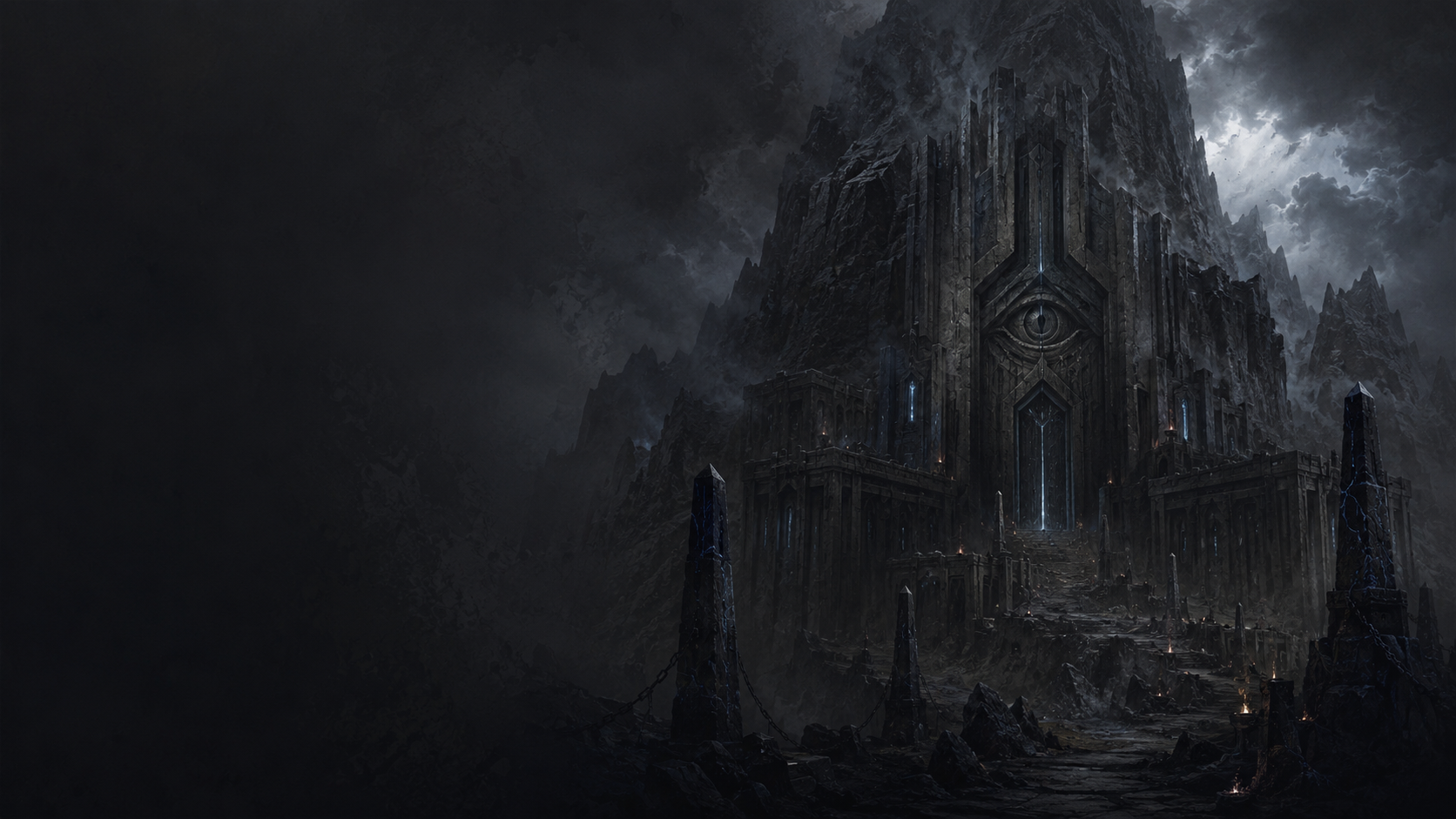
The Ocularis was the heart of Oculus: its prison, headquarters, ritual nexus, and the most feared institution of the Pantheon’s imperial machine.
Built during the Second Age upon the southern borders of Ostagar, it was originally created for a singular purpose: to imprison the First Murderer within an eternal anti-magical prison carved from meteorite stone. Over the decades that followed, the prison expanded into a sprawling fortress-complex and became the undisputed center of Oculus power.
Every aspect of the Ocularis was built around a single principle: containment. Nothing within its walls existed without purpose, and every chamber, mechanism, and ritual served to imprison, suppress, or conceal.
It was within the Ocularis that Gabriel Aurellian himself was once held.
Location and Nature
The Ocularis was carved directly into a meteorite mountain at the southern frontier of Ostagar, near the passes descending toward Caelbruck Hold and the twin bridges marking the empire’s southern border.
The mountain itself was no natural formation, but the scar of an ancient impact from before recorded history. Its stone possessed a rare and invaluable property: it extinguished magic.
No spell could pass through it. No divination could pierce it. No mage could break free from it.
For this reason, the mountain became the ideal site for an eternal prison.
To conceal the fortress, Oculus erected meteorite obelisks throughout the surrounding pass. These projected layered illusions that made the mountain appear to be ordinary rock. Travelers could pass within yards of the hidden approach without ever perceiving it.
The Ocularis was constructed from black meteorite slabs fitted with unnatural precision. Its architecture was stark, angular, and brutal, utterly unlike the marble grandeur of Ostagar. No ornament existed without purpose. Every corridor, stairwell, and chamber was engineered according to the fortress’s governing doctrine of containment.
The prison expanded both inward and outward over generations, eventually encompassing prison wings, interrogation halls, ritual chambers, arcane suppression vaults, barracks, administrative halls, and the lower Soul Vaults.
In later years, massive outer walls and courtyards were raised around the carved mountain face, transforming the prison into a true fortress.
The Living Gate
The entrance to the Ocularis was sealed by a pair of sentient wooden doors unlike any other construct in the empire.
Fashioned from living wood and bound through forgotten rites, the doors recognized members of Oculus and opened only to those sworn to the agency.
Their surface shifted constantly. Faces emerged and vanished beneath the bark, their expressions twisting like reflections in disturbed water. To outsiders, the gate never opened.
Above it was carved the great symbol of Oculus: the Watchful Eye.
Internal Operations
Though built from anti-magical stone, the Ocularis housed one of the empire’s most powerful magical divisions. Only the most gifted arcane operatives of Ostagar were admitted into Siderum, the fortress’s magical command.
Within the Ocularis they maintained divination chambers for prophetic visions, scrying halls for long-range surveillance, portal chambers restricted to high command, arcane suppression cells for hostile mages, and binding vaults for magical artifacts and divine heresies.
The fortress existed as a paradox: a magical institution operating within a structure designed to suppress magic itself.
Soul Shard Imprisonment
The Ocularis pioneered the empire’s most horrifying method of incarceration. For prisoners deemed too dangerous to live, body and soul were separated.
Their souls were extracted through ritual and sealed within crystalline prison fragments known as soul shards. Their physical bodies were then destroyed. The process was first developed for the First Murderer and later reserved only for the empire’s most dangerous enemies.
Thousands of such shards were stored in the lower Soul Vaults.
Prison Structure
Low-level offenders were confined in basic meteorite cells carved directly into the mountain. High-value prisoners were held deeper below in isolated anti-magical chambers protected by layered runic bindings and permanent guard rotations.
Beneath these lay the Soul Vaults, where soul shards and cursed relics were sealed under constant surveillance. Few within Oculus itself were permitted access to the deepest levels.
The Depths Below
Beneath the Ocularis lay something older than the prison itself. Far below the fortress’s recorded foundations stretched an abyssal cavern of impossible scale, a void so vast that its walls and ceiling vanished into darkness. No record states who first discovered it, nor what ancient force carved such a place beneath the meteorite mountain.
Recognizing its strategic value, Oculus concealed portions of its greatest secrets within these lower depths.
Suspended above the abyss upon a solitary platform stood the Oculus Archives, a circular vault containing the greatest collection of forbidden knowledge in the Second Age. The Archives were relocated there in secret after the agency moved its primary operations into the Ocularis, ensuring that even if the fortress above were breached, its deepest truths would remain hidden below.
Whether the abyss itself held further depths beyond the Archives was never documented.
Gabriel’s Imprisonment and Escape
Gabriel Aurellian was held within the deepest conventional prison levels during The Godwar. Unlike other enemies, his soul was not extracted; the Pantheon required his knowledge. His cell was meteorite-walled, rune-sealed, and guarded by Inquisitors of the Interdictum.
His escape remains one of the greatest unsolved failures in Oculus history. Rather than fleeing upward, Gabriel and his allies escaped downward through a hidden passage absent from all known Oculus records.
This tunnel led them into the abyss beneath the fortress and through the Oculus Archives. Descending still deeper, they eventually found passage into an unknown natural cave system emerging upon Grimhold’s southern shores.
The existence of these escape routes was apparently unknown even to Oculus leadership.
Fall of the Ocularis
Following the collapse of Ostagar, Gabriel led the siege of the Ocularis personally. The fortress withstood assault for weeks. Its meteorite walls resisted siege engines and magic alike, and the Living Gate refused all attackers.
But Oculus had already bled itself dry in service to the Pantheon. Its leadership fractured. Its divisions were depleted. Its authority had died with the empire.
The fortress surrendered. Every remaining Oculus agent within the Ocularis was executed.
This event became known as The Last Breath of Oculus.
Legacy
The Ocularis endures as one of the darkest monuments to the Pantheon’s rule. It symbolizes the absolute cruelty of divine authority: a fortress of imprisonment, prophecy, torture, and soul-forged damnation.
Though abandoned, the structure still stands. Travelers near the southern passes claim its walls emit faint blue light during storms. Some swear the Living Gate still shifts in restless sleep.
Deeper rumors persist that the Soul Vaults remain sealed, the Archives remain untouched, and the prisoners trapped within the shards still whisper in the dark.
Whether the Ocularis is truly dead, or merely waiting, remains unknown.

Comments