Oculus
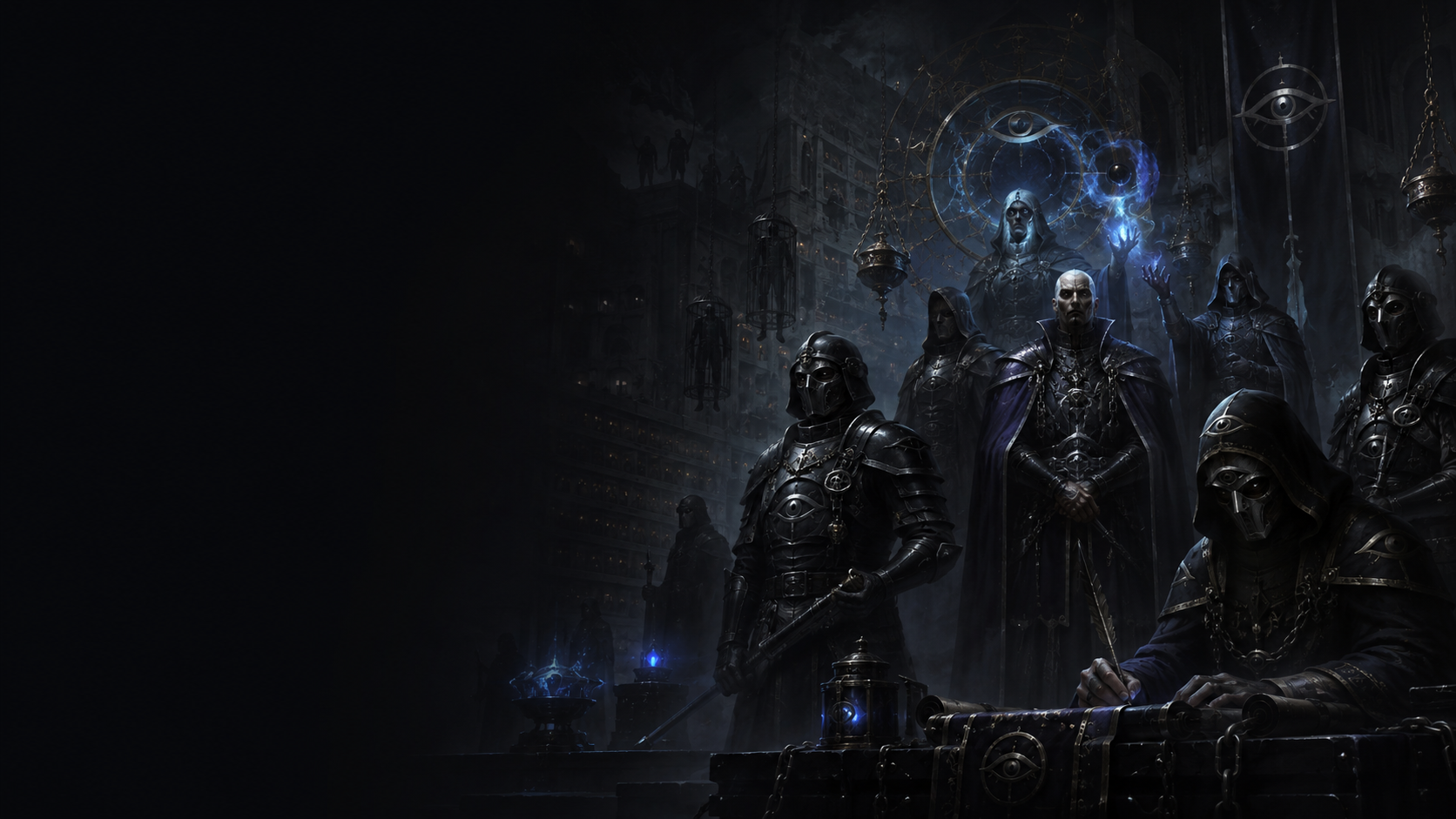
Oculus was the imperial intelligence and enforcement agency of Ostagar, founded in the Second Age to serve as the eyes, ears, and hidden hand of the Pantheon’s dominion. It functioned simultaneously as secret police, investigative authority, internal security bureau, and foreign intelligence service, wielding jurisdiction across the full extent of Ostagar’s territories. To loyal imperial citizens, Oculus represented order, safety, and the certainty that law would be enforced without hesitation. To dissidents, rebels, and conquered peoples, it represented surveillance, disappearance, and fear.
At its height, no institution in the empire rivaled Oculus in reach, secrecy, or authority.
Origins and Formation
Oculus emerged during the early consolidation of Ostagar, when the Pantheon required a centralized body capable of enforcing divine law uniformly across increasingly vast territories. Local magistrates, city guards, and noble retainers proved insufficient for maintaining control over distant provinces, rooting out sedition, and suppressing organized resistance.
In response, the Pantheon authorized the creation of a permanent intelligence and enforcement apparatus whose authority superseded local governance in matters of imperial security, heresy, sedition, and internal threat assessment.
From its inception, Oculus answered directly to the highest organs of imperial and divine authority.
Role During The Godwar
During the opening phase of The Godwar, Oculus served as the Pantheon’s primary counter-insurgency force.
Its agents hunted rebel sympathizers, infiltrated anti-Pantheon cells, intercepted military intelligence, and coordinated suppression campaigns across contested territories. The organization played a critical role in identifying and dismantling early resistance networks before open war fully engulfed the empire.
Oculus was responsible for the capture and imprisonment of Gabriel Aurellian during the conflict, confining him within the Ocularis under the authority of the Pantheon. Its unwavering loyalty to the gods cemented its status as one of the regime’s most feared institutions and ensured its destruction when the rebellion triumphed.
Organizational Structure
Oculus was ruled by a singular supreme authority known as the Grand Seer, whose identity remained concealed from all but the highest echelons of the Pantheon and Ostagar’s ruling houses.
The office was deliberately anonymized; the public never knew whether a Grand Seer had changed, died, or been replaced. To most, the title itself appeared eternal.
Beneath the Grand Seer, Oculus was divided into specialized internal branches:
Umbram Speculari oversaw espionage, infiltration, and intelligence gathering beyond imperial borders.
Interdictum handled investigation, interrogation, prison administration, and inquisitorial enforcement.
Purgatio Internum monitored corruption, disloyalty, and internal compromise within Oculus itself.
Manus Obscurum conducted covert eliminations, disappearances, deniable operations, and politically sensitive assignments.
Vigilum Lex served as the visible enforcement arm of the organization, acting as patrol officers and public investigators within major imperial settlements.
Siderum maintained the agency’s diviners, augurs, and prophetic specialists, using arcane foresight and magical surveillance to identify emerging threats.
Each division operated within strict compartmentalization, though all remained subordinate to the Grand Seer.
Methods and Operations
Oculus employed a comprehensive intelligence doctrine combining conventional investigation with covert espionage, magical surveillance, psychological intimidation, informant cultivation, and targeted assassination.
Its influence extended into every level of imperial society. Informants operated in taverns, noble courts, military commands, temples, and marketplaces. Entire communities lived under the assumption that any careless word might be overheard and reported. The organization deliberately cultivated this paranoia.
Whether Oculus truly saw everything mattered less than whether people believed it did.
Headquarters and Ocularis
Though Oculus initially operated from administrative compounds within Ostagar itself, the capture of the First Murderer prompted the construction of a dedicated high-security prison and intelligence citadel: the Ocularis.
Built into a meteorite mountain on Ostagar’s southern frontier, the Ocularis became the true heart of the organization. It served as prison, archive, headquarters, interrogation complex, ritual center, and strategic command nexus.
From this fortress, Oculus directed operations across the empire and housed its most dangerous prisoners, forbidden records, and classified relics.
By the late Second Age, the Ocularis had eclipsed all prior headquarters and become synonymous with Oculus itself.
Fall of the Organization
When the Pantheon fell and Ostagar collapsed, Oculus disintegrated with startling speed.
Its authority had always derived from the divine-imperial structure it served. Once that structure was shattered, the organization lost both legitimacy and protection. Its outposts were overrun. Its archives were burned or seized. Its agents were executed, imprisoned, or driven into hiding.
The Ocularis itself fell during Gabriel Aurellian’s purge of remaining Pantheon loyalists, marking the formal end of the institution.
Legacy
Though Oculus no longer exists, its legacy endures as one of the most feared institutions in recorded history.
Across Grimhold, abandoned outposts, hidden safehouses, and sealed archives still bear its mark. Rumors persist that forgotten cells, buried intelligence caches, and surviving operatives remain hidden in remote corners of the world. Most historians dismiss such claims as paranoia and folklore.
Few speak of them with certainty. Fewer still dismiss them entirely.

Comments