Seat of the Empire
At the exact center of Targon stands Palace Imperia, the imperial palace complex that serves as the Seat of the Empire. It is the political and ceremonial center of Aurellian rule, the residence of the imperial household, and the place from which the highest functions of state are conducted. From its halls decrees are issued, envoys are received, petitions are heard, and the authority of the Aurellian throne is presented to the realm.
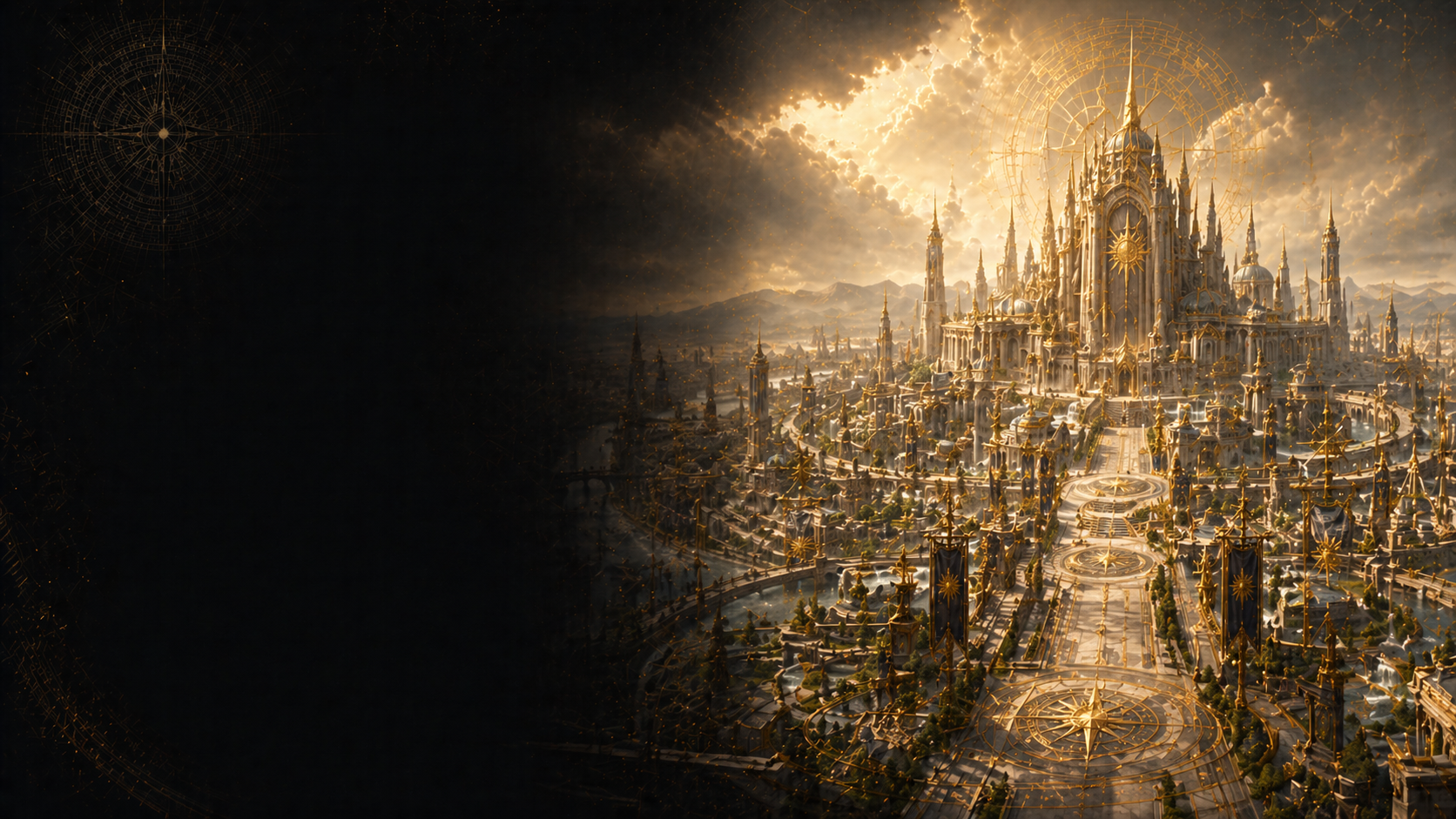
Its place within Targon defines the city itself. Targon was built outward from the palace, and its radial layout gives the capital the shape of a great sun when seen from above. This design reflects the sigil of The Aurellian Dynasty, with Palace Imperia forming the central disc and the city’s great avenues spreading outward like rays. In both form and meaning, the palace is the fixed center of the capital.
In the present age, Palace Imperia remains fully active even though the throne stands vacant. Its courts, chambers, and order halls continue to function, but the absence of a crowned Aurellian gives the palace a strained and watchful atmosphere. It remains the center of empire, though its innermost seat of rule lies dormant.
Founding of the Seat
Palace Imperia was founded in the aftermath of The Godwar, when Gabriel and and Althea sought a place from which a new order could be raised. Crossing the heart of Targon, they came to the Green Hills and looked out across peaceful, fertile land, with fields of corn stretching for miles. Gabriel knew that this was where the imperial center would stand.
The site was chosen neither by inheritance nor by older custom. It was chosen because it offered room for growth, a stable heartland, and the promise of renewal after devastation. They did not inherit a capital. They founded one.
The palace came first. In its earliest conception, it was meant to be the beginning of the city itself. Targon then grew outward around it as roads formed, districts emerged, and plazas gathered life around the new imperial center. The city did not receive the palace as an addition. It took shape because the palace was already there.
Construction of Palace Imperia
The construction of Palace Imperia was a collaborative work led by Gabriel and Althea, shaped by the engineers and builders of Khazural, and accelerated by Winrey Auric and his automatons. As in the rebellion that came before it, the work drew together allies who believed the new age had to be built deliberately and on enduring foundations.
Khazural provided both the stone and the skill that defined the palace. White and black marble were brought from the dwarven realm in vast quantities and worked into monumental facades, halls, courtyards, arches, and colonnades. Gold inlays were set throughout the complex, giving the palace its distinct imperial character. From the beginning, the design was grand in scale. No part of it was conceived as temporary or modest.
Though it functioned as the Seat long before completion, Palace Imperia remained under construction for decades. Gabriel died in 4A Y190, and the palace was fully completed only in 4A Y210, twenty years later. By then it had already become the unquestioned center of imperial authority.
Place Within Targon
Palace Imperia stands inside its own walled precinct at the center of the capital. Those walls mark the boundary between civic life and imperial ground. They are ceremonial and administrative first, though they can serve a defensive purpose if needed. Four main gates open through them, one on each side of the compass, aligning the palace with the ordered geometry of Targon. Outside the walls lie some of the liveliest public spaces in the capital. The plazas, squares, and avenues around the palace are civic spaces filled with daily traffic, gathering, and ceremony. This gives the palace a visible and constant presence in the life of the city. It is distinct from Targon, but not remote from it.
Within the walls, the palace is vast enough to feel like a city in itself. Wings, halls, gardens, pools, courtyards, offices, and restricted inner structures all belong to the same greater complex. Its outward appearance is majestic, defined by marble, gold, solar courtyards, and carefully planned gardens. It projects order, wealth, and permanence without separating itself entirely from the world outside its gates.
Seat of Imperial Rule
Palace Imperia houses the highest level of imperial government. It serves as the place where decrees are issued, foreign envoys are formally received, military planning is directed, noble houses are recorded, and petitions reach the highest levels of authority. It is also the setting for state banquets, formal audiences, and the major ceremonial acts of the dynasty.
Only the highest levels of administration operate from within the palace. Lesser offices and broader clerical functions are housed elsewhere in Targon. This keeps Palace Imperia reserved for the uppermost institutions of state and for those whose responsibilities must remain close to the throne.
Several major imperial orders also maintain their headquarters within the complex. Their presence reflects the fact that the palace is not merely a residence or ceremonial court, but the living center of imperial command, continuity, and law.
Sunheart Hall
At the center of Palace Imperia stands Sunheart Hall, the throne room of the empire. It occupies the innermost core of the palace and serves as the ceremonial chamber of coronation and sovereign rule. Here stands the imperial throne, which may be occupied only by an Aurellian who bears the Cinderbrand.
The hall is built in black and white marble worked with gold, and lined with statuary depicting Gabriel, Althea, the emperors who followed them, and other foundational figures of the empire. Its design is grand, but severe. It is meant to impress.
In the present age the throne is legally vacant and dormant. No regent or minister may sit upon it. During ordinary reigns the hall is restricted but active. During coronations it is opened to public witness. During the current interregnum it is completely sealed, and entry is forbidden on pain of death except to the great leaders of the imperial orders and the five Imperators of Ordo Imperator.
Notable Places Within the Palace
Beneath the palace lies the Necropolis, where all members of the Aurellian bloodline are buried. Gabriel and Althea rest there among the dead of their house. The Necropolis is sealed to all except the Aurellians and Ordo Imperator.
The Imperos Vaults are the guarded vault chambers of Ordo Imperator. Their full purpose belongs to deeper matters of the throne and the Pale Crown, but their presence marks the order’s intimate connection to the palace’s most restricted inner spaces.
Dux Alba is the headquarters complex and war room of Ordo Decimus, the official army of the Aurellian Empire. From there the empire’s military leadership directs campaigns, strategy, and readiness.
The Halls of Memory form a grand museum space devoted to the rebellion, the rise of the Aurellian family, and the history of the empire. Through statues and curated memorial works, they preserve the state’s account of its own beginnings and endurance.
Outside the palace walls, in the Grand Plaza, stands the Foundation Stone, the first stone laid in the construction of Palace Imperia. Unlike the restricted spaces within the complex, it remains visible to all and serves as a public reminder of the palace’s beginning.
The Interregnum
In 4A 502, Palace Imperia remains active under the regency of Servius Livia, leader of Ordo Dominus. He governs from the Regent Chambers and does not sit upon the imperial throne, which remains reserved for the next rightful bearer of the Cinderbrand. The palace continues to function in all practical matters. Orders carry out their duties, envoys are received, records are maintained, and state business proceeds. Yet the atmosphere is tense. Sunheart Hall remains sealed, and the vacancy at the center of the empire is felt throughout the complex.
This gives Palace Imperia its present character. It is neither weakened nor abandoned, but suspended. The machinery of empire still moves, while its highest seat waits.
Legacy
Palace Imperia remains the enduring center of Aurellian power. It was the first foundation of Targon, the fixed core around which the capital grew, and the place where the empire’s rule is housed in its highest form. Its halls contain governance, ceremony, dynastic memory, military command, and succession law within a single complex.
Even in an age of vacancy, it has not lost that role. The empire still turns toward it, the city still radiates around it, and the dormant throne still defines the horizon of imperial expectation. Palace Imperia endures as the Seat of the Empire because it was built to do exactly that: to outlast uncertainty and remain the center until the next bearer comes.

Comments