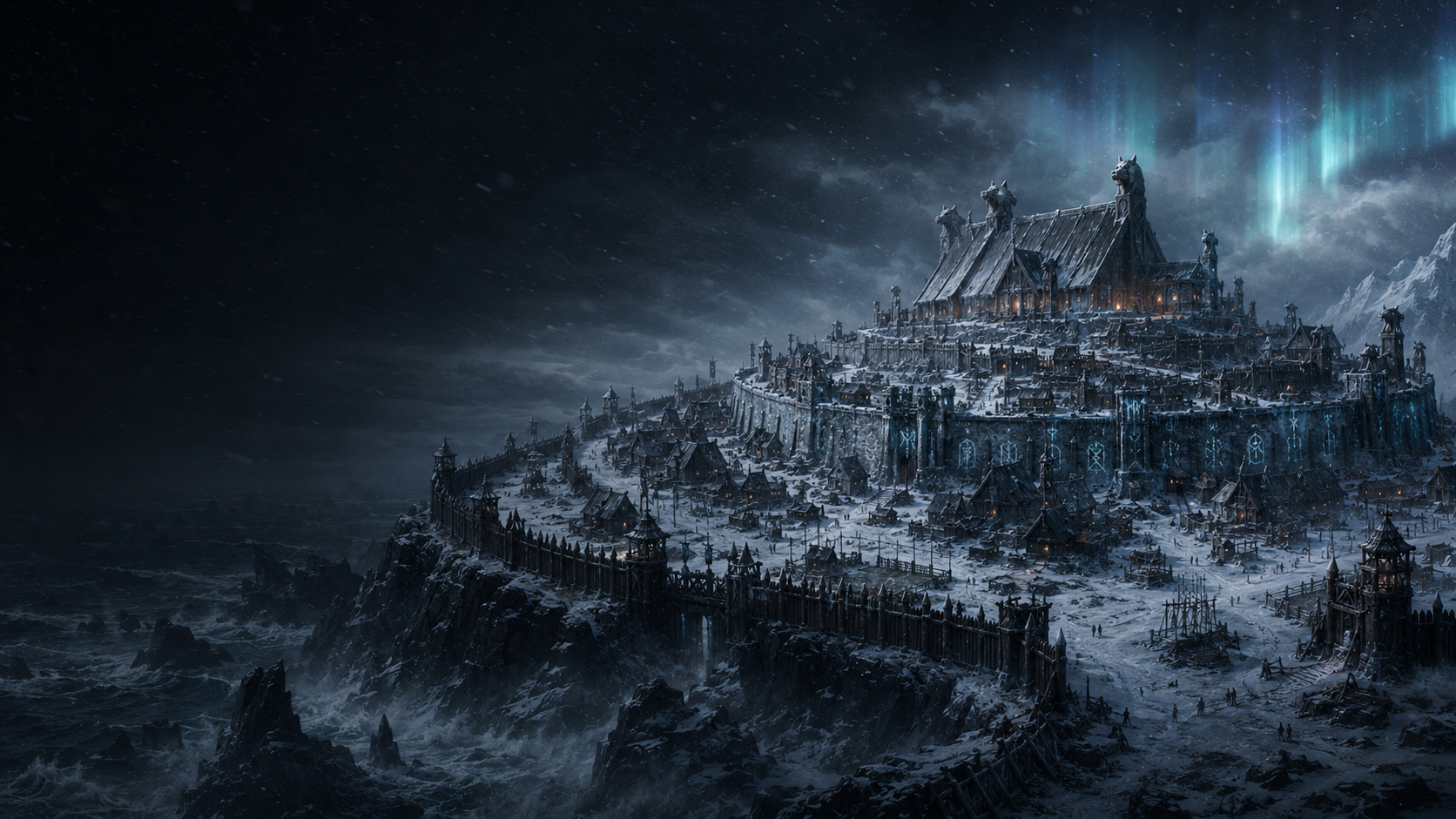
Tham Lorn
Tham Lorn is the ancestral capital of Clan Grimwulf and the second-largest settlement in the Skarnn homelands, surpassed only by Nifleheim. The city is built entirely on open ground along the eastern edge of the Nifleheim Valley. It remains fully exposed to wind, weather, and sky, reflecting the Skarnn principle that strength is proven without shelter.
Though positioned near the sea, the coastline is impassable. Jagged cliffs and submerged rock formations prevent all naval approach. The sea functions as a natural barrier, requiring no defense.
Geography and Setting
Tham Lorn occupies a gradual rise above a hostile coastal stretch defined by shifting tides and concealed stone formations. At low tide, the rocks emerge across the shoreline. At high tide, they disappear completely, creating an unpredictable and lethal approach zone. No stable landing exists.
The land slopes inland toward the White Border, forming a primary land corridor linking Ravenhold to the interior of Grimwulf territory. Winds move continuously through the valley, carrying cold air, moisture, and seasonal snow.
Urban Layout and Architecture
The city is organized in concentric defensive and residential rings. The outermost perimeter consists of a high wooden palisade, designed to absorb initial impact and delay assault. Within it stands the primary defensive wall, a broad stone structure dating back to the First Age.
The inner wall is marked with carved runes whose origin predates recorded Skarnn history. These markings are preserved without alteration. During periods of aurora activity, the runes emit a faint blue illumination across the surface of the wall. At the center of the city stands the Long Hall.
The structure is built from timber over a stone foundation. Its scale exceeds all surrounding buildings. Interior supports are carved into wolf-headed beams. Twin hearths burn continuously, serving as both light and symbolic center. The Long Hall functions as the seat of authority and the central gathering space for the city.
Population and Society
The population of Tham Lorn is approximately thirty thousand. The majority are members of Clan Grimwulf, with additional inhabitants drawn from lesser clans, trade groups, and independent workers. The city maintains a mixed but controlled population structure, defined by allegiance and function. Its position along the White Border trade corridor generates continuous economic activity. Caravans moving between Ravenhold and the interior are required to pass through Grimwulf-controlled routes, contributing to steady resource flow.
Markets operate daily, with goods including furs, timber, preserved meat, and bone-crafted items.
Military Presence and Defense
Tham Lorn maintains a permanent, professional military force. All soldiers train year-round under established command structure. The force operates independently of levy systems and is maintained at full readiness. Training grounds are located in the western districts, where formation drills, combat exercises, and mage instruction are conducted.
Frost mages are present in limited number and are integrated into battlefield operations. Their role is specialized and controlled. The Wolf Guard serves as the Jarl’s personal force. They remain stationed near the Long Hall and function as the final defensive layer of the city.
Landmarks
The central square contains the Bratnarr Rune Obelisk. This monolith records the lineage of the Jarls of Nifleheim. Names are carved directly into its surface, forming a continuous historical record. The obelisk serves as both archive and symbolic authority marker. The marketplace surrounds the obelisk and forms the primary economic center of the city. South of the square lie the main training grounds. The Long Hall dominates the northern central axis. The only subterranean structures are the burial chambers beneath the Long Hall, where Clan Grimwulf inters its dead.
Culture and Character
Daily life is structured around survival, training, and communal function. Behavior is direct and controlled. Public expression is limited, but communal gatherings are frequent. Feasts, storytelling, and shared ritual activity occur within enclosed spaces, primarily around central hearths. The city operates under a balance of discipline and cohesion. Individual strength is expected, but collective identity is reinforced through shared hardship and continuity.

Comments