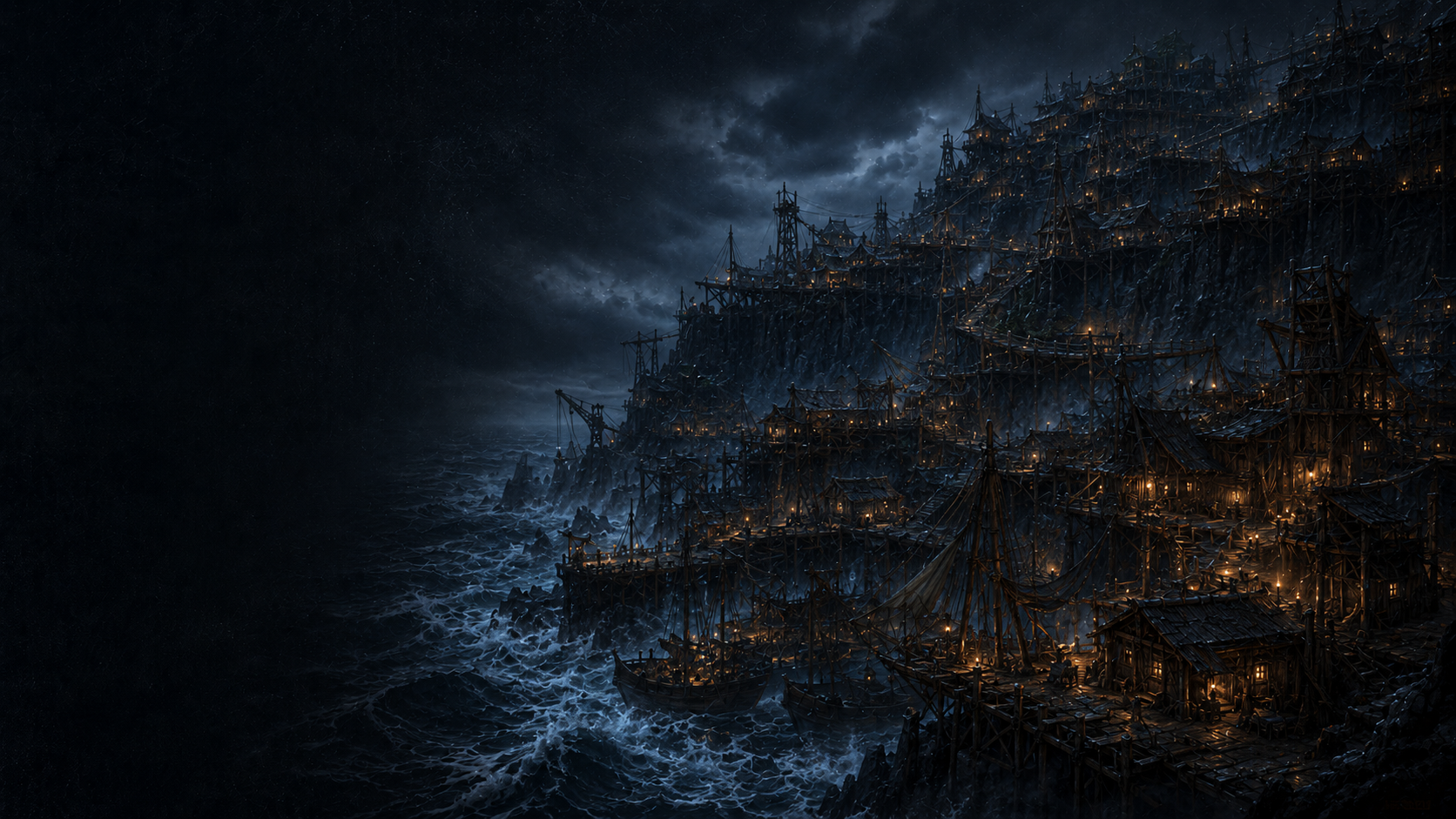
Ravenhold
Ravenhold is a storm-battered coastal city on the western edge of Grimhold, built along black cliffs overlooking the violent waters of the White Sea. It is a city defined by noise, instability, and constant movement. Mercenaries, traders, wanderers, and deserters converge here, drawn by opportunity rather than allegiance.
Unlike Nifleheim, which is governed by tradition and ritualized combat, Ravenhold operates through shifting power structures, trade networks, and the influence of competing guilds. It serves as Grimhold’s primary coastal port. Southern merchants arrive seeking furs and cold-forged steel, while expeditions form here before venturing into the Icemarch or the ruins of Ostagar. Ravenhold sustains itself through constant activity. Stability is maintained only through balance between its dominant factions.
Geography and Setting
Ravenhold is built across uneven stone terraces rising from the coastline. The cliffs provide partial protection from storms, but strong sea winds move freely through the city year-round. The surrounding terrain consists of damp forests and fractured rock formations, making overland travel slow and unreliable. Its location places it between the Needles and the Grimhold Basin, positioning the city as a junction for both regional and long-distance trade. The waters offshore are hazardous, marked by reefs and unpredictable weather patterns, requiring experienced navigation.
Districts of Ravenhold
The city is divided into loosely defined districts, each shaped by function rather than formal boundary.
Saltgates
The harbor district, built directly along the lower cliffs. It contains docks, warehouses, taverns, and densely packed housing. Activity is constant, and the area is dominated by sailors, traders, and smugglers.
Bladeshade
A district centered on controlled violence. It contains fighting pits, mercenary compounds, and private guild holdings. Conflicts are resolved through hired combat or organized bouts rather than formal tradition.
Highquarter
The upper terraces, occupied by wealthy merchants, guild officials, and power brokers. The district is fortified and controlled. Decisions made here influence trade routes, guild relations, and regional stability.
Government and Power
Ravenhold is governed through distributed authority. Five dominant guilds control the city’s economy, security, and political direction. Together they form a volatile balance of power, maintained through negotiation, pressure, and the threat of force.
The Five Guilds
Blackram — Dock enforcement, mercenary labor, and physical control of trade zones.
Guild of the Hollow Eyes — Intelligence, surveillance, and covert operations.
Heavy Coin — Trade regulation, contracts, tariffs, and financial systems.
Vigil — Law enforcement, patrols, and internal order.
Gravetide Company — Monster control, ruin operations, and high-risk assignments.
Guild authority is conditional. Any loss of strength invites replacement or absorption by rivals.
Culture and Society
Ravenhold operates at a constant state of tension. Life is direct, transactional, and often violent. Outsiders are common, and allegiance is temporary. Social stability depends on the continued balance between guild influence and economic necessity.
Regular conditions within the city include public combat in Bladeshade, continuous trade movement in Saltgates, private negotiations in Highquarter, and steady arrival of expeditions seeking access to the Icemarch or surrounding ruins. Due to the lack of reliable infrastructure across Grimhold, Ravenhold functions as a staging point for travel, trade, and exploration. Information circulates quickly, and opportunities are acted on immediately.
History
Ravenhold originated as a fishing settlement along Grimhold’s western coast. During the Third Age, southern trade routes began to expand, bringing increased traffic, resources, and external influence. The settlement grew into a port, though it remained structurally unstable and politically fragmented.
During The Godwar, the city suffered significant damage from fire, conflict, and refugee influx. Reconstruction occurred rapidly, but without centralized planning. This period marked the rise of guild-based control, as organized groups began managing trade, defense, and internal order. In the Fourth Age, Ravenhold maintains its role as Grimhold’s most active external connection. Its structure remains decentralized, and its stability depends on continued economic flow and controlled competition between guilds.

Comments