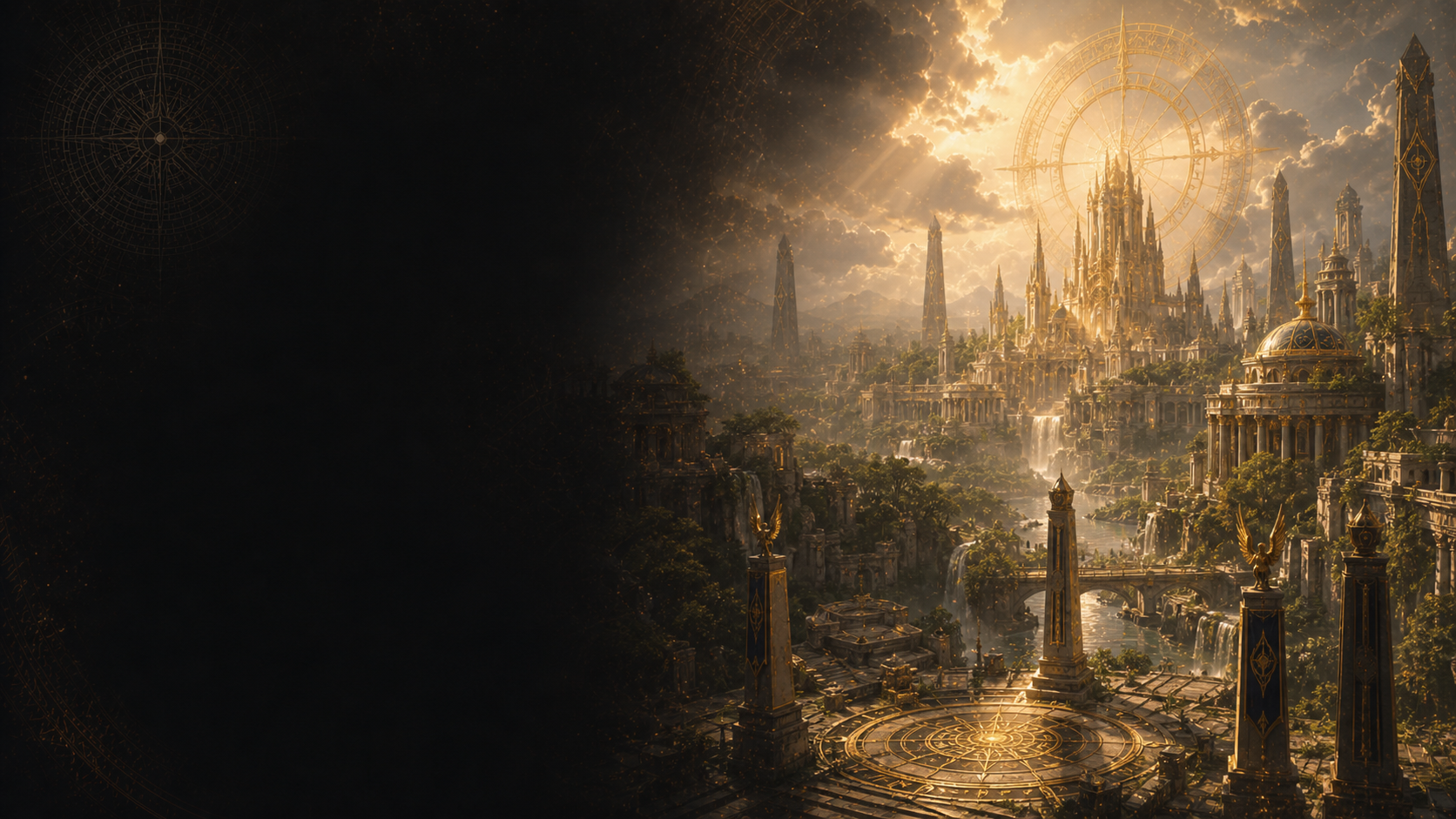
The Age of Dominion
The Age of Dominion began in the final years following The Godwar, marking the transition from divine rule to mortal authority over Arkanthys. It was not an age born from triumph, but from aftermath. The Pantheon had fallen. The structures that upheld divine order had collapsed. What remained was a world scarred by war, its lands fractured, its people scattered, and its future uncertain.
In this absence of divine authority, dominion did not vanish. It changed hands.
A World Without Gods
The immediate years following The Godwar were defined by devastation. Entire regions bore the marks of divine conflict. Cities lay in ruin, trade routes had collapsed, and populations were displaced across continents. Nowhere was this more evident than in Grimhold, where the war had left vast stretches of land broken and uninhabitable. Across Arkanthys, the consequences of the conflict were visible not as singular events, but as lasting conditions. Recovery was slow, uneven, and uncertain. Yet despite the destruction, something fundamental had changed. For the first time in recorded history, the world existed without the rule of gods. There were no divine decrees. No sacred hierarchies enforcing order. No higher authority beyond the reach of mortals. The silence that followed was not peace.
It was absence.
The Rise of the Aurellian Empire
In the years after the war, Gabriel Aurellian did not seek to claim the world he had freed. Instead, he withdrew from it. With much of the known world already occupied or fractured by its own struggles, Gabriel turned eastward, beyond the centers of power. There, on the vast plains of Targon, a land of scattered settlements and open fields, he established a new beginning. From this place, the Aurellian Empire was formed. Unlike the Ostagarian system that came before it, the Aurellian Empire was not a continuation of divine structure. It was built anew, shaped by the ideals that had driven the rebellion itself. Gabriel and Althea Aurellian established the foundations of a dynasty that would rule by mortal authority.
At its center rose Targon City, not as the capital of the world, but as the heart of a new order.
Dominion Reclaimed
The fall of the Pantheon did not remove the need for structure. It removed the source from which that structure had once flowed. In its place, dominion became a mortal responsibility. The Aurellian Empire did not impose control through conquest, but through preservation. Its authority was shaped by the need to prevent the world from collapsing further into disorder. Laws replaced decrees. Governance replaced doctrine. Power was no longer inherited from the divine, but held and enforced by those capable of maintaining it. Gabriel was not seen as a conqueror. He was seen as the one who had ended something that could not continue.
The world did not unify under the Aurellian Empire. The great regions of Arkanthys remained independent, each shaped by its own history and recovery. Khazural stood as the strongest ally of the new empire, bound not by submission, but by shared purpose forged during the war. Myrien and Cadrien maintained a distant alignment, their relationship with the empire defined more by caution than trust. Aranna, shaped by rebellion long before The Godwar, remained separate, unwilling to yield its independence to any external authority.
Magic and Relics
With the gods gone, magic did not fade. It endured, but without the structures that once defined its limits. In response, the Aurellian Empire established control over arcane practice. Magic remained accessible, but it was no longer without oversight. Its use became regulated, shaped by the understanding that unchecked power had once nearly undone the world. The relics of the Pantheon still existed, though few remained in open circulation. Most were gathered and secured within the Pyro’s Vaults beneath Altarra Tower, where they were kept from those who might seek to use them as the gods once had. The war had proven what such power could do. The Age of Dominion would ensure it was not repeated.
The Weight of Freedom
The Age of Dominion is not remembered as an age of victory. It is remembered as what followed one. The world was free, but it was not whole. The structures that had once defined existence were gone, and what replaced them was still forming. Mortals now held authority over their own fate, but with that came the burden of maintaining it. Gabriel Aurellian is remembered as a hero, not because he created a new empire, but because he ended an old one that could not be allowed to endure. What he built afterward was not meant to replace the gods.
It was meant to ensure they were never needed again.

Comments