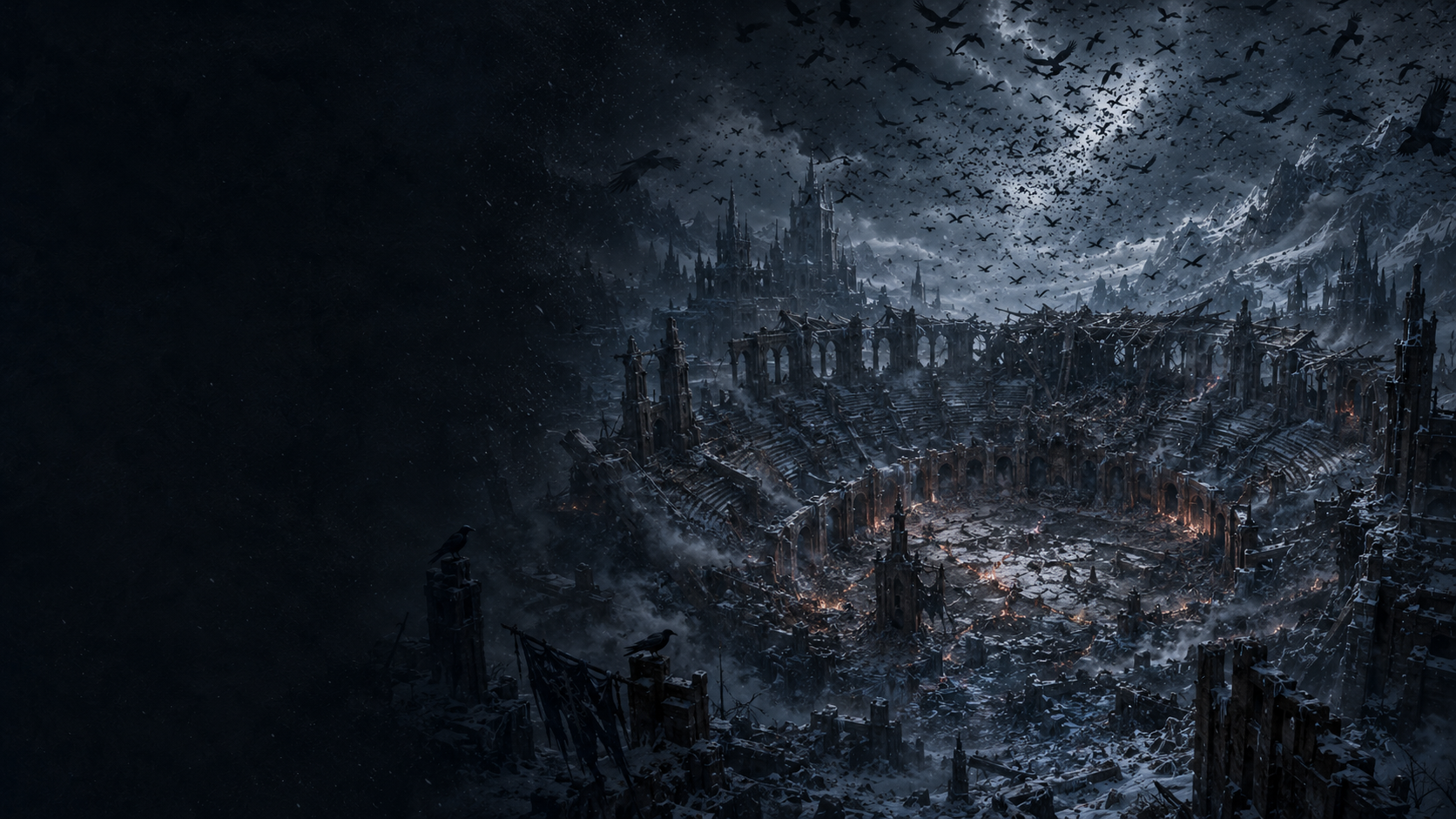
The Day the Ravens Blocked the Sun
The Day the Ravens Blocked the Sun is one of the darkest events in the history of Nifleheim and the wider Skarnn homelands. Occurring in the aftermath of the failed Skarnn rebellion against Ostagar during the First Age, it reshaped northern culture, transformed the meaning of the Nifleheim Arena, and remains the defining tragedy of Skarnn historical memory.
Its name derives from eyewitness accounts describing the sky above the Arena darkened by the vast number of carrion birds descending upon the dead.
Historical Context
Following the collapse of organized Skarnn resistance, Ostagaran forces entered Nifleheim in force. Rather than destroy the city outright, the occupiers sought to make an example of its people.
Civilians, captured warriors, and remaining defenders were gathered under the pretense of registration and relocation. Instead, they were marched into the Nifleheim Arena and sealed within.
At the time, the Arena served primarily as a site of ritual combat, adjudication, and clan judgment. It had never before been used as a place of execution.
The Burning of the Arena
Once the Arena was filled, Ostagaran forces barricaded all exits and reinforced the surrounding approaches.
Burning pitch and oil were hurled into the structure while siege engines bombarded the upper terraces. The sustained assault destabilized the Arena’s elevated rings, causing large portions of the upper structure to collapse inward.
Hundreds died beneath falling stone. Many more burned or suffocated as smoke filled the pit. Those who attempted to scale the inner walls were shot down by archers stationed above. By the end of the assault, the upper tiers of the Arena had been destroyed and the structure left in ruin.
Aftermath
The dead remained within the shattered Arena for several days. Smoke, ash, and the smell of blood spread across the city and surrounding tundra. Ravens and carrion birds descended upon the corpses in such numbers that contemporary witnesses claimed the sky itself darkened beneath their wings.
This phenomenon gave the event its name. Among the Skarnn, ravens are regarded not merely as scavengers, but as witnesses to death and carriers of memory. Their presence transformed the massacre into something mythic within Skarnn cultural consciousness.
The Inscriptions
When the lower structure of the Arena was later restored, two inscriptions were carved into its surviving walls.
Northern Wall
“The wind turned black, the field grew numb, we knew the hour had finally come.”
This inscription acknowledges the inevitability of the slaughter and the understanding that resistance would bring ruin.
Southern Wall
“On the day the ravens blocked the sun, we raised our steel, we did not run. The shadow swept across the land. Yet still we marched. We made our stand.”
This inscription serves as a declaration of endurance rather than victory.
Cultural Impact
After the massacre, the Nifleheim Arena ceased to be merely a place of combat. It became sacred ground: a memorial to the dead and a symbol of Skarnn defiance.
Clan duels fought within its walls are considered binding before history itself.
No Jarl may permanently seal the Arena. Fire is forbidden in ceremony within its walls. Ravens are never driven from Nifleheim.
The Day the Ravens Blocked the Sun remains central to Skarnn identity, reinforcing their distrust of foreign rule and their belief that honor lies not in victory, but in endurance.

Comments