The Founding of Arkanthys
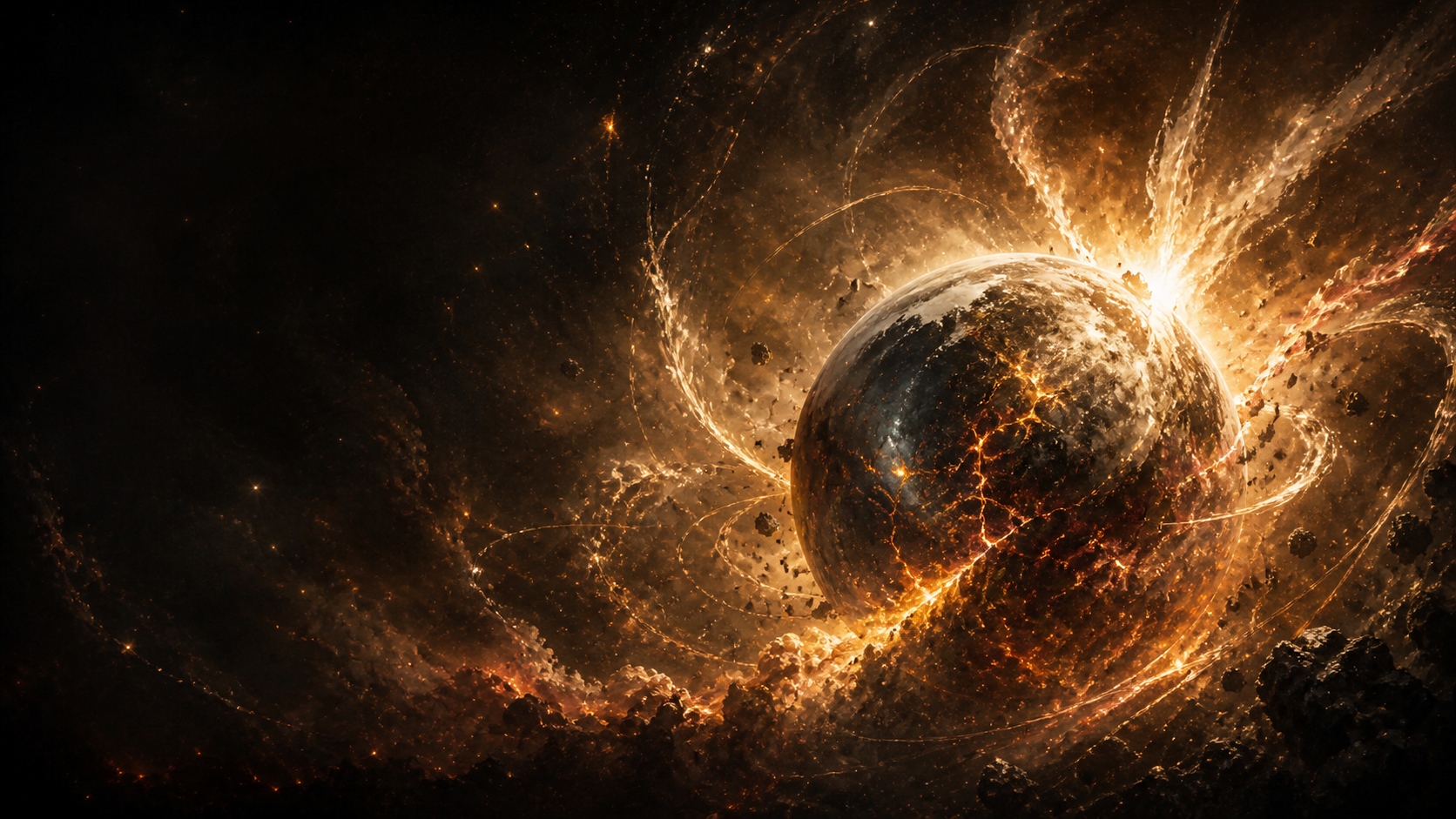
The Founding of Arkanthys, known only in restricted scholarship as the Age of the Creators, describes the earliest era of existence long before the Pantheon, the Divine Concord, or the birth of mortal civilizations. This era, referred to in forgotten fragments as Primordia, was shaped not by gods or sentient beings, but by the presence of vast cosmic manifestations known as the Creators. These entities were not alive, nor conscious, nor purposeful in any way mortals or gods could comprehend. They were fundamental principles of reality made temporarily manifest, drifting into and out of existence without intention. Their presence shaped Arkanthys by accident. Their withdrawal allowed everything else to begin.
The Nature of the Creators
The Creators cannot be classified within any mortal or divine taxonomy. They were not beings with agency or thought. They were temporary expressions of cosmic principles, structure, flow, transformation, motion, void, and entropy, intersecting with the Roil, the unformed arcane chaos that existed before the world. Their arrival was a fluctuation, not an act. Their departure was dissipation, not death.
They could not be killed, because they were not alive. They could not be commanded, because they lacked volition. They could not respond to worship, because worship was irrelevant to their nature. Despite this, their influence is still present in the deepest strata of Arkanthys, embedded into its geography, its magic, and its metaphysical laws.
Only six Creators are known to have touched Arkanthys. Whether these were the only ones, or merely the ones whose presence left the strongest footprints, is unknown.
Khoran, the Principle of Form
Khoran was the first to impose structure on the Roil. Where his presence intersected with chaos, the foundations of the world solidified. Stone, metal, and the earliest landmasses arose around him. The runic geometry known today as the Deepforge Script originated not from dwarven invention but from Khoran’s imprint on the bones of the world.
Selira, the Principle of Flow
Selira softened Khoran’s rigid formations, filling the world with oceans, rivers, and tides. She introduced the first emotional resonance into existence, allowing water to retain memory, echo, and impression. Though she is gone, remnants of her presence linger in rare phenomena where water carries visions or recalls forgotten events.
Pyrrhex, the Principle of Transformation
Pyrrhex manifested violently, bringing fire, eruption, and the concept of transformative change. Volcanic ranges, ashlands, and unstable arcane regions trace their lineage to him. Magic’s inherent volatility, its tendency toward inspiration and disaster remains a consequence of Pyrrhex’s lingering influence.
Aeltheon, the Principle of Motion and Thought
Aeltheon introduced wind, storms, sound, and the earliest frameworks of time. His presence gave the world its first breath of movement and consciousness. After later divine conflicts, fragments of Aeltheon’s essence persisted through storm-spirits, high-altitude visions, and whispering winds that mortals often mistake for divine messages.
Nyvara, the Principle of Void and Balance
Nyvara governed the balance between presence and absence. She shaped the night sky, the first natural decay, and the quiet boundary between being and nonbeing. Dreams, celestial order, and the earliest natural death all stem from her influence.
Vaaldros, the Principle of Entropy
Vaaldros did not arrive. He occurred. A flaw, a fissure, a hunger in the newborn world. His influence erodes, consumes, and destabilizes. Deep chasms, void pockets, and regions of arcane collapse are remnants of his presence.
The Shaping of the World
The world’s earliest form emerged from the interactions of these principles. Khoran’s order created the skeleton of the land. Selira’s motion softened its edges. Pyrrhex’s eruptions reshaped continents. Aeltheon’s winds sculpted the sky. Nyvara’s presence set boundaries and cycles. Vaaldros carved voids and left scars that have never healed.
Nothing about the shaping of Arkanthys was intentional. Creation was a side effect of proximity, a byproduct of forces transiently overlapping.
Withdrawal of the Creators
Eventually, the Creators receded from the world. They did not fall or fade; they simply ceased their intersection with Arkanthys. Their absence left the world stable for the first time, governed by the laws their presence had imposed without purpose.
The energies remaining after their departure condensed and resonated with one another. In time, these residues birthed the gods of the Second Age. Self-born divine beings with limited form, personality, ambition, and need. They were not the makers of the world. They were the inheritors of what the Creators left behind.
The Lost Age and the Numbering of the Ages
Although Arkanthys has lived through four distinct ages, only three are publicly recorded. The Age of the Creators is entirely absent from mortal history. This omission was deliberate. When the gods of the Second Age rose to prominence, they discovered fragments of Primordia embedded in ancient arcane layers, remnants of truths that threatened their claim to power. A god cannot demand worship if it admits it did not create the world.
To secure their authority, the Pantheon rewrote the dawn of history. Their Concord and scriptures established the lie that the world began with them. Temples, scholars, and ruling houses followed this doctrine, erasing all evidence of an age older than the divine. What could not be destroyed was reinterpreted, mislabeled, or buried.
For many centuries, the truth remained hidden.
It was not until Gabriel Aurellian seized the Pale Crown from Thalor that a mortal once again glimpsed the age before the gods. In the Crown’s fractured divine memory, Gabriel saw echoes of the Creators, traces of forces older than any god, and the truth that Arkanthys existed long before the Pantheon claimed it. When he shattered the Crown, he severed the last filter obscuring the world’s origin and became the only mortal in history to witness Primordia as it truly was.
The Aurellian archives now recognize four ages. The rest of the world still speaks of only three. The First Age remains unspoken, not because it is gone, but because its truth is too vast, too indifferent, and too disruptive for a world still unlearning the lies of its former gods.

Comments