Arkanthys Today
The current year is 4A 502, and the Aurellian Empire still stands as the greatest political power in Arkanthys. Its rule remains strong, its institutions remain intact, and its capital continues to serve as the beating center of the known world. From a distance, the empire appears stable. Its roads still carry trade, its orders still function, its laws still hold, and its borders, though strained, remain under imperial claim. The age has not collapsed into open disorder. The machinery of state still turns.
Yet that strength is burdened by tension. The imperial throne remains vacant, and the Cinderbrand has not appeared upon any living Aurellian since the death of Emperor Uriel III. The empire has now lived long enough with that absence that shock has given way to routine, but not to peace of mind. What began as crisis has hardened into an uneasy normal. Rule continues, but it continues with a silence at its center. The throne is there. The palace is active. The empire endures. But the one thing that grants final legitimacy has not yet returned.
For that reason the Present Day is defined not by collapse, but by suspension. Life goes on because it must. Fields are still harvested, taxes still collected, trade still negotiated, laws still written, and decisions still made. Yet beneath all of it lies waiting. The empire is stable, but it is not settled. In the streets, in the halls of power, and in the quieter corners of the realm, people speak in lower tones than they once did. The Fourth Age remains strong in form, but in spirit it stands beneath a shadow.
The Vacant Throne
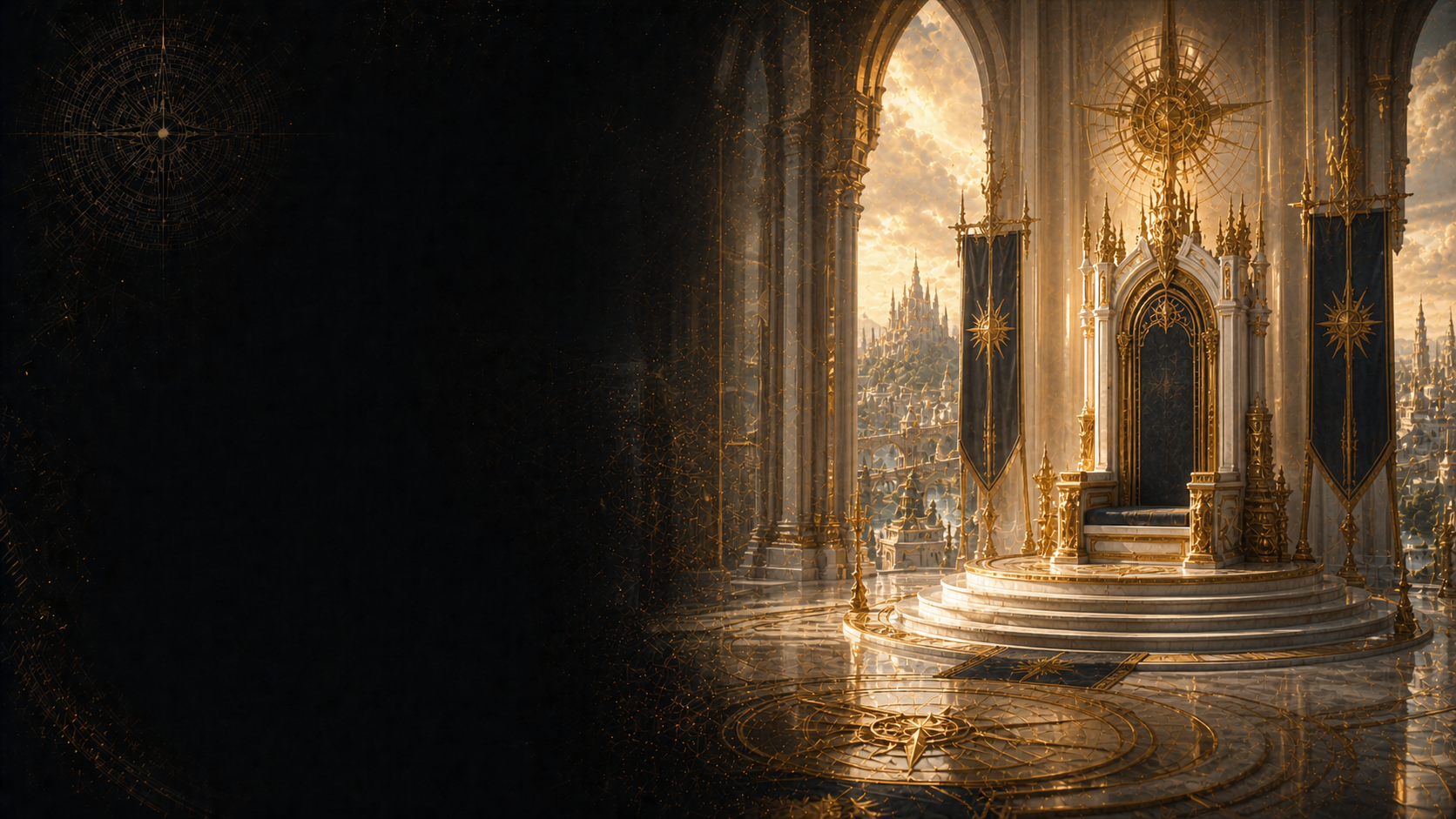
The greatest political fact of the age is the vacancy of the throne. Since the death of Uriel III in 4A 489, no bearer of the Cinderbrand has emerged. The Aurellian bloodline continues and is far from broken. Many members of the dynasty still live. Children are born, families endure, and branches of the line remain active. What is absent is not the blood, but the mark. Without the Cinderbrand, no Aurellian may lawfully claim the throne, and without such a claimant the empire can do nothing but wait.
That waiting has become one of the defining rhythms of the age. It is not treated as a matter open to debate or political improvisation. The law of succession remains fixed, and Ordo Absolvo enforces it. There is no serious internal struggle over who should rule in the meantime, because the answer is already known: no one may take the throne until the mark appears. In that certainty lies both stability and frustration. The empire is protected from open succession wars, but it is also forced into long anticipation with no power to hasten its resolution.
Among the people, the absence of the Cinderbrand has produced restlessness and fear. Many wait with patience, but it is the patience of necessity rather than calm. Others watch every birth and every branch of the Aurellian line with obsessive attention. There are sects and cults that speak constantly of the day the mark will return, and among many common folk the expectation has taken on the tone of prophecy. The belief that it could happen at any moment is widespread. The longer it does not happen, the more heavily that expectation presses upon the empire.
Regency and Rule
In the absence of a crowned emperor, the empire is held together through the regency of Servius Livia, leader of Ordo Dominus. He is widely regarded as competent, disciplined, and capable, but his position is burdened in ways no rightful emperor’s would be. He governs an empire that does not belong to him, from a throne he cannot sit, under a law he cannot alter, while the people look to him for answers that only the return of the Cinderbrand can finally provide.
This makes the regency a task of constant strain. It is not a ceremonial holding pattern. It is rule without ownership, authority without full legitimacy, responsibility without the one symbol that would quiet doubt. Every problem of empire still reaches the regent. Every petition, every crisis, every foreign pressure, every internal strain, and every widening fracture still demands a response. The empire does not pause simply because the rightful sovereign has not appeared.
Servius’s burden is made heavier by the fact that much of his attention is now drawn away from the imperial heart and toward Grimhold, where he must manage a growing and dangerous situation. Tensions between the empire and the Skarnn threaten to erupt into open conflict. The Skarnn want Grimhold, including Ostagar, for themselves, while the empire continues to press more heavily into those lands. Servius resides there in large part to keep that conflict from turning into another unnecessary war. At the same time, he must contend with growing corruption within the empire itself, an issue less visible than border unrest but no less dangerous to the long-term health of imperial rule. The result is a regency that functions, but at cost. The empire is governed, yet its regent is stretched across too many fires at once.
Life in the Empire
For ordinary people, life continues. The empire has not descended into daily panic, nor has the vacancy of the throne shattered the routines by which people live. Most citizens are still concerned first with their own work, families, obligations, and local survival. Farmers tend their fields. Merchants conduct trade. Artisans labor in their shops. Rural life and city life continue under the same broad pattern that has defined the Fourth Age for generations.
Conditions vary by region and class. The larger cities bear heavier taxation, while rural communities often face less direct financial burden. Poverty exists, as it always has, and there are plenty of unfortunate people living hard lives at the edges of urban wealth or in forgotten stretches of the empire. Crime remains a steady problem, especially where borders grow thin or administration weakens. Banditry, corruption, and local abuse of power are all part of the present reality. Yet these things exist within a functioning state rather than amid total breakdown.
This is part of what makes the Present Day distinctive. The empire is not failing in some obvious and dramatic fashion. Most people still live ordinary lives beneath imperial order. That order is strained, but it remains real. The danger of the age lies not in visible collapse, but in the knowledge that many small fractures are spreading beneath a surface that still appears whole.
Targon in 4A 502
Targon remains the greatest city in the world and the living center of the empire. Even now it continues to grow. Its streets are crowded, its districts are dense with life, and its population keeps pressing outward as the capital expands further beyond its older boundaries. The city has not become stagnant under the vacancy of the throne. It remains politically central, economically vital, and culturally unmatched in scale.
Its farmlands are among the most important foundations of that power. The broad fields surrounding Targon stretch for miles and miles, feeding not only the capital but much of the wider world linked to it by trade and imperial reach. The abundance of the Targon heartland remains one of the reasons the empire can endure so much strain without immediate collapse. So long as the capital is fed and the roads remain open, the center holds.
Yet Targon also reflects the atmosphere of the age more sharply than any other place. It is crowded not only with workers, merchants, nobles, and petitioners, but also with rumor, expectation, and political unease. People continue to live, trade, and build, but they do so in the shadow of a vacant throne. The city is still magnificent, still growing, still the center of the world, but its greatness now carries a tension that can be felt as much as seen.
Magic in the Present Age
Magic remains part of ordinary life in the Fourth Age. Mages, druids, and sorcerers are born across the world every day, and while they are not common enough to fill every street, they are common enough that most people know of magic through experience rather than legend. In daily life it is more often encountered in useful or wondrous forms than in catastrophic ones. Illusion, restoration, controlled arcane craft, and the quieter disciplines of magical practice are all known to the people of the empire.
At the same time, magic is regulated and watched. The empire does not treat it as a private freedom to be exercised without oversight. Institutions such as Altarra Tower exist precisely because magical power is both respected and feared. Dangerous artifacts are confiscated. volatile knowledge is controlled. Magical awakenings are tracked. This system gives the people a complicated relationship with the arcane. Magic is not alien to them, but it is never entirely casual either.
There is one absolute boundary. Clerical teachings are outlawed completely. In the Fourth Age, to live openly as a cleric is to invite death. No more bowing to gods is permitted. The old structures of divine devotion, at least in that form, are forbidden by imperial order and by the deeper historical memory of what divine power once did to the world. This prohibition shapes the present age profoundly. Magic may be tolerated, regulated, and even admired, but anything tied to the old divine authority remains beyond the law.
Foreign Affairs
The empire’s foreign position remains strong in appearance but increasingly complicated in reality. Khazural is still its only true ally, and the bond between them remains deep. Trade flows heavily between the two powers, and the empire continues to assist Khazural wherever it can. Yet Khazural is not free of its own problems. Internal struggles among its great forgehouses weaken its unity, and the empire, already stretched thin by unrest in multiple regions, cannot always support its ally as fully as it might wish. The alliance is real and enduring, but it exists under strain.
Relations with Myrien have deteriorated sharply since the assassination of Emperor Uriel III there. The empire has cut ties, and the wound remains open. High-ranking imperial figures publicly blame Myrien for the killing, and suspicion has hardened into estrangement. Where caution once defined the relationship, now anger and distrust prevail. Myrien is no longer treated as a nominal partner, but as a realm tied to one of the greatest unresolved crimes of the age.
Cadrien remains distant from imperial crisis. It lives its own life, centered in harmony with Syrandora and sustained by its Solari, in an existence marked more by celebration and continuity than by imperial anxieties. It is not an enemy, but neither is it a deeply committed partner in the empire’s present burdens. Its distance is not openly hostile, but it is real.
Aranna remains outside imperial order entirely. A united Aranna exists more as idea than reality. The region shifts constantly as one warlord rises only to be cast down by another. The empire once tried to impose order there and was driven back. Since then it has effectively given up on the effort, at least for now. Aranna is unstable, unbound, and not worth the cost of direct intervention in the empire’s current condition.
Fragility Beneath Stability
The empire’s greatest danger does not come from one single enemy or one immediate war. It comes from accumulation. Its borders are too large to keep perfectly under control at all times. Corruption is rising. Local unrest smolders. Crime and banditry persist. Administrative strain runs through the state wherever wealth and power collect too densely. There is coin in the empire, and where there is coin, there is corruption.
This does not mean the empire is on the verge of visible collapse. It means rather that it is carrying too much weight for too long without final resolution at its center. A strong state can endure local disorder, regional tension, and political resentment for many years. But every burden becomes harder to bear when legitimacy itself is waiting on an absent sign. The throne’s vacancy does not create all the empire’s problems, but it sharpens them and makes them more dangerous.
The situation in Grimhold is one of the clearest examples of this broader fragility. The conflict there has not yet become open war, but it could. If it does, it may become one of the first true tests of whether the present imperial order can still command obedience and restraint across all the lands it claims. For now, peace remains intact. But it is brittle peace, not settled peace.
Hope and Fear
The greatest fear of the present age is not simply invasion or rebellion, but the possibility that the long vacancy at the center of rule may eventually open the way to chaos. Civil wars, power struggles, growing corruption, border unrest, and the failure of imperial authority to keep pace with its own reach all live in the background of public thought. People speak of darker things in quieter tones. Rumor has become one of the great languages of the age.
Against that fear stands one overwhelming hope: the return of the Cinderbrand. Across the empire, from palace officials to laborers in distant settlements, that hope remains the closest thing the age has to a shared answer. Different people imagine different futures. Some long for renewed strength, some for peace, some for restored certainty, some simply for the end of waiting. But nearly all of them tie that hope to the same event. The mark must return. The rightful bearer must come. Until then, the age remains unresolved.
This is why the empire has not yet broken despite all its tension. Fear is strong, but hope still has shape. It is not scattered among rival claimants or new doctrines. It is fixed on one expectation that law, memory, and belief all reinforce together.
The Tone of the Age
The Present Day of 4A 502 is the age of a stable empire under shadow. It is not an age of open ruin, nor one of simple triumph. The empire remains powerful, functional, and immense. Its cities live, its orders act, its allies endure, and its institutions hold. Yet beneath that strength lies unease. People whisper. Leaders strain. Borders groan. Old wounds remain open, and new ones threaten to form.
It is still too early in the Fourth Age to call the whole age a success or a failure. Only five centuries have passed, and history has not yet delivered its final judgment. What can be said is that the age still holds. It has not yet slipped into the darkness that many fear, but neither does it stand in easy confidence.
For now, Arkanthys lives in suspension. The empire waits. The throne waits. The people wait. And in that waiting, the whole world seems to lean toward a future no one can yet name.

Comments