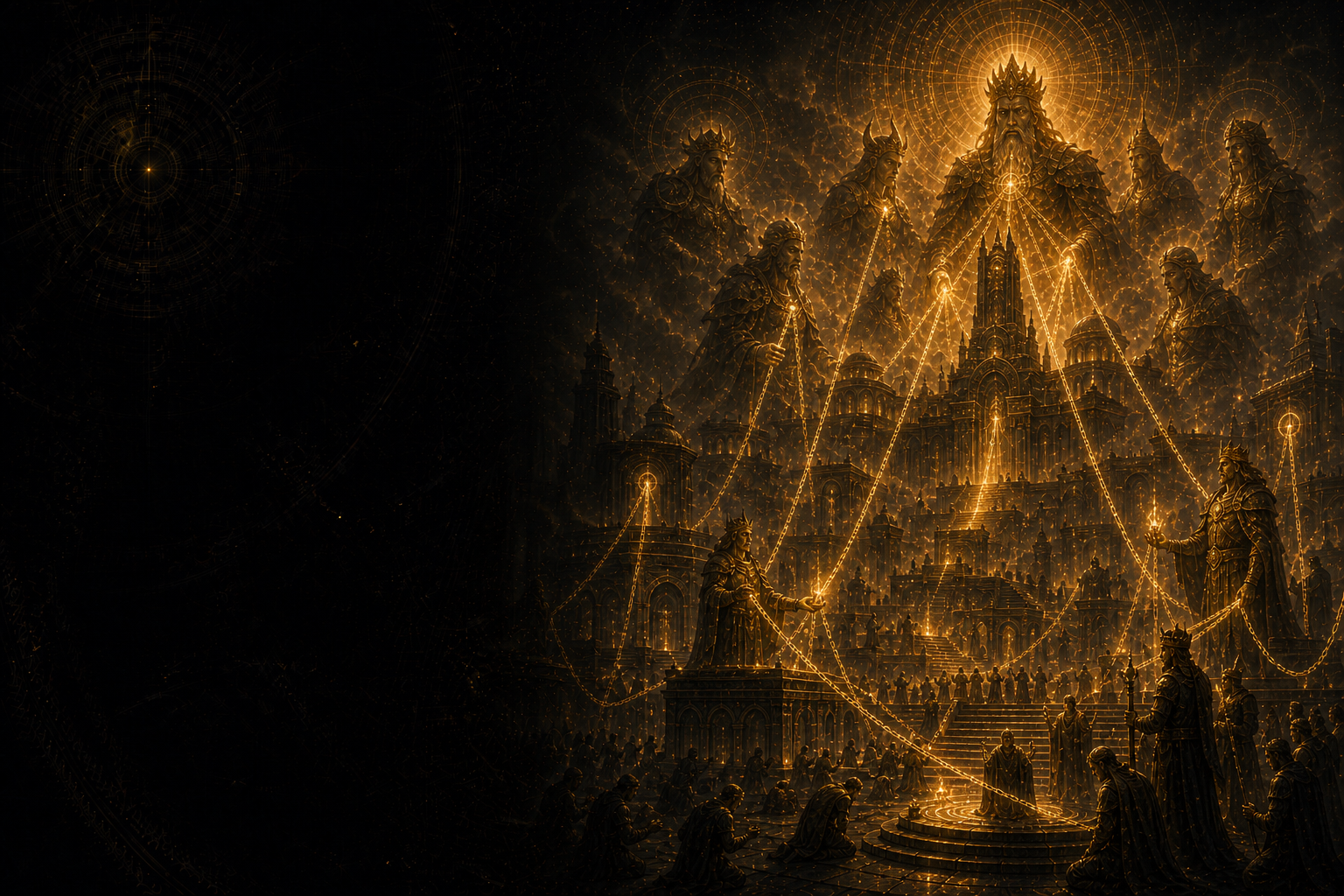
The Age of Worship
The Age of Worship marks the final and longest phase of the Second Age, following the establishment of the Divine Concord. During this era, devotion to the Pantheon became the central pillar of civilization across much of Arkanthys.
While the Concord had originally been intended to balance divine guidance with mortal governance, the centuries that followed saw the influence of the gods grow steadily through religious institutions, priesthoods, and sacred law.
Temples dedicated to the Pantheon rose in nearly every major city. Religious orders gained authority in matters of law, education, and governance. Public life increasingly revolved around devotion to the gods and adherence to divine doctrine. Although the Pantheon rarely ruled directly, their authority became deeply embedded within the structure of civilization itself.
Expansion of Divine Institutions
Following the Divine Concord, temples and religious academies expanded rapidly across the territories influenced by the Ostagarian Empire. Priests served not only as spiritual leaders but also as judges, advisors, historians, and scholars. Sacred texts and divine teachings became the foundation of law and governance in many regions.
In cities across Grimhold and beyond, monumental sanctuaries were constructed to honor the gods. These temples often served as centers of civic administration, education, and cultural life. Pilgrimages, festivals, and sacred rites tied communities together under the shared reverence of the Pantheon.
For many generations, this system appeared to bring stability and unity to the world. Over time, the institutions devoted to the Pantheon gained increasing authority.
In many regions, divine law began to supersede mortal law. Councils and rulers often deferred to temple authorities when resolving disputes or shaping policy. Scholars and scribes trained within religious institutions became the primary keepers of knowledge and history. This gradual shift transformed devotion from a cultural practice into a defining feature of political and social order. Although the Pantheon themselves still rarely intervened directly, their influence over the world had never been greater.
By the later centuries of the Age of Worship, reverence for the Pantheon had become nearly universal across the lands influenced by the Ostagarian Empire. Cities competed to construct the grandest temples. Sacred rites marked nearly every aspect of public life, from the crowning of rulers to the founding of new settlements. The gods were no longer merely guides of civilization. They were regarded as the ultimate arbiters of order, knowledge, justice, death, and destiny.
For many people of this era, the authority of the Pantheon seemed eternal and unquestionable.
Seeds of Discontent
Yet beneath this outward stability, tensions slowly began to emerge. As divine institutions expanded, some scholars and rulers grew uneasy with the growing power of temple authorities. Innovations in engineering and arcane study were increasingly restricted or discouraged when they conflicted with religious doctrine. In places like Ostagar, once known for its spirit of discovery and invention, intellectual pursuits gradually gave way to strict reverence for divine order.
For many generations these concerns remained quiet, spoken only in private circles of scholars and dissidents. But the foundations of discontent had already begun to take root.
Legacy
The Age of Worship represents the final stage of harmony between mortals and the Pantheon before that harmony began to fracture. For centuries it was remembered as a period of stability, devotion, and shared belief in the divine order of the world.
Yet the same structures that elevated the Pantheon to the center of civilization also concentrated power in ways that limited mortal independence. Over time, these tensions would grow until they erupted into open rebellion.
The Age of Worship therefore stands as the final calm before the storm that would become The Godwar.

Comments