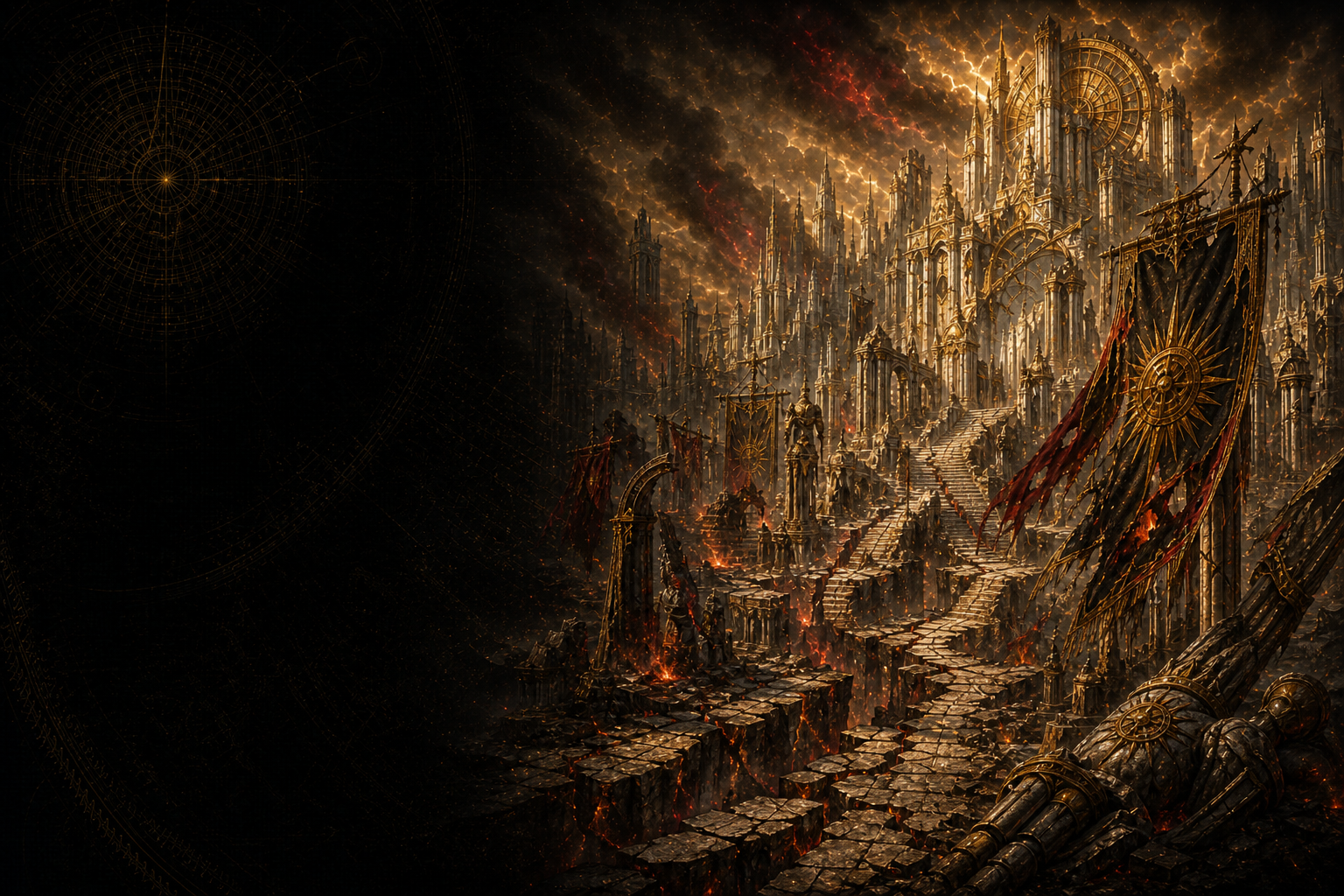
The Fracturing of the Ostagarian Order
The Fracturing of the Ostagarian Order marks the opening period of the Third Age, when the once-stable structure of the Ostagarian Empire began to show the first signs of internal strain. For centuries following The Age of Worship, the empire had stood as the dominant political and cultural force in Arkanthys. Guided by institutions devoted to the Pantheon, the empire maintained vast networks of cities, trade routes, and scholarly centers that connected much of the known world.
Yet beneath this appearance of stability, tensions had begun to grow. Imperial authorities sought tighter control over distant provinces, religious institutions expanded their influence into civic governance, and older cultures increasingly resisted the reach of Ostagar’s authority.
The events of this period did not yet shatter the empire, but they marked the first fractures in the order that had defined civilization for centuries.
The Subjugation of the Skarnn
Among the earliest conflicts of the Third Age were the imperial campaigns against the Skarnn tribes of Grimhold. The Skarnn, who had once helped build the earliest settlements of the Saren civilization, had gradually withdrawn from imperial structures over generations. Many returned to tribal traditions rooted in mountain strongholds, ancestral altars, and shamanic rites. To the imperial authorities of Ostagar, these independent tribes represented instability within the heartland of the empire.
Over the course of several generations, imperial forces launched a series of campaigns against the Skarnn strongholds scattered across the mountains of Grimhold. Cities were destroyed, tribal leaders were executed or captured, and sacred sites were dismantled. By the end of these campaigns, Skarnn resistance had largely been broken. Survivors scattered across the wilderness, and many of their traditions were outlawed by imperial decree.
Although the empire had secured its control over Grimhold, the violence of the subjugation left lasting resentment among the surviving Skarnn.
The Arcana Memorandum
As unrest and dissent began appearing in several regions of the empire, Ostagar issued one of the most controversial decrees in its history: the Arcana Memorandum.
The memorandum declared that all magical relics, artifacts, and arcane knowledge ultimately belonged to the empire. Independent mage guilds were dissolved, magical research was brought under imperial supervision, and possession of certain relics without authorization became a capital offense. The official justification was the preservation of order and the prevention of dangerous magical misuse.
In practice, the decree gave the empire unprecedented control over arcane knowledge. Libraries were seized, private collections confiscated, and scholars suspected of unauthorized research were imprisoned or executed.
While the Arcana Memorandum strengthened imperial authority in the short term, it also drove many practitioners of magic into secrecy. Underground circles of mages, scholars, and dissidents began forming across the empire. These hidden networks would later play a significant role in the conflicts that followed.
Shifting Imperial Authority
During this period, the institutions that had once balanced imperial governance began to shift. Temple authorities and imperial officials increasingly worked together to enforce centralized rule. Local traditions were often suppressed in favor of standardized imperial law, and distant provinces were placed under stricter oversight from Ostagar.
Although these policies were intended to preserve stability, they gradually weakened the cooperative structures that had once defined the Ostagarian Empire. Some provinces began to view the empire not as a unifying force, but as an occupying power.
Legacy
The Fracturing of the Ostagarian Order did not immediately destroy the empire. Ostagar remained the greatest city in the world, and the institutions of the empire still held immense power across Arkanthys.
Yet the policies and conflicts of this period created divisions that would continue to deepen in the centuries that followed. The suppression of the Skarnn tribes, the control of arcane knowledge, and the growing centralization of imperial authority all contributed to a gradual erosion of the balance that had once sustained the empire.
These early fractures would eventually lead to new rival empires, widespread rebellion, and the upheavals that defined the later Third Age.

Comments